

Non-FictionSelf-HelpLearning DisabilitiesStudent Advocacy
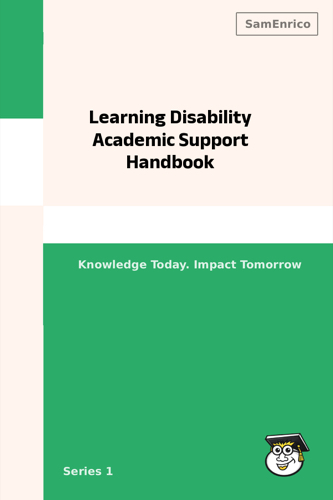
Learning Disability Academic Support Handbook eBook
Navigate accommodations, self advocacy, and study
by Kern August
Navigate accommodations, self advocacy, and study modifications for dyslexia, dyscalculia, or processing disorders.
Formats
Free sample
Chapter 1: The Invisible Backpack--You have been carrying something heavy for a very long time, and no one ever told you that you were allowed to put it down.It is not a physical backpack. You cannot see it in a mirror or feel its straps digging into your shoulders. But it is there, every single day, from the moment you open your eyes in the morning to the moment you finally close them at night, exhausted from a day that looked, to everyone else, completely ordinary. This invisible backpack is filled with things no one gave you permission to set down: the memory of every test you studied twice as hard for and still failed, every time a teacher wrote “see me” on an assignment you had poured your soul into, every whispered comment from a peer who read faster, calculated quicker, or simply understood something on the first try when you were still trying to figure out what the question was asking.Inside this backpack are labels that were handed to you like ill-fitting clothes: lazy, unfocused, not trying hard enough, so bright but so inconsistent, if you would just apply yourself. These labels were given to you by people who meant well, perhaps, or by people who had given up, or by people who simply could not see what was actually happening inside your brain.
You wore these labels because no one handed you a better explanation. You carried them because you did not yet have the words to say: This is not who I am. This is a learning disability, and it has a name, and it is not my fault.This book is your permission slip to set that backpack down.Not all at once, because that is not how healing works. But piece by piece, chapter by chapter, strategy by strategy. By the time you finish this book, you will have a new backpack—one that is not filled with shame and confusion, but with tools, scripts, legal knowledge, and the quiet, powerful confidence of someone who finally understands how their own brain works and knows exactly what to ask for.But before we get to any of that—before the scripts, the accommodations, the tech hacks, the legal frameworks, the study modifications—we have to start here.
We have to start with the truth about what a learning disability actually is, because most of what you have been told, directly or indirectly, is wrong.The Most Dangerous Lie You Have Been Told The most damaging lie about learning disabilities is not that they do not exist. The most damaging lie is that they are a measure of effort or intelligence.You have heard this lie in a thousand different forms, though no one ever said it quite so bluntly. You heard it in the sigh of a teacher who handed back a test with a C- and said, “I know you can do better than this.” You heard it in the carefully neutral tone of a parent who asked, “Did you really study?” You heard it in your own head, late at night, staring at a textbook page you had read three times without understanding a single paragraph, wondering what was wrong with you.Here is the truth that will take most of this first chapter to prove: A learning disability has nothing to do with how smart you are or how hard you try.Nothing.The scientific literature is extraordinarily clear on this point. The Learning Disabilities Sourcebook, which compiles decades of peer-reviewed research, defines Specific Learning Disabilities (often abbreviated as Sp LD or LD) as “neurobiological disorders that affect the brain’s ability to receive, process, store, or respond to information.” Notice what that definition does not say. It does not say “caused by low intelligence.” It does not say “caused by lack of effort.” It does not say “caused by poor teaching” or “lazy parenting” or “not caring enough.”It says neurobiological.
That means your brain is wired differently.Not worse. Differently.Imagine two people trying to travel from New York to Los Angeles. One takes a direct flight. The other takes a route that requires three connections, a layover in Chicago, and a bus from the airport to the final destination. Both people arrive in Los Angeles.
Both people traveled the same distance. But one of them spent significantly more time, energy, and mental resources to get there.That is what a learning disability feels like. You are not incapable of arriving at the destination—understanding the concept, solving the math problem, writing the essay. You are just taking a different route, and that route costs more in terms of cognitive fuel. The problem is not your destination.
The problem is that the world designed the maps for people taking the direct flight, and it keeps telling you that you must be doing something wrong because you are not landing as quickly as everyone else.The Science in One Paragraph (You Can Skip This If You Are Tired)If you are already exhausted just thinking about reading a dense scientific explanation, here is the tl;dr version: Your brain processes some types of information differently, and that difference is real, measurable, and has nothing to do with your potential.For those who want the slightly longer version, here it is. Functional magnetic resonance imaging (f MRI) studies have repeatedly shown that individuals with dyslexia, for example, show different patterns of brain activation during reading tasks compared to typical readers. The areas of the brain responsible for phonological processing—breaking words down into their component sounds—do not activate as efficiently. This is not a choice. This is not a moral failing.
This is neurology.Similarly, individuals with dyscalculia show differences in the intraparietal sulcus, the region of the brain responsible for number sense and quantity representation. When you struggle to estimate whether fifteen objects is more or less than twenty-three, or when you cannot hold a sequence of numbers in your head long enough to perform a simple calculation, you are not “bad at math” in some vague, characterological sense. You have a brain that processes numerical information through a different pathway.And for those with Auditory Processing Disorder (APD) or Visual Processing Disorder (VPD)—terms we will use consistently throughout this book—the challenge is not in understanding language or seeing clearly. It is in what the brain does with the information after the ears hear it or the eyes see it. The sounds are clear, but they get scrambled in transit.
The symbols are visible, but they take too long to decode. The information arrives, but the processing center is understaffed.This is not a metaphor. This is biology.The Three Core Profiles (And One Important Clarification)Throughout this book, we will use specific, consistent terminology when we talk about different types of learning disabilities. This is important because the popular language around learning differences is often sloppy and confusing. A parent might say “my child has processing issues” and mean something completely different from a neurologist using the same phrase.
By the end of this chapter, you will know exactly what your profile looks like and what to call it.Let…
This is the end of the free sample. Get the eBook to keep going. Buy now
About this book
Details
- Author
- Kern August
- Publisher
- SamEnrico
- Language
- English
- Genre
- Non-Fiction, Self-Help, Learning Disabilities, Student Advocacy
- Released
- 2026-06-07
- Pages (approx.)
- 153
- Available as
- eBook, Audiobook

Read better in the ZLOADR app
Your eBooks on your phone or tablet. Sign in with your SamEnrico account and start reading.
More by Kern August
 The Simpson Desert CrosserKern August$11.99
 The Spousal Caregiver Self Care GuideKern August$11.99
 Sleep Meditation JournalKern August$11.99
 Mining Underground Stress GuideKern August$11.99
 Hops & Revolutions: How Beer Fueled the Fall of the Berlin WallKern August$11.99
 Seeds of the Sun God: The Lost Agriculture of the MinoansKern August$11.99
 Remote Fairness ProtocolKern August$12.99
 Ghanaian Founder Legal PrimerKern August$12.99Ghanaian Founder Legal PrimerKern August$12.99Ghanaian Founder Legal PrimerKern August$12.99Ghanaian Founder Legal PrimerKern August$12.99
 Studio ManagerKern August$11.99
You may also like
 Hong Kong Handover 1997Dunn Johnnie$11.99
 Zumba For Postnatal Recovery CourseNeal Christian$11.99
 Zumba for BeginnersLadner Nikia$11.99
 YouTube Comment Mining GuideHumes Pandora$12.99
 Worry Box MeditationCarlin Rudy$11.99
 Workplace Stress MeditationNguyen Lynn$11.99
 Workplace Stress and Sleep RepairHawley Ivory$11.99
 Workplace Perfectionism CureDelaney Jeffry$11.99
 Workplace Injustice Anger GuideWallen Isabelle$11.99
 Work Addiction and Burnout LinkGreenwood Ester$11.99
 Women in Yoga and WellnessBeattie Galina$11.99
 Women in Stand Up ComedyChun Evangeline$11.99