
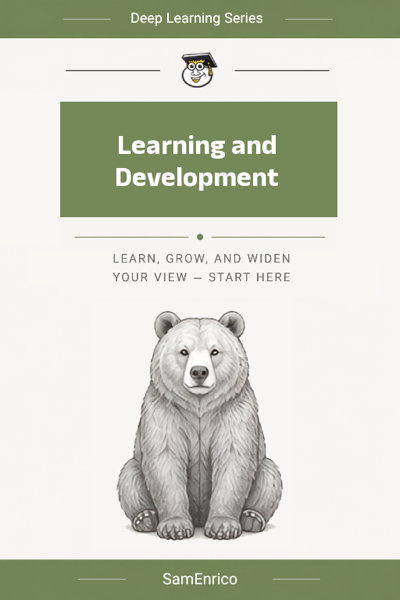
Learning and Development eBook
A Coursebook on Learning and Development
by Kovach Seema
A Coursebook on Learning and Development
Formats
Free sample
Chapter 1: The Hundred-Billion-Dollar Lie--–- Let me tell you a story that will make every training manager in every Fortune 500 company want to hide under their desk.In 2018, a multinational retail corporation we will call Global Mart spent exactly $2.3 million on a leadership development program. They hired a prestigious consulting firm. They flew seventy-two high-potential managers to a resort in Arizona. They delivered six months of virtual coaching, three in-person workshops, and a beautifully designed digital workbook. The participants gave the program an average rating of 4.8 out of 5.
The feedback forms were filled with words like "transformative," "inspiring," and "the best training I have ever received."Eighteen months later, Global Mart measured the results. Voluntary turnover among the program participants had increased by 12 percent. Not decreased. Increased. Their teams reported lower engagement scores than before the training.
And when the company tracked actual leadership behaviors—things like frequency of one-on-one meetings, quality of feedback, and promotion rates of direct reports—they found precisely zero measurable improvement.Two point three million dollars. Seventy-two leaders. Eighteen months. Zero impact.This is not an outlier. This is the rule.Every year, organizations around the world spend more than one hundred billion dollars on employee training and development.
That is not a typo. One hundred billion dollars. To put that number in perspective, it is roughly the GDP of Iceland, Jamaica, and Brunei combined. It is more than the entire budget of NASA. It is enough money to give every single person in the state of Texas a thousand-dollar check, with billions left over.And according to a meta-analysis of more than three hundred studies published in the Journal of Applied Psychology, somewhere between 70 and 90 percent of that spending produces no lasting change in on-the-job behavior.Let me say that again in plain language.
Most of what organizations spend on training is simply wasted. It evaporates. It buys temporary smiles, full parking lots at conference centers, and expensive PDFs that will never be opened again. It does not buy better leaders, faster workers, or more capable teams.The hundred-billion-dollar question is not why this happens. The hundred-billion-dollar question is why we keep doing it.The Conspiracy of Good Intentions The answer is uncomfortable.
It requires us to look in a mirror that most L&D professionals would rather break.The training industry—and yes, it is an industry, complete with vendors, certifications, conferences, and billion-dollar platforms—runs on a conspiracy of good intentions. Everyone involved genuinely wants to help. HR leaders want to develop their people. Managers want their teams to succeed. Facilitators want to inspire transformation.
But good intentions do not equal results, and the gap between what we want to achieve and what we actually achieve is filled with wasted money and frustrated employees.Consider the typical sequence. A business leader notices a problem. Maybe customer satisfaction scores are dropping. Maybe safety incidents are rising. Maybe a new software rollout is failing.
The leader does what leaders have been trained to do: they call for training. "Send my people to a class," they say. "Fix this."The L&D team, eager to be helpful and mindful of their political standing, says yes. They conduct a quick needs assessment—often a survey or a few conversations—and design a program. They select a vendor or build content internally.
They market the program. They schedule sessions. They deliver content. They hand out evaluation forms that ask questions like "Did you enjoy this training?" and "Would you recommend it to a colleague?"The evaluation forms come back positive. The program is declared a success.
Everyone moves on to the next fire.But no one ever goes back to ask the question that actually matters: did anything change? Did customer satisfaction improve? Did safety incidents decline? Did the software rollout finally work? And if not—why did we spend all that money?This is what I call the Learning Industrial Complex: a self-perpetuating system that measures activity instead of outcomes, smiles instead of results, and attendance instead of application.The Four Fatal Assumptions The Learning Industrial Complex rests on four assumptions that are demonstrably false.
Once you see them, you will never be able to unsee them. And once you name them, you will never again be able to defend the training programs you have been running.Assumption One: If they know it, they will do it.This is the most dangerous assumption in all of learning and development. It is the belief that knowledge transfer automatically leads to behavior change. If we teach someone the principles of good feedback, they will start giving good feedback. If we explain the safety protocols, they will follow them.
If we show them the new software, they will use it.This assumption is not just wrong. It is backwards.Decades of research in behavioral psychology, neuroscience, and organizational behavior have demonstrated that knowing and doing are almost entirely different things. You can know that you should exercise more and still sit on the couch. You can understand the importance of saving money and still carry credit card debt. You can recite the four steps of active listening and still interrupt your direct reports constantly.The gap between knowledge and action is not a small crack.
It is a canyon. And most L&D interventions do not even try to build a bridge across it. They simply drop knowledge on one side and hope people will jump.Assumption Two: Happy learners are learning.The standard training evaluation form—the "happy sheet"—asks participants about their satisfaction. Did they enjoy the facilitator? Was the venue comfortable?
Was the content interesting? These questions feel reasonable. Of course we want learners to have a good experience.But here is the problem: satisfaction correlates almost perfectly with entertainment, and almost not at all with learning or behavior change. A funny facilitator with compelling stories will get high ratings even if no one learns anything. A difficult, challenging session that forces learners to confront their own incompetence will get lower ratings even if it produces dramatic improvement.The research on this is clear and damning.
A meta-analysis by Alliger and colleagues found that reaction measures (happy sheets) explained less than 2 percent of the variance in actual learning outcomes. Two percent. That is statistical noise. That is meaningless.Yet the happy sheet remains the most common evaluation tool in corporate training. It is used because it is easy, because it makes people feel good, and because no one ever gets fired for producing positive feedback forms.
It is not used because it measures anything that matters.Assumption Three: More training is better training.When something is not working, the standard response in most organizations is to do more of it. If sales training is not improving sales, add a second week of training. If leadership development is not developing leaders, add more modules. If compliance training is not changing compliance behavior, add more scenarios and more quizzes.This is the equivalent of pouring more water into a bucket that has a hole in the bottom. The problem is not the volume of training.
The problem is the transfer of training—the ability to apply what was learned back on the job. And transfer is…
This is the end of the free sample. Get the eBook to keep going. Buy now
About this book
Details
- Author
- Kovach Seema
- Publisher
- SamEnrico
- Language
- English
- Genre
- Non-Fiction, Informative, Educational
- Released
- 2026-05-04
- Pages (approx.)
- 154
- Available as
- eBook, Audiobook

Read better in the ZLOADR app
Your eBooks on your phone or tablet. Sign in with your SamEnrico account and start reading.
More by Kovach Seema
 Sustainable Success Habits GuideKovach Seema$11.99
 Pomodoro Technique Study GuideKovach Seema$11.99
 Indian GST Composition Scheme Registration CourseKovach Seema$11.99Indian GST Composition Scheme Registration CourseKovach Seema$11.99
 Remote Work Career Transition GuideKovach Seema$11.99
 Uber Driver Rating GuideKovach Seema$11.99
 Laci Peterson Birth FamilyKovach Seema$11.99
 Citation Rules Memory Palace GuideKovach Seema$11.99
 Henry Ford AssemblyKovach Seema$11.99
 Sir Sandford Fleming: The Timekeeper of the Transcontinental RailwayKovach Seema$11.99
 Black Sunday: The Storm That Stole the ChildrenKovach Seema$11.99
 The Complete Guide to Packaged Food DietsKovach Seema$11.99