
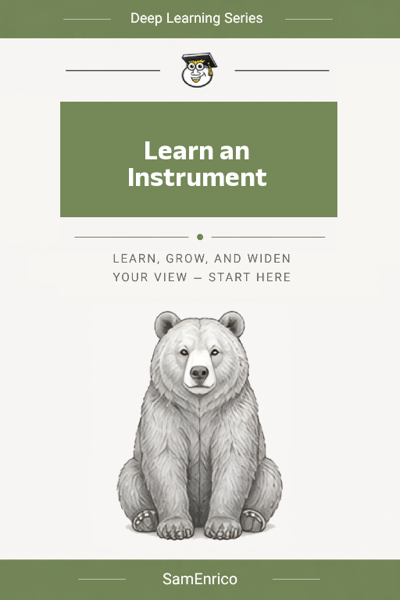
Non-FictionInformativeEducational
Learn an Instrument eBook
A Coursebook on Learn an Instrument
A Coursebook on Learn an Instrument
Formats
Free sample
Chapter 1: The Silent Majority--–- Every year, millions of people buy an instrument. Guitars in glossy cardboard boxes, keyboards in white-and-blue styrofoam, ukuleles from airport gift shops, digital pianos that cost more than a used car. These instruments leave the store with an owner full of hope. Within six months, most of them will be gathering dust in a corner, serving as an expensive clothes rack or a decorative object that whispers I really should try again someday. This book exists because that moment of quitting happens not from a lack of desire, but from a lack of a map.The problem is not talent.
The problem is not age. The problem is not whether you have "musical genes" or whether your mother sang in the choir or whether you can already clap in time. The problem is that most people try to learn an instrument the same way they would try to learn a language by owning a dictionary. They buy the tool, flip through the first few pages, attempt a scale, hit a wrong note, feel a flicker of embarrassment even though no one is listening, and quietly put the instrument back in its case. The flicker of embarrassment is the real enemy.
Not the wrong note. Not the slow fingers. Not the strange symbols on the page. The shame of sounding bad at something you want to be good at.This chapter is going to walk you through the very first decision of your musical life, and it is not which instrument to buy. The first decision is whether you are ready to sound like a beginner.
Not a bad musician. A beginner. There is a vast difference. A bad musician is someone who has stopped learning. A beginner is someone who has just started.
Every master musician you have ever admired was, at some point, a beginner who could not play a clean C major scale, who squeaked on a high note, who dropped a guitar pick, who forgot which key was which. The only difference between that person and the person who quit is that the master kept going through the uncomfortable phase where the sound did not match the vision.This chapter has three jobs. First, to help you choose an instrument that fits your actual life, not your fantasy life. Second, to show you how to set up that instrument and your body so that you do not hurt yourself or build bad habits. Third, and most importantly, to give you permission to sound bad for a while.
The sounding bad is not a bug. It is a feature. It is the sound of your nervous system rewiring itself. It is the sound of learning.The Myth of the Natural Musician Let us clear something out of the way immediately. There is no such thing as a natural musician in the way most people imagine.
There are people who started younger. There are people who practiced more efficiently. There are people who had better teachers. There are people whose parents created an environment where music was as normal as breathing. But no one emerged from the womb able to play a Bach fugue or improvise over a twelve-bar blues.Research from cognitive psychology, particularly the work of Anders Ericsson and his colleagues, has shown that what we call "talent" is almost always the visible tip of an iceberg made of thousands of hours of deliberate practice.
The child who seems to have perfect pitch was likely exposed to music from infancy. The teenager who shreds on guitar has calluses that took months to form. The adult who sits down at a piano and plays by ear spent years failing quietly before anyone heard them succeed.This is liberating news. It means you are not missing a mystical gene. You are missing only time and the right kind of instruction.
Both are available to you. The question is not can I learn? The question is am I willing to be a beginner?The Five Entry Points: Matching Instrument to Life Most method books assume you have already chosen your instrument. This chapter meets you earlier, at the moment of decision. Below are five realistic entry points.
Each has trade-offs. None is objectively better than the others. The right choice is the one that fits your living situation, your budget, your physical body, and your temperament.Piano and Digital Keyboard Piano is the most common recommendation for beginners, and for good reason. The keyboard is laid out linearly from low notes on the left to high notes on the right. This visual logic makes music theory easier to understand than on almost any other instrument.
You can play both melody and harmony simultaneously. You never have to worry about tuning or intonation beyond turning the instrument on.The trade-offs are size and portability. A full eighty-eight-key digital piano with weighted keys weighs between twenty-five and fifty pounds and requires dedicated floor space. A cheaper sixty-one-key keyboard fits on a desk but lacks weighted keys, which means your fingers will not develop the same strength and control. The compromise is a eighty-eight-key keyboard on a folding stand that can be pushed against a wall when not in use.Best for: People who want to learn music theory efficiently, who have space for a stationary instrument, and who enjoy playing both melody and chords at the same time.Budget range: One hundred fifty to three hundred dollars for a decent entry-level keyboard with touch-sensitive keys.
Five hundred to one thousand dollars for a digital piano with weighted keys that will last for years.Guitar Guitar is the most popular instrument in the world for a reason. It is portable, social, and capable of playing everything from folk to flamenco to heavy metal. The learning curve is steeper than piano in the first few weeks because your fingers will hurt and because the fretboard is not visually linear. But the payoff is enormous: once you learn three or four chords, you can play thousands of songs.The trade-offs are physical discomfort and initial confusion. Every guitarist goes through a period of sore fingertips.
This is normal. The skin will toughen. The confusion about where notes are on the fretboard is also normal. Unlike a piano keyboard, where each note appears exactly once, the same pitch appears in multiple places on a guitar. This takes time to internalize.Best for: People who want to play songs quickly, who enjoy singing while playing, and who need a portable instrument that can be played anywhere.Budget range: One hundred to two hundred dollars for a decent entry-level acoustic guitar.
Two hundred to three hundred dollars for an entry-level electric guitar with a small amplifier. Avoid guitars that cost less than eighty dollars new—they are often unplayable and will discourage you.Ukulele Ukulele is not a toy. It is a real instrument that has been used for serious music for over a century. But it is also the easiest string instrument for an absolute beginner. The nylon strings are soft on the fingers.
The small fretboard is easy to reach. The four strings mean fewer combinations to learn. You can be strumming your…
This is the end of the free sample. Get the eBook to keep going. Buy now
About this book
Details
- Author
- Prescott Christian
- Publisher
- SamEnrico
- Language
- English
- Genre
- Non-Fiction, Informative, Educational
- Released
- 2026-06-02
- Pages (approx.)
- 158
- Available as
- eBook, Audiobook

Read better in the ZLOADR app
Your eBooks on your phone or tablet. Sign in with your SamEnrico account and start reading.
More by Prescott Christian
 Bedtime Meditation GuidePrescott Christian$11.99
 The Desert Oasis RestPrescott Christian$11.99
 Sugar Free Meal PrepPrescott Christian$11.99
 Burnout Recovery Sense Of HumorPrescott Christian$11.99
 Meiji Freedom and Rights GuidePrescott Christian$11.99
 The Rift That Shook the World: Africa's Hidden Tectonic RevolutionPrescott Christian$11.99
 Tangaroa's Shadow: The Navigator Spies of the PacificPrescott Christian$11.99
 How to Start a Printing Onto Wood Business (Beginners Guide)Prescott Christian$11.99
 Panel Data Excel GuidePrescott Christian$12.99
 Disability Accommodation TrapPrescott Christian$12.99
 Understanding Glucocorticoid Sensitive HypertensionPrescott Christian$17.99
You may also like
 Hong Kong Handover 1997Dunn Johnnie$11.99
 Zumba For Postnatal Recovery CourseNeal Christian$11.99
 Zumba for BeginnersLadner Nikia$11.99
 YouTube Comment Mining GuideHumes Pandora$12.99
 Worry Box MeditationCarlin Rudy$11.99
 Workplace Stress MeditationNguyen Lynn$11.99
 Workplace Stress and Sleep RepairHawley Ivory$11.99
 Workplace Perfectionism CureDelaney Jeffry$11.99
 Workplace Injustice Anger GuideWallen Isabelle$11.99
 Work Addiction and Burnout LinkGreenwood Ester$11.99
 Women in Yoga and WellnessBeattie Galina$11.99
 Women in Stand Up ComedyChun Evangeline$11.99