
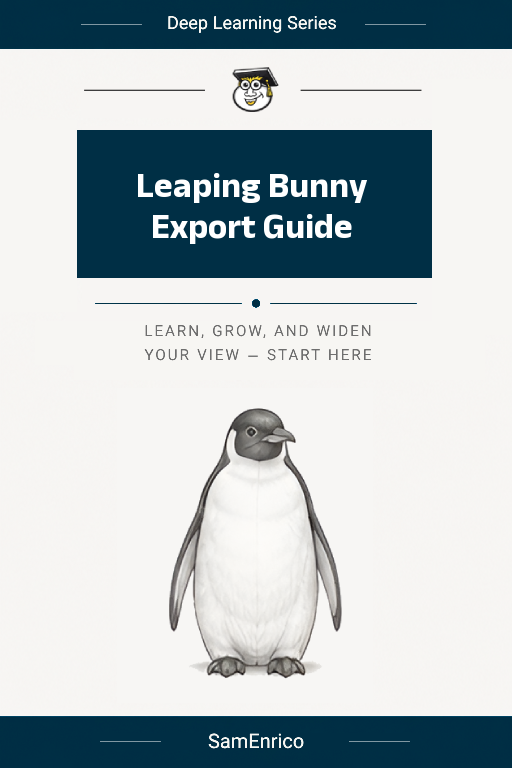
Leaping Bunny Export Guide eBook
Get Leaping Bunny cruelty free certification for c
Get Leaping Bunny cruelty free certification for cosmetics and personal care exports to Europe.
Formats
Free sample
Chapter 1: The €200,000 Glycerin...--–- In June of 2025, a small but ambitious cosmetics brand from Portland, Oregon, watched eighteen pallets of their flagship skincare line get fed into an industrial incinerator at the Port of Rotterdam. The brand had done everything right—or so they believed. Their labels proudly declared "Cruelty-Free" in elegant gold foil. Their website featured a heartfelt manifesto about loving animals. Their suppliers had all signed letters stating that no animal testing occurred.
None of it mattered. The reason for destruction, scrawled on a Dutch customs form in block letters, was a single word: GLYCERIN.The glycerin in question had been purchased from a German chemical distributor who had sourced it from a Chinese manufacturer. That Chinese manufacturer, seven years before the Portland brand even filed its articles of incorporation, had conducted a routine safety test on that specific batch of glycerin. The test involved rabbits. The test was legal at the time and place it occurred.
The test had nothing to do with the finished cosmetic product. But under EU law, none of those distinctions mattered. The molecule itself carried the testing history like an inherited sin, and when that molecule crossed into Dutch territory, the entire finished product became contraband.The brand lost €200,000 in inventory. They lost their largest retail contract with a German pharmacy chain. They lost eighteen months of market development.
They did not lose a lawsuit against their supplier because the supplier's "certificate of compliance" contained a clause that explicitly disclaimed liability for historical testing. The brand closed its doors four months later.This is not a cautionary tale. It is the baseline reality of exporting cosmetics to Europe in 2026. The only difference between the Portland brand and the successful exporters you will meet in this book is that the successful ones understood a brutal truth that most beauty entrepreneurs learn too late: a cruelty-free claim is not a fact about your product. It is a fact about every molecule that went into it, at every point in its existence, going back decades.This book exists because that truth is survivable.
More than survivable—it is exploitable. The Leaping Bunny certification, which the Portland brand did not have, would not have saved that shipment on its own. But the supply chain infrastructure required to earn that certification would have. The Fixed Cut-Off Date system would have flagged that glycerin as unusable before the first bottle was filled. The supplier monitoring system would have traced the molecule back to its Chinese origin.
The legal contract would have shifted the €200,000 loss onto the distributor who concealed the testing history.This chapter establishes the landscape you are entering. It maps where animal testing is banned, where it remains legal, and where—most dangerously—it is required by law. It introduces the REACH loophole, the single greatest threat to any cruelty-free claim made on European soil. It quantifies the financial upside of certification: not just the 15-40% price premiums, but the insurance against exactly the kind of catastrophe that destroyed the Portland brand. And it provides a roadmap for the remaining eleven chapters, showing how each one builds a specific firewall against a specific point of supply chain failure.By the end of this chapter, you will understand why the European market is simultaneously the most rewarding and most treacherous territory for cruelty-free cosmetics.
You will know why your current "Not Tested on Animals" label is legally fragile. And you will be ready to begin the work of building a certification dossier that turns your ethical commitments into an unassailable competitive advantage.The 2026 Landscape: Where Animal Testing Is Banned, Legal, and Required The global map of animal testing regulations resembles a patchwork quilt stitched by legislators who rarely communicate with one another. Before you export a single unit to Europe, you must understand not only where testing is prohibited but where it is mandatory—because a mandatory test in one jurisdiction can poison your product's eligibility in another.Full Bans (Finished Cosmetics and Ingredients)As of 2026, the following jurisdictions have enacted comprehensive bans on animal testing for both finished cosmetic products and their individual ingredients:European Union (27 member states): Ban in effect since 2013 under Regulation EC 1223/2009, Article 18. Covers both finished products and ingredients, regardless of where the test was conducted. This is the strictest ban in the world because it includes the "marketing ban"—you cannot sell a product in the EU even if the testing occurred entirely outside EU jurisdiction.United Kingdom: Maintained the EU ban post-Brexit under UK Cosmetics Regulation (2019), with no material differences.Norway, Iceland, Liechtenstein: Adopted the EU ban through EEA agreement.Australia: Ban effective July 2020 for finished products, with ingredient ban fully phased in by July 2022.South Korea: Ban effective February 2018 for finished products, with ingredient ban following in 2019.
Notably, South Korea allows an exception for "re-testing" when no alternative method exists—a loophole that makes Korean certification more complex.New Zealand: Ban effective 2021 for finished products, with ingredient ban still phasing in as of 2026.Turkey: Ban effective 2020, though enforcement remains inconsistent.India: Ban effective 2014 for finished products, with ingredient ban following in 2020. India also prohibits importation of animal-tested cosmetics, making it one of the few non-Western nations with a full ban.Partial Bans and Enforcement Gaps Several major markets have bans that sound comprehensive but contain exceptions that can destroy a Leaping Bunny application:Canada: The Environmental Protection Act prohibits cosmetic animal testing but does not prohibit the sale of products tested elsewhere. This means a Canadian brand can legally sell a product that was tested in China, which makes Canadian "cruelty-free" claims nearly meaningless without third-party certification.Brazil: Individual states (São Paulo, Paraná, Amazonas, Mato Grosso do Sul, Mato Grosso, Rio de Janeiro, Minas Gerais) have bans, but no federal ban exists as of 2026. This creates a patchwork where a product legal in Rio de Janeiro might be illegal in Brasília.United States: No federal ban. Ten states (California, Nevada, Illinois, Virginia, Louisiana, New Jersey, Maine, Hawaii, Oregon, Washington) have enacted bans, but these only prohibit in-state testing, not sales of products tested elsewhere.
The FDA does not require animal testing but does not prohibit it either.Where Testing Is Still Required (The Compliance Trap)This is the most dangerous category for Leaping Bunny applicants. In the following jurisdictions, animal testing for cosmetics or cosmetic ingredients is not merely permitted—it is required by law under certain conditions:China (Pre-2023): Before 2023, all imported cosmetics required mandatory animal testing. After 2023, "ordinary cosmetics" (shampoos, lotions, cleansers) are exempt from mandatory testing, but "special use cosmetics" (hair dyes, sunscreens, anti-dandruff products, products making new ingredient claims) still require testing. Post-market random testing also continues. The critical point: if your Tier 2 or Tier 3 supplier manufactures in China, their compliance with Chinese law may have required animal testing that you cannot erase from the supply chain.Russia: Mandatory testing for all imported cosmetics continues as of 2026, with no exemption for "cruelty-free" claims.Japan: No mandatory testing, but the Ministry of Health, Labour and Welfare can require testing for new ingredients.
Most major Japanese manufacturers maintain historical testing records that predate their current cruelty-free policies.Brazil (federal): No federal ban means testing can be…
This is the end of the free sample. Get the eBook to keep going. Buy now
About this book
Details
- Author
- Pepper Adaline
- Publisher
- SamEnrico
- Language
- English
- Genre
- Non-Fiction, Business Brief, Cruelty Free
- Released
- 2026-05-30
- Pages (approx.)
- 153
- Available as
- eBook, Audiobook

Read better in the ZLOADR app
Your eBooks on your phone or tablet. Sign in with your SamEnrico account and start reading.
More by Pepper Adaline
 Building Friendship After 30Pepper Adaline$11.99
 Slow Motion ComedyPepper Adaline$11.99
 Maurice LaMarche Brain VoicePepper Adaline$11.99
 Spitfire Battle of BritainPepper Adaline$11.99
 The Retirement Housing Virtual Tour GuidePepper Adaline$11.99
 Difficult Conversation TrainingPepper Adaline$11.99
 Supplements For Menopause ReliefPepper Adaline$11.99
 Morning Routine for Project ManagersPepper Adaline$11.99
 The Flying Flynns: How a Family of Daredevils Redefined the CircusPepper Adaline$11.99
 Lens of the East: How Li Zhensheng Captured China's Fashion RevolutionPepper Adaline$11.99
 Service Providers Guide to Building & Home InspectionPepper Adaline$11.99
 How to Produce Laboratory ChemicalsPepper Adaline$11.99