
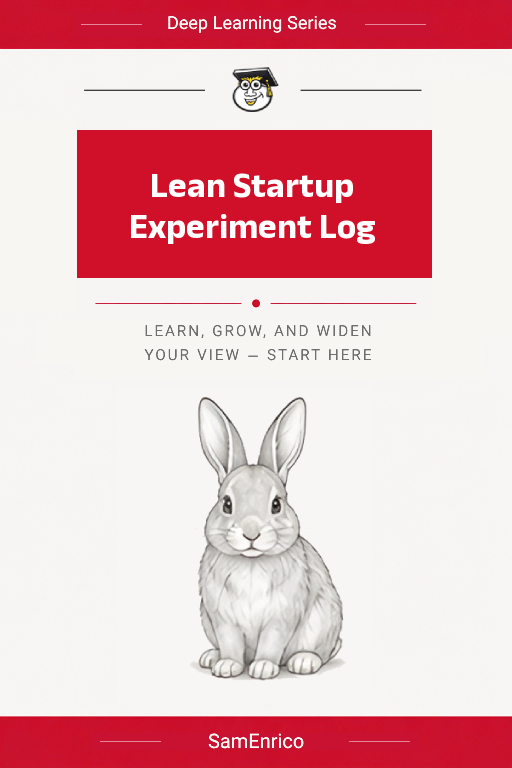
Non-FictionFirst 30 DaysExperimentation
Lean Startup Experiment Log eBook
Document build measure learn cycles and pivot or p
Document build measure learn cycles and pivot or persevere decisions on one tracking page.
Formats
Free sample
Chapter 1: The Lab Notebook Lie...--I spent nine months building a product that exactly zero people wanted.Not a handful. Not a disappointing few. Zero.I had done everything right—or so I told myself. I wrote a sixty-page business plan. I incorporated an LLC.
I hired designers and developers. I agonized over font choices and button colors and onboarding flows. I launched with a press release, a Product Hunt campaign, and a small but mighty social media blitz. Hundreds of people visited the landing page. Dozens signed up for early access.And then they saw the product.
And they left.Not slowly, like a dying relationship. Immediately, like a fire alarm.I watched the analytics dashboard in real time. A user would land on the product, click around for ninety seconds, and vanish forever. No complaints. No feedback.
No "here's what would make this better." Just silence. The kind of silence that screams.I spent the next three months adding features. Maybe they needed a dashboard? I built one. Maybe the design was ugly?
I hired a better designer. Maybe the pricing model was wrong? I made it free. Nothing changed. Ninety seconds, then gone.I had read The Lean Startup.
I had highlighted passages. I had nodded along to Eric Ries's warnings about building products nobody wanted. And then I had gone ahead and built a product nobody wanted anyway. Because reading about scientific method is not the same as practicing it. Knowing you should test hypotheses is not the same as actually writing them down and holding yourself accountable.That is why this book exists.
Not because I have all the answers, but because I learned the hard way that you cannot do this work without a lab notebook. And no one had given me one.The Problem That No One Talks About Most startup books are written by survivors. They tell stories of triumph—the pivot that worked, the feature that caught fire, the customer interview that revealed a billion-dollar insight. What they don't show you is the week-by-week, decision-by-decision grind of figuring out whether you are building something real or just polishing a delusion.The statistics are brutal, but not for the reasons you think. According to a comprehensive study by CB Insights, the number one reason startups fail—cited by forty-two percent of founders—is "no market need." Not running out of money.
Not team conflict. Not competition. Building something that, at its core, no one actually wanted.Here is what that statistic does not tell you: most of those founders thought they had validated their idea. They had talked to friends who said "sounds great." They had run surveys that came back positive. They had built what customers asked for.
And they still failed. Because validation that does not come from the scientific method is just expensive wishful thinking.The traditional approach to building a product looks something like this. You have an idea. You get excited. You tell people about it.
They say nice things because they like you and do not want to hurt your feelings. You interpret their politeness as permission. You start building. You build for months. You launch.
And then you discover that the only person who wanted this product was you.This is not a failure of effort. It is a failure of learning. And the only way to fix it is to replace gut feeling with a disciplined, repeatable system for turning guesses into knowledge.Why Your Brain Is Working Against You Before we talk about the solution, we need to talk about the enemy. The enemy lives inside your skull, and it is called confirmation bias.Confirmation bias is the human brain's tendency to seek out, favor, and remember information that confirms what you already believe—while ignoring or dismissing evidence that contradicts you. It is not a bug.
It is a feature. Your brain is designed to protect your existing worldview because changing your mind takes energy and questioning your assumptions feels threatening.Here is how confirmation bias destroys startups in real time. You believe your product is solving an important problem. You talk to a potential customer. They say, "Hmm, interesting." You hear, "This is the solution to all my problems." You ignore the hesitation in their voice.
You do not follow up on their lukewarm body language. You write down "positive feedback" in your mental notes and move on.Then you build something. The first version is rough. A few people try it and bounce immediately. You tell yourself they were not your target customer anyway.
You find a single user who stuck around for five minutes, and you convince yourself that this is validation. You ignore the ninety-nine users who left. You focus on the one who stayed.This is not stupidity. This is neuroscience. And it is why you cannot trust yourself to run experiments without a written record.The Scientific Method for People Who Hate Science Here is the good news.
You do not need a Ph D in statistics. You do not need to run double-blind randomized controlled trials. You do not need to calculate p-values before you are allowed to learn something.What you need is a stripped-down, practical version of the scientific method that fits inside a chaotic, underfunded, time-crunched startup. That method has three steps, and you already know them even if you have never used them intentionally.Step one: hypothesize. State what you believe to be true, in a way that could be proven wrong.Step two: test.
Run a small, fast, cheap experiment that will generate evidence about your hypothesis.Step three: learn. Look at the evidence without fooling yourself, and decide what to do next.That is it. That is the entire framework. Every successful product ever built emerged from some version of these three steps, applied over and over again, hundreds or thousands of times.Here is what most people get wrong. They think the scientific method is slow.
They think it requires expensive equipment and months of analysis. They think it kills creativity and replaces intuition with bureaucracy.The opposite is true. The scientific method is the fastest way to stop wasting time on things that do not work. Intuition is valuable, but intuition without evidence is just a story you are telling yourself. The scientific method does not kill creativity; it frees you to be creative about things that actually matter, because you are no longer guessing about the fundamentals.The Lab Notebook Every Scientist Needs Every real scientist keeps a lab notebook.
It is not optional. It is not a nice-to-have. It is the primary document of the scientific enterprise.A lab notebook contains, in chronological order, every hypothesis tested, every experiment run, every observation recorded, and every conclusion drawn. It is written before the results are known. It is dated and sequential.
It is immutable—once an entry is made, it is not erased or revised. If you made a mistake, you note the mistake and move on. You do not go back and change history.Why do scientists go to all this trouble? Because memory is unreliable. Because confirmation bias is real.
Because when you are in the middle of an experiment, you will see what you want to see unless you…
This is the end of the free sample. Get the eBook to keep going. Buy now
About this book
Details
- Author
- Porter Santos
- Publisher
- SamEnrico
- Language
- English
- Genre
- Non-Fiction, First 30 Days, Experimentation
- Released
- 2026-06-01
- Pages (approx.)
- 152
- Available as
- eBook, Audiobook

Read better in the ZLOADR app
Your eBooks on your phone or tablet. Sign in with your SamEnrico account and start reading.
More by Porter Santos
 Stress and Posture GuidePorter Santos$11.99
 Retirement Stress TransitionPorter Santos$11.99
 Hair Thinning During MenopausePorter Santos$11.99
 Erwin Schrödinger Cat ParadoxPorter Santos$11.99
 Galaxy Core MeditationPorter Santos$11.99
 Post Purchase Follow Up SequencePorter Santos$11.99
 Eisenhower Matrix for TherapistsPorter Santos$11.99
 Central SensitizationPorter Santos$11.99
 The Corsair of the Casbah: Oruç Reis and the Birth of Barbary PiracyPorter Santos$11.99
 Whispers of the Forgotten: The Lost Code of the AntikytheraPorter Santos$11.99
 Chinese Supplier Long Term Agreement HandbookPorter Santos$12.99
 Mastering Adet-i Ağnam: Ottoman Sheep TaxPorter Santos$11.99
You may also like
 Hong Kong Handover 1997Dunn Johnnie$11.99
 Zumba For Postnatal Recovery CourseNeal Christian$11.99
 Zumba for BeginnersLadner Nikia$11.99
 YouTube Comment Mining GuideHumes Pandora$12.99
 Worry Box MeditationCarlin Rudy$11.99
 Workplace Stress MeditationNguyen Lynn$11.99
 Workplace Stress and Sleep RepairHawley Ivory$11.99
 Workplace Perfectionism CureDelaney Jeffry$11.99
 Workplace Injustice Anger GuideWallen Isabelle$11.99
 Work Addiction and Burnout LinkGreenwood Ester$11.99
 Women in Yoga and WellnessBeattie Galina$11.99
 Women in Stand Up ComedyChun Evangeline$11.99