
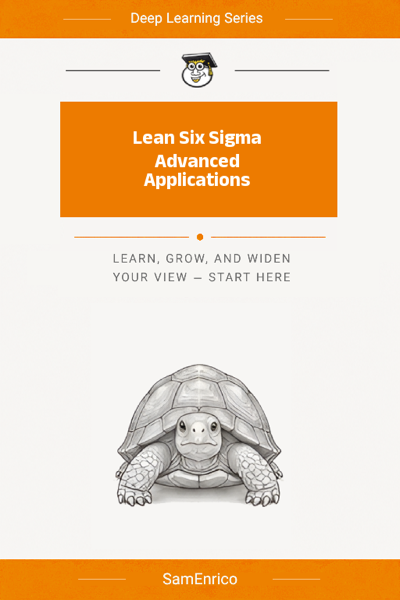
Non-FictionInformativeEducational
Lean Six Sigma Advanced Applications eBook
A Coursebook on Lean Six Sigma Advanced Applicatio
by Sauls Lacy
A Coursebook on Lean Six Sigma Advanced Applications
Formats
Free sample
Chapter 1: The Strategy Trap--–- Every Master Black Belt remembers the exact moment they realized their technical skills weren't enough. For Sarah, it came during a Tuesday morning quarterly business review. She had spent six weeks optimizing a critical manufacturing line, reducing defect rates from 8.3 percent to 1.2 percent. Her statistical analysis was flawless. Her control charts were textbook perfect.
She had even built a elegant dashboard in Minitab that updated in real time. When the plant manager asked about her project's impact on the company's inventory turns, Sarah froze. She could calculate a p-value in her sleep. She could explain the difference between a Weibull and a Lognormal distribution without hesitation. But she had no idea how her defect reduction connected to inventory strategy, let alone the broader financial health of the organization.
In that moment, the uncomfortable truth settled over her like a weight: she had been trained as a technician when the organization needed a strategist.This book exists for every Black Belt who has felt that same discomfort. The gap between technical excellence and strategic impact is not a small crack to be papered over with a few leadership platitudes. It is a chasm, and it is the single greatest reason why Lean Six Sigma deployments fail to deliver lasting value. The top ten best-selling books on this topic cover the tools thoroughly. They explain Gage R&R and Design of Experiments with admirable clarity.
They provide case studies and certification exam tips. But they largely fail to address the fundamental shift required to move from Black Belt competence to Master Black Belt mastery. That shift is not about learning more statistics. It is about learning to think differently about what statistics are for.The False Promise of Tool Proficiency The Lean Six Sigma industry has done an excellent job training practitioners in tool usage. There are thousands of certified Black Belts who can run a regression analysis or build an Xbar-R chart without hesitation.
This is not a small achievement. Statistical literacy is rare and valuable, and these practitioners deserve credit for their technical skill. But proficiency with tools is not the same as mastery of a discipline, and mastery of a discipline is not the same as creating organizational change.Consider the difference between a carpenter who owns every tool in the catalog and a master craftsman who builds furniture that lasts for generations. The carpenter can cut a perfect dovetail joint. The master craftsman knows which woods will shrink and swell together over decades, which finishes will protect against the humidity of a coastal home, and which proportions will please the eye without being told.
The carpenter has skills. The master craftsman has wisdom. In Lean Six Sigma, Black Belts are the carpenters. Master Black Belts are the craftsmen. The tools are necessary, but they are far from sufficient.The most common complaint from executives who have invested in Lean Six Sigma training is not that their Belts lack technical ability.
It is that their Belts cannot connect improvement projects to business strategy, cannot communicate results in financial terms that resonate with the C-suite, and cannot sustain gains once the initial enthusiasm fades. These are not statistical problems. They are strategic problems dressed in statistical clothing.The Strategic Asset Mindset Shift Moving from Black Belt to Master Black Belt requires a fundamental reorientation in how you view your role. The Black Belt mindset asks: "What tool should I use to solve this problem?" The Master Black Belt mindset asks: "Does solving this problem serve the organization's strategic objectives, and if so, how do I deploy the right resources and methods to solve it sustainably?" This is not semantic hair-splitting. It is the difference between being a resource and being a leader.A strategic asset mindset manifests in several concrete ways.
First, you stop asking "what can I measure?" and start asking "what should we measure to make better decisions?" The distinction is subtle but powerful. The first question leads to data collection for its own sake, producing thick binders of control charts that no one reads. The second question leads to targeted measurement systems that inform specific decisions at specific intervals. Second, you stop asking "how do I fix this defect?" and start asking "is this defect worth fixing given our strategic priorities?" This question requires you to understand not just the cost of poor quality but the opportunity cost of improvement efforts. Every hour spent on a low-impact project is an hour not spent on a high-impact project.Third, and most critically, you start viewing Lean and Six Sigma not as separate methodologies to be balanced but as a unified framework for creating organizational value.
The mathematical unity between Lean waste reduction and Six Sigma variance reduction is not merely an academic curiosity. It is the foundation of advanced practice. Lean says that any activity that consumes resources without creating customer value is waste. Six Sigma says that variation is the enemy of quality. These two statements are not contradictory; they are complementary.
Waste creates variation, and variation creates waste. A process with excessive motion (waste) is more likely to produce variation in output. A process with high variation in temperature (variance) requires more inspection and rework (waste). Understanding this unity allows you to diagnose problems holistically rather than through the narrow lens of one methodology.The Y = f(x) Paradigm at Scale Every Lean Six Sigma practitioner learns the basic transfer function: Y equals f of x, where Y is the output you care about and x represents the inputs that influence it. This is foundational.
But at the advanced level, you must learn to apply this paradigm across entire value streams, managing multiple critical output variables simultaneously rather than optimizing one Y at the expense of others.Consider a simple manufacturing line. A Black Belt might focus on reducing defects in a specific operation, treating defect rate as Y and optimizing tool speed, feed rate, and material hardness as x variables. This is valuable work. But a Master Black Belt sees the entire value stream as a system of interconnected transfer functions. The defect rate at operation three affects rework at operation four, which affects cycle time at operation five, which affects on-time delivery (a different Y), which affects customer satisfaction (yet another Y), which affects revenue (the ultimate Y).
Improving one local Y without understanding its impact on other Ys is like tuning a single instrument in an orchestra while ignoring the rest of the ensemble. You might make the violin sound beautiful, but the symphony will still fail.The advanced application of Y = f(x) requires three capabilities that go far beyond basic training. First, you must be able to map the causal structure connecting local outputs to strategic outcomes. This is not a statistical exercise alone; it requires organizational knowledge and systems thinking. Second, you must be able to quantify the trade-offs between competing Ys.
Reducing setup time (a Lean Y) might increase variation in the first few units after changeover (a Six Sigma Y). Is the trade-off worth it? The answer depends on strategic priorities. Third, you must be able to communicate these trade-offs to decision-makers who…
This is the end of the free sample. Get the eBook to keep going. Buy now
About this book
Details
- Author
- Sauls Lacy
- Publisher
- SamEnrico
- Language
- English
- Genre
- Non-Fiction, Informative, Educational
- Released
- 2026-05-25
- Pages (approx.)
- 151
- Available as
- eBook, Audiobook

Read better in the ZLOADR app
Your eBooks on your phone or tablet. Sign in with your SamEnrico account and start reading.
More by Sauls Lacy
 Transcendental Meditation for TinnitusSauls Lacy$11.99
 Children's Dream WorkbookSauls Lacy$11.99
 FODMAP Wine And Spirits GuideSauls Lacy$11.99
 Workplace Environmental Toxin GuideSauls Lacy$11.99
 Sarcopenia Bone Density LinkSauls Lacy$11.99
 Non Stick Pan Toxin GuideSauls Lacy$11.99
 Bipolar Support GroupsSauls Lacy$11.99
 Arthritis And Covid GuideSauls Lacy$11.99
 The Battle of Tsushima: Japan's Naval Triumph in the Sky (1905)Sauls Lacy$11.99
 Bridge Jump SurvivorSauls Lacy$11.99
 The Last Round: How Mike Tyson Lost EverythingSauls Lacy$11.99
 Stanley Meets Livingstone: The Pacific Link to Africa's HeartSauls Lacy$11.99
You may also like
 Hong Kong Handover 1997Dunn Johnnie$11.99
 Zumba For Postnatal Recovery CourseNeal Christian$11.99
 Zumba for BeginnersLadner Nikia$11.99
 YouTube Comment Mining GuideHumes Pandora$12.99
 Worry Box MeditationCarlin Rudy$11.99
 Workplace Stress MeditationNguyen Lynn$11.99
 Workplace Stress and Sleep RepairHawley Ivory$11.99
 Workplace Perfectionism CureDelaney Jeffry$11.99
 Workplace Injustice Anger GuideWallen Isabelle$11.99
 Work Addiction and Burnout LinkGreenwood Ester$11.99
 Women in Yoga and WellnessBeattie Galina$11.99
 Women in Stand Up ComedyChun Evangeline$11.99