
Non-FictionInformativeEducational
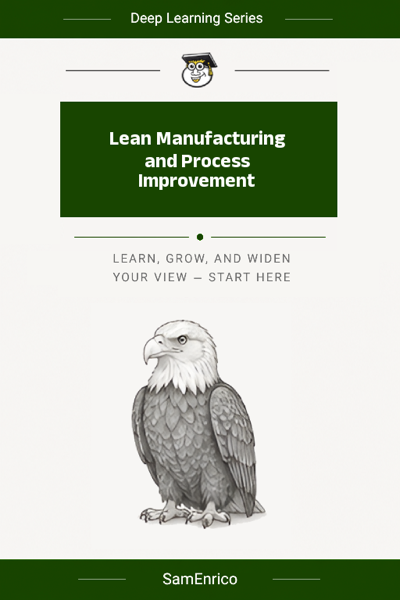
Lean Manufacturing and Process Improvement eBook
A Coursebook on Lean Manufacturing and Process Imp
by Rosales Hoyt
A Coursebook on Lean Manufacturing and Process Improvement
Formats
Free sample
Chapter 1: The NUMMI Miracle--–- In 1984, General Motors opened a car factory in Fremont, California, that everyone expected to fail. The plant had been shut down two years earlier because it was, by every measurable standard, the worst factory in the GM system. Absenteeism ran above 20 percent. Grievances filed by workers against management numbered in the thousands. Drug deals happened openly in the parking lot.
Quality was so poor that cars rolled off the line with missing parts, mismatched panels, and engines that wouldn’t start. When GM closed the plant in 1982, they laid off 2,500 workers and chalked up the loss as inevitable—some factories, they concluded, were simply unfixable.Then something strange happened. Toyota, the Japanese automaker that had been quietly eating Detroit’s lunch for a decade, approached GM with an unprecedented proposal: a joint venture. Toyota would take over the failed Fremont plant, hire back 80 percent of the same union workforce, build cars alongside GM, and prove that their production system could work anywhere. The new venture was called NUMMI—New United Motor Manufacturing, Inc.
Skeptics called it a fool’s errand. The same workers who had sabotaged the old plant, who had shown up drunk or not at all, who had hidden defects and fought management at every turn—these workers would now build Toyotas alongside Japanese managers? Impossible.Eighteen months later, NUMMI was producing cars with higher quality than any GM plant in North America and productivity that matched Toyota’s best factories in Japan. The same workforce. The same building.
The same machines. The only thing that changed was the system. This chapter tells the story of that transformation because it contains the single most important lesson of Lean Manufacturing: your problems are not your people. Your problems are your process. When you change the process, you change everything.The Three Ages of Production: From Craft to Mass to Lean To understand why NUMMI shocked the automotive world, you must first understand how factories evolved from craft production to mass production to lean production—and why each leap created new possibilities and new forms of waste.Age One: Craft Production (Pre-1900)Before Henry Ford, everything was made by craftsmen.
A single cabinetmaker built a cabinet from raw lumber to finished product. A single watchmaker assembled every gear and spring. This approach produced beautiful, high-quality goods, but it had catastrophic limitations. Production volume was tiny. Consistency was nonexistent—no two craftsmen built the same thing the same way.
And because each craftsman needed years of training, scaling up meant finding more craftsmen, which was nearly impossible. A carriage maker in 1890 might build fifty carriages per year. If demand suddenly jumped to five hundred, there was no way to respond.Age Two: Mass Production (1910–1970)Henry Ford’s moving assembly line changed everything. Instead of craftsmen walking from station to station, the product moved past workers who performed a single, repeatable task. The Model T assembly line reduced labor hours per car from twelve hours to ninety minutes.
Price dropped from $850 to $260. Ford went from building 10,000 cars in 1908 to 2 million in 1923. Mass production had a hidden cost, however. The system was rigid. Changeovers took days.
Inventory piled up everywhere to keep the line running. And quality suffered because defects were discovered at the end of the line, not at the source. Ford’s famous response to complaints about color choices—“Any customer can have a car painted any color that he wants so long as it is black”—was not a customer-friendly innovation. It was a confession of inflexibility.Age Three: Lean Production (1970–Present)Toyota faced a problem that Ford never had: they were broke. Post-World War II Japan had no capital, no natural resources, and a domestic market too small to support mass production volumes.
Taiichi Ohno, the engineer who became the father of the Toyota Production System, realized he could not simply copy Detroit. He had to invent something better. That invention became Lean Production, a system built on three radical ideas. First, produce only what the customer wants, when they want it, in the quantity they want. Second, build quality into the process so defects are caught immediately, not at final inspection.
Third, empower every employee to stop the production line when they see a problem. These ideas seem obvious today. In the 1950s, they were heresy.The Man Who Walked the Floor: Taiichi Ohno Taiichi Ohno was not a charismatic executive. He was a wiry, intense engineer who spent most of his time walking the factory floor, watching, asking questions, and pointing at things. His most famous teaching method was to draw a chalk circle on the floor, stand a manager inside it, and say, “Watch.
Don’t move. Tell me what you see.” A junior manager might stand in that circle for hours while Ohno came back repeatedly to ask, “What else do you see?” The lesson was brutal but essential: data is a lie. Reports are filtered. The only truth is what happens at the actual place where value is created—the Gemba.Ohno’s insights came not from theory but from obsessive observation. He noticed that machinists spent most of their time waiting—waiting for materials, waiting for tools, waiting for the previous operation to finish.
He noticed that parts traveled enormous distances between machines because equipment was arranged in functional clusters (all lathes together, all presses together) rather than in production sequence. He noticed that defects were produced continuously but only discovered hours later, resulting in massive rework. One by one, he attacked these problems with counterintuitive solutions: rearrange equipment into U-shaped cells so one operator could run multiple machines; reduce changeover times from hours to minutes so small batches became economical; install stop cords at every station so any worker could halt the line the instant a defect appeared.Ohno codified his discoveries into the Toyota Production System, which later became known as Lean Manufacturing after a 1988 MIT study by John Krafcik and the 1990 book The Machine That Changed the World by Womack, Jones, and Roos. But the name is less important than the philosophy. Lean is not a toolkit.
It is a way of seeing waste and a discipline of eliminating it through systematic problem-solving.The 4P Model: The DNA of Toyota After decades of studying Toyota, researchers Jeffrey Liker and David Meier distilled the Toyota Production System into the 4P Model: Philosophy, Process, People and Partners, and Problem Solving. This framework appears throughout this book, and you will return to it repeatedly as you diagnose and improve your own operations.Philosophy: Long-Term Thinking Over Short-Term Profit Toyota’s first and most important principle is to base management decisions on a long-term philosophy, even at the expense of short-term financial goals. This sounds like corporate platitude, but it has concrete implications. When Toyota introduced the Prius, they lost money on every car for years because they believed hybrid technology was the future. When the 2008 financial crisis hit, Toyota did not lay off a single full-time employee in Japan—they retrained them, redeployed them, and kept them on the payroll because they valued people over quarterly earnings.
In contrast, GM’s relentless focus on quarterly profit led them to cut R&D, defer maintenance, and push cars off the…
This is the end of the free sample. Get the eBook to keep going. Buy now
About this book
Details
- Author
- Rosales Hoyt
- Publisher
- SamEnrico
- Language
- English
- Genre
- Non-Fiction, Informative, Educational
- Released
- 2026-06-03
- Pages (approx.)
- 134
- Available as
- eBook, Audiobook

Read better in the ZLOADR app
Your eBooks on your phone or tablet. Sign in with your SamEnrico account and start reading.
More by Rosales Hoyt
 Anger Management for New HiresRosales Hoyt$11.99
 Workaholism in TradesRosales Hoyt$11.99
 Empty Nest Sleep MeditationRosales Hoyt$11.99
 Emergency Kit for People with DiabetesRosales Hoyt$11.99
 Egyptian MummificationRosales Hoyt$11.99
 Sales Burnout PreventionRosales Hoyt$11.99
 Jenkins Lyrical EyeRosales Hoyt$11.99
 Diver's Guide to Midnight TrenchesRosales Hoyt$11.99
 Memory Palace MaintenanceRosales Hoyt$11.99
 Ice and Ashes: The Meth Empire That Burned Down a TownRosales Hoyt$11.99
 The Ballad of the Sundown Rider: The Last Outlaw of the Oklahoma StampedeRosales Hoyt$11.99
 Gwythyr’s Lost Bride: The Forgotten Rival of ArthurRosales Hoyt$11.99
You may also like
 Hong Kong Handover 1997Dunn Johnnie$11.99
 Zumba For Postnatal Recovery CourseNeal Christian$11.99
 Zumba for BeginnersLadner Nikia$11.99
 YouTube Comment Mining GuideHumes Pandora$12.99
 Worry Box MeditationCarlin Rudy$11.99
 Workplace Stress MeditationNguyen Lynn$11.99
 Workplace Stress and Sleep RepairHawley Ivory$11.99
 Workplace Perfectionism CureDelaney Jeffry$11.99
 Workplace Injustice Anger GuideWallen Isabelle$11.99
 Work Addiction and Burnout LinkGreenwood Ester$11.99
 Women in Yoga and WellnessBeattie Galina$11.99
 Women in Stand Up ComedyChun Evangeline$11.99