
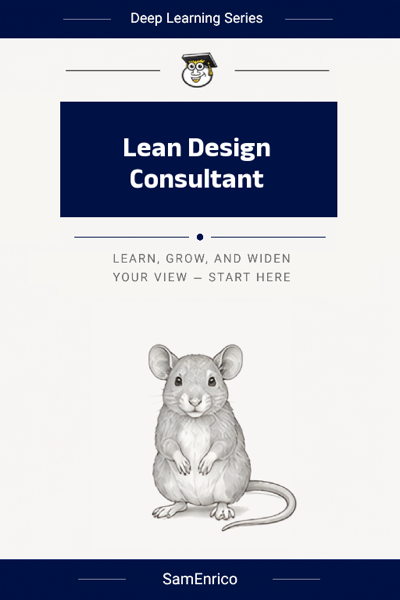
Non-FictionInformativeEducational
Lean Design Consultant eBook
A Coursebook on Lean Design Consultant
A Coursebook on Lean Design Consultant
Formats
Free sample
Chapter 1: The Lens Shift--–- Every consulting engagement begins the same way: with a question masquerading as an answer. The client says, “We need a new website,” or “Redesign our mobile app,” or “Create a brand guidelines document.” And because you are a professional, paid to deliver solutions, you nod. You ask about deadlines, budgets, team structures. You agree on deliverables. You shake hands.
And then you spend the next eight weeks building exactly what they asked for. Only to discover, at the final presentation, that no one actually needed any of it.This is not a failure of skill. It is a failure of framing. You have been asked to solve a problem that has not yet been defined. Worse, you have accepted a request as if it were a need.
And in that single, subtle substitution—request masquerading as need—lies the birthplace of nearly every form of waste in design consulting: rework, overprocessing, waiting, handoffs, unused research, and the quiet, creeping realization that the 100-page deliverable will be opened once and then buried in a digital folder forever.The Lean Design Consultant does something different. Before sketching a single wireframe, before writing a single user story, before opening Figma or Miro or any other tool, they ask a question that most consultants are terrified to ask: “Why?”Not once. Not twice. Five times.And then they ask the question that separates order-takers from value-creators: “How will we measure that we have succeeded?”This chapter is about the most difficult and most important shift in the entire Lean journey: learning to see through the client’s eyes. It is not about being nice.
It is not about customer service. It is about precision—the kind of precision that turns vague requests into testable hypotheses, that converts endless revision loops into closed decisions, that transforms a reactive consulting practice into a proactive, value-driven one. Without this shift, the rest of this book is merely technique. With it, every tool—Kanban, value stream mapping, A3 problem solving—becomes surgical.The Problem of Solutioneering There is a term for consultants who fall in love with their own solutions before understanding the problem: solutioneers. They are everywhere.
They are often brilliant. And they are almost always expensive in ways that have nothing to do with their hourly rates.Solutioneering works like this. A client says, “We need to improve our customer onboarding flow.” The solutioneer immediately thinks of a half-dozen best practices: progressive disclosure, in-app tooltips, email drip campaigns. Within an hour, they have sketched three high-level concepts. Within a week, they have a prototype.
Within a month, they have delivered a beautifully designed onboarding sequence that reduces friction by 40%. The client is thrilled. The team celebrates.But here is what the solutioneer never discovered: the real problem was not the onboarding flow. It was that the sales team was promising features that did not exist, so customers arrived confused no matter how elegant the interface. The onboarding redesign did not fail—it just did not matter.
The root cause remained untouched. And six months later, the client is back with a new request, and the cycle repeats.Solutioneering is not malice. It is a cognitive bias called the law of the instrument: when all you have is a hammer, everything looks like a nail. Design consultants have wireframing tools, so every problem looks like a wireframing problem. Brand consultants have logo sketchbooks, so every problem looks like a brand problem.
Strategy consultants have two-by-two matrices, so every problem looks like a strategic repositioning problem. The tool defines the diagnosis, and the diagnosis guarantees the solution.Lean thinking breaks this cycle with a simple, brutal rule: You may not propose a solution until you can articulate the problem in terms the client would recognize as true.This is harder than it sounds. Because clients themselves often do not know their own problems. They know their symptoms: slow sales, low engagement, high churn. They know their requests: a new website, a mobile app, a rebrand.
But the gap between symptom and root cause is where value lives. And crossing that gap requires a specific set of tools.The Five Whys: From Request to Root Cause The most famous diagnostic tool in Lean is the Five Whys. Developed by Sakichi Toyoda (the founder of Toyota Industries), it is deceptively simple: when you encounter a problem, ask “why” five times in succession. By the fifth answer, you are usually at the root cause.In design consulting, the Five Whys works differently. You are not diagnosing a machine breakdown.
You are diagnosing a request. Here is how it looks in practice.Client request: “We need a new dashboard for our operations team.”Why? “Because the current dashboard takes too long to load.”Why does it take too long to load? “Because it queries across three different databases, and two of them are slow.”Why are they slow? “Because we never normalized the data structures when we acquired Company X three years ago.”Why was that never done?
“Because the integration was considered ‘good enough,’ and no one has been allocated to fix it.”Why has no one been allocated? “Because the leadership team does not see data normalization as a strategic priority; they only see front-end features.”Now pause. The original request was a new dashboard. The root cause is a data normalization problem buried in a past acquisition. Building a new dashboard on top of the same slow databases would be like repaving a road that leads to a collapsed bridge.
It might look nicer for a week, but no one is getting to their destination.The Lean Design Consultant does not deliver the requested dashboard. They deliver an analysis that says: “Your real problem is data normalization. Here are three ways to solve it, ranging from minimal (normalize just the two tables used most often) to complete (refactor the entire data model). The new dashboard would be a cosmetic fix. Which path do you want?”This is not what the client asked for.
It is what the client needs. And that is the difference between a vendor and a trusted advisor.The Five Whys has three rules in consulting contexts:Stay curious, not defensive. The goal is not to prove the client wrong. It is to discover together. If the client says, “No, the real problem is the UI,” you do not argue.
You say, “Help me understand: if the data loaded instantly, would the UI still be a problem?” This reframes the conversation without triggering defensiveness.Write down each answer. Memory is unreliable. A shared whiteboard or document forces both parties to commit. When the client sees the chain of “whys” in writing, they often have their own aha moment.Stop when you reach a process or policy failure. A root cause is something you can act on.
“Because the VP is stubborn” is not actionable. “Because the approval policy requires three signatures for any database change” is actionable. Stop at the latter.The Value Definition Statement The Five Whys gives you the root cause. But root cause alone does not define value. Value, in Lean terms, is anything the client is willing to…
This is the end of the free sample. Get the eBook to keep going. Buy now
About this book
Details
- Author
- Edward Vergie
- Publisher
- SamEnrico
- Language
- English
- Genre
- Non-Fiction, Informative, Educational
- Released
- 2026-06-02
- Pages (approx.)
- 148
- Available as
- eBook, Audiobook

Read better in the ZLOADR app
Your eBooks on your phone or tablet. Sign in with your SamEnrico account and start reading.
More by Edward Vergie
 NICU Nurse Burnout GuideEdward Vergie$11.99
 The First Generation Student GuideEdward Vergie$11.99
 Dreams And Abandonment TraumaEdward Vergie$11.99
 The Syndication Tax Benefits GuideEdward Vergie$11.99
 DBT For Grandparents Raising GrandkidsEdward Vergie$11.99
 The Fall and Rise of the New German Masters: Günter Grass and the Literary ReckoningEdward Vergie$11.99
 Insurance Pop Up GuideEdward Vergie$12.99
 Manufacturing Green Credit OptimizerEdward Vergie$12.99
 Understanding Tay Syndrome IchthyosisEdward Vergie$17.99
 How to Become a Continuity ClerkEdward Vergie$11.99
You may also like
 Hong Kong Handover 1997Dunn Johnnie$11.99
 Zumba For Postnatal Recovery CourseNeal Christian$11.99
 Zumba for BeginnersLadner Nikia$11.99
 YouTube Comment Mining GuideHumes Pandora$12.99
 Worry Box MeditationCarlin Rudy$11.99
 Workplace Stress MeditationNguyen Lynn$11.99
 Workplace Stress and Sleep RepairHawley Ivory$11.99
 Workplace Perfectionism CureDelaney Jeffry$11.99
 Workplace Injustice Anger GuideWallen Isabelle$11.99
 Work Addiction and Burnout LinkGreenwood Ester$11.99
 Women in Yoga and WellnessBeattie Galina$11.99
 Women in Stand Up ComedyChun Evangeline$11.99