
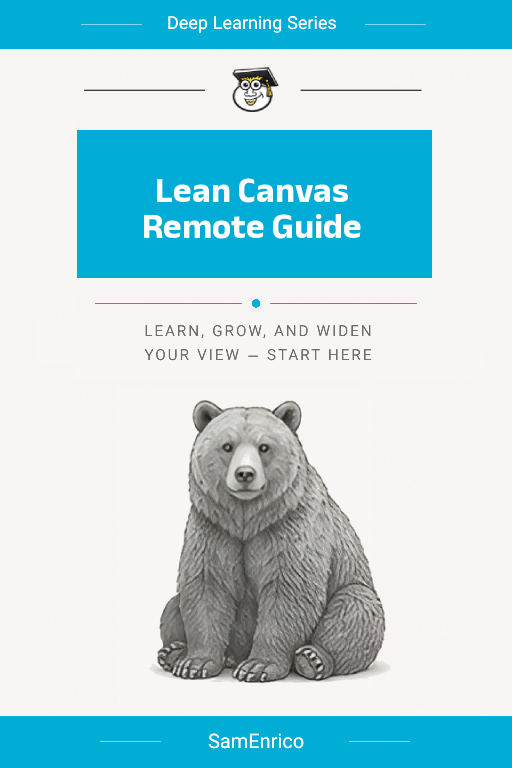
Lean Canvas Remote Guide eBook
Complete Lean Canvas online for your startup busin
by Loomis Thanh
Complete Lean Canvas online for your startup business plan. Free template and validation approach.
Formats
Free sample
Chapter 1: The Whiteboard Lie--–- It was 11:47 PM on a Sunday when I finally admitted the truth: the sticky notes on my office wall were a monument to procrastination, not planning.I had spent six weeks meticulously filling out a Lean Canvas. The Problem block contained three beautifully articulated pain points. The Customer Segments section was a work of art. I had even color-coded the Unfair Advantage block with a highlighter that cost eight dollars. My co-founder, who lived 3,000 miles away in a different time zone, had never seen the physical whiteboard.
I had taken photos of it—thirty-seven photos, to be exact—and emailed them to him in a thread that now spanned fourteen messages. He had replied with comments like "Looks good" and "Maybe move this box?" and "What does this word mean again?"We were not building a business. We were building an asynchronous museum exhibit of our own guesses.The worst part? I had read all the right books. I had devoured Eric Ries' The Lean Startup on a red-eye flight.
I had highlighted half of Ash Maurya's Running Lean until my marker ran out of ink. I had even forced my team to watch a webinar on the "Continuous Innovation Framework." And yet, there I was, alone in a home office at midnight, staring at a wall that would never meet the eyes of my co-founder, my advisors, or—most importantly—a single paying customer.This book exists because that night, I threw away the highlighters.Not because highlighters are evil, but because I finally understood a truth that the best-selling lean startup literature whispers but never shouts: the physical whiteboard is a single-player game in a multiplayer world. The Lean Canvas, as originally conceived, is a brilliant tool for co-located teams who can stand shoulder-to-shoulder and move sticky notes in real time. But for the rest of us—the remote founders, the distributed teams, the solo builders in coffee shops, the cross-continental co-founders—the physical whiteboard is not a tool. It is a trap.The Great Misunderstanding: Why Your Business Plan is Already Obsolete Let me be direct about something that most business books dance around: the traditional 40-page business plan was never a plan.
It was a ritual.From 1950 until approximately 2010, entrepreneurs were taught that the path to funding ran through a document of escalating absurdity. You would write 40 pages of market analysis, financial projections, competitive matrices, and operational timelines—all based on nothing but hope and Excel autofill. You would print three copies, bind them in spiral notebooks, and present them to investors who would skim the executive summary and ask one question: "What happens when reality disagrees with page 27?"The answer, of course, was chaos. Because a 40-page business plan is not a map. It is a fossil of your assumptions at a single moment in time.
The moment you talk to your first customer, that fossil cracks. The moment a competitor launches a feature, that fossil crumbles. The moment your developer says "actually, that's impossible," that fossil becomes ash.Enter the Lean Canvas.Ash Maurya created something genuinely revolutionary when he stripped the business plan down to nine boxes on a single page. No more 40 pages of fiction. No more five-year financial projections that assume linear growth in a nonlinear world.
Just nine questions that every startup must answer:What problem are you solving?Who has that problem?What is your unique solution?What is your unfair advantage?How will you reach customers?What metrics will tell you the truth?What will it cost you?How will you make money?What value do you promise?Beautiful. Elegant. And, for a remote team, completely broken.The Hidden Assumption That Kills Remote Startups Here is the problem that no best-selling book has solved: the Lean Canvas methodology was designed for a conference room.When Ash Maurya wrote Running Lean, he described a process where the founder stands in front of a whiteboard, writes assumptions on sticky notes, and moves them around with a team that is physically present. The "Customer Interview" chapter assumes you will sit across a table from someone and watch their face react to your questions. The "Pivot or Persevere" decision assumes you can look your co-founder in the eye and say "we were wrong."But what if your co-founder is asleep?
What if your customer lives in a different country? What if your advisor will only communicate via email because they have three other board meetings today?The remote founder faces a reality that the original Lean Canvas literature never anticipated: asynchronous collaboration is not a convenience; it is a constraint.And most teams respond to this constraint by doing exactly what I did—they digitize the problem instead of solving it. They take a photo of the whiteboard. They recreate the nine boxes in a Power Point slide. They paste the Canvas into a Google Doc that nobody opens.
They call this "going remote" when what they have really done is created a static artifact that will be ignored until the next all-hands Zoom call.This book is the antidote to the static Canvas.The Three False Solutions (And Why They Fail)Before I show you what works, let me name the three most common ways remote teams butcher the Lean Canvas. I know these intimately because I have committed all three sins myself, often in the same week.False Solution #1: The Email Attachment Carousel This is what I did with my co-founder. Someone creates a Canvas in a PDF, a Word document, or—God help them—a JPEG. They email it to the team. Someone replies with comments.
Someone else replies with a revised version attached. Someone else replies-all asking which version is current. Within three days, the email thread contains seventeen versions of the Canvas, none of which match, and the founder has stopped reading anything except the subject lines.The failure mode here is not laziness; it is the illusion of progress. Each email feels like work. Each attachment feels like documentation.
But in reality, you have built a system that punishes collaboration. The person who speaks last—or who has the most aggressive "Reply All" finger—wins, regardless of the quality of their ideas.False Solution #2: The Synchronous Zoom Canvas This is the "let's all get on a call and fill out the Canvas together" approach. It sounds noble. It sounds collaborative. In practice, it is a nightmare of scheduling across time zones, awkward silences while someone shares their screen, and the tyranny of the loudest voice in the room.I watched a team spend ninety minutes on a Zoom call trying to agree on the wording of their Unique Value Proposition.
The founder in New York kept saying "disrupt." The product manager in London kept saying "streamline." The developer in Bangalore kept typing "????" in the chat. At minute seventy-three, someone suggested they table the discussion and "circle back tomorrow." They never did. The Canvas remained half-empty for another two weeks.The tragic irony is that this team could have resolved their UVP disagreement in twenty minutes of asynchronous work. But because they were conditioned to believe that "real collaboration requires real-time meetings,"…
This is the end of the free sample. Get the eBook to keep going. Buy now
About this book
Details
- Author
- Loomis Thanh
- Publisher
- SamEnrico
- Language
- English
- Genre
- Non-Fiction, Startup Guide, Strategic Planning
- Released
- 2026-05-30
- Pages (approx.)
- 142
- Available as
- eBook, Audiobook

Read better in the ZLOADR app
Your eBooks on your phone or tablet. Sign in with your SamEnrico account and start reading.
More by Loomis Thanh
 The Winter Exercise SAD GuideLoomis Thanh$11.99
 Remote Work Stress GuideLoomis Thanh$11.99
 Values And Mission Alignment Vendor Selection GuideLoomis Thanh$11.99
 Mediterranean Diabetes GuideLoomis Thanh$11.99
 Foot In Door Influence TechniqueLoomis Thanh$11.99
 The Golden Minds of Timbuktu: Philosophers Who Shaped the WorldLoomis Thanh$11.99
 Assistant Blend Line LeaderLoomis Thanh$11.99
 Understanding Tricho Retino Dento Digital SyndromeLoomis Thanh$17.99
 One Page Business Plan SprintLoomis Thanh$12.99
 How to Become a PlaywrightLoomis Thanh$11.99
You may also like
 WPS Office Business Plan GuideHammer Jewell$12.99
 Wi Fi Market Analysis GuideWallen Isabelle$12.99
 Wi Fi Financial Forecast GuideRaymond Fernanda$12.99
 Trello Business Plan GuideHorvath Wai$12.99
 Strategyzer Remote GuideDow Loma$12.99
 Strategic Planning on a Hotspot GuideLedford Jenniffer$12.99
 Remote Financial Model GuideGarber Stefanie$12.99
 P&L Statement Online GuidePaz Myriam$12.99
 Notion Business Plan GuideZavala Rosaura$12.99
 Miro Business Plan GuideShultz Robt$12.99
 LivePlan Remote AlternativeFarrell Malinda$12.99
 Executive Summary Wi Fi GuideYoungblood Mica$12.99