
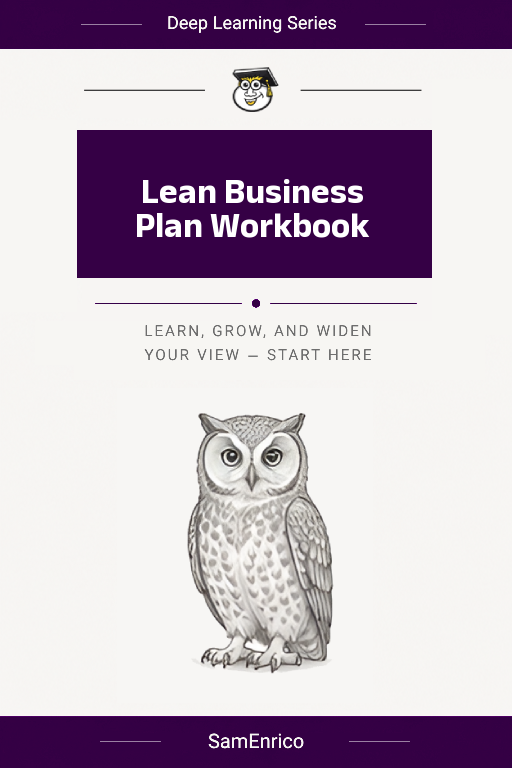
Non-FictionStartup GuideLean Methodology
Lean Business Plan Workbook eBook
Build a practical one-page business plan using fre
Build a practical one-page business plan using free Wi-Fi tools while validating assumptions with real customer feedback before writing a full document.
Formats
Free sample
Chapter 1: The 40-Page Lie--–- You have probably already wasted two hundred hours of your life on documents that expired the moment you printed them.–- That feels harsh. Let me say it differently: every business plan you have ever written was obsolete before you finished the first sentence. Not because you are bad at planning. Because you were planning for a world that does not exist—a world where nothing changes, where customers behave exactly as you predicted, and where your biggest risk was running out of paper.–- That world is fiction.–- This chapter is going to dismantle the myth that a thick business plan equals safety. By the time you finish reading, you will understand why traditional planning is not just useless for startups—it is actively dangerous.
More importantly, you will adopt a new operating system for your business: one that treats plans as experiments, documents as dashboards, and uncertainty as fuel rather than fear.The Funeral for Your Old Business Plan–- Let us perform a small ceremony. Think about the last business plan you wrote—or the one you have been meaning to write. How many pages was it? How many spreadsheets? How many hours did you spend formatting the table of contents?–- Now ask yourself a harder question: how many of those assumptions did you test before you wrote them down?–- If you are like ninety-nine percent of entrepreneurs, the answer is zero.
You wrote a plan based on what you believed, not what you knew. Then you probably showed it to an advisor, a mentor, or a potential investor, who nodded and said something encouraging. Then you put it in a drawer—or a Google Drive folder—and reality immediately proved it wrong.–- This is not your fault. You were taught that planning is responsible and that “failing to plan is planning to fail.” That advice is perfect for someone running a mature business with stable customers, known competitors, and predictable cash flow. It is terrible advice for someone starting something new.–- The difference is simple: execution versus search.–- A large company executes a known business model.
They already know who their customers are, what problem they solve, and how much it costs to acquire a user. Their job is to do more of what works, faster and cheaper. A startup, on the other hand, is searching for a business model. You do not know your customers with certainty. You do not know which features matter.
You do not know if your pricing is right. Writing a forty-page plan during the search phase is like drawing a detailed map of a country you have never visited.–- The only thing that map will be accurate about is your imagination.The Three Ways Traditional Plans Fail Startups–- Let me be specific. Traditional business plans fail new ventures in three predictable ways. Each one is a trap, and each one is avoidable once you see it.Failure One: They Assume No Change–- A traditional business plan is a static document. You write it in January, and by February, something has already shifted.
A competitor launched a new feature. A customer segment you ignored suddenly became urgent. A supplier raised prices.–- The plan cannot adapt because it was never designed to. It is a photograph, not a video. And in a startup, change is not an exception—it is the only constant.–- I once worked with a founder who spent three months writing a fifty-page plan for a food delivery service.
By the time he finished, three new competitors had entered his market, and the restaurant partnership model he had painstakingly negotiated was obsolete. He had a beautiful document and a dead business.–- He did not fail because he was lazy. He failed because he planned for a world that stopped moving while he was writing.Failure Two: They Prioritize Certainty Over Learning–- A business plan asks you to forecast revenue, customer acquisition costs, and growth rates. It asks you to be precise. But precision is expensive when you are searching for a model.–- To be precise, you need data.
To get data, you need to run experiments. To run experiments, you need to build something. To build something, you need to spend money. Most founders reverse this sequence: they spend money to build something, then they run experiments, then they collect data, and then they realize their forecast was wrong.–- Lean planning flips the sequence. You start with a cheap experiment, collect a small amount of data, update your forecast, and repeat.
You accept that your early forecasts will be wildly imprecise because you are learning. The goal is not to be right. The goal is to be less wrong every week.Failure Three: They Reward Activity Instead of Results–- Have you ever felt productive after writing a business plan? Of course you have. It feels good to fill pages, to organize thoughts, to create charts.
That feeling is dangerous because it is a substitute for actually testing your assumptions.–- Writing a plan is an activity. Interviewing a customer is a result. Building a landing page is an activity. Measuring whether someone clicks “Buy Now” is a result.–- Traditional planning rewards the activity. Lean planning ignores everything except the result.The Build-Measure-Learn Loop–- So what replaces the forty-page document?
A feedback loop called Build-Measure-Learn. This is not theory. It is the engine of every successful lean business, and it is simple enough to explain in three sentences.–- First, you build the smallest possible thing that can generate learning. This is not a product. It is not even a prototype.
It is an experiment.–- Second, you measure how customers respond. You do not ask them what they think. You watch what they do.–- Third, you learn whether your assumption was correct. If it was, you refine and repeat. If it was not, you change your assumption—a pivot—and start over.–- The entire loop should take days, not weeks.
In some cases, hours.–- Let me give you a concrete example. A founder I mentored wanted to build an app that helped freelancers track their invoices. His traditional plan would have required building the app, hiring a developer, and spending six months and fifty thousand dollars before seeing a single customer.–- Instead, he ran a Build-Measure-Learn loop in one weekend. He created a simple Google Form that looked like an invoice tracker. He posted it in a freelancer Facebook group with a message: “I am testing a new tool.
Enter your invoice data here, and I will manually send you a summary report within twenty-four hours.”–- Twenty-three people signed up. He manually generated their reports over the weekend. Then he asked them: “Would you pay ten dollars a month for this?”–- Eleven said yes.–- He had validated demand for less than five dollars in Facebook ads and one weekend of his time. He built nothing. He measured real behavior.
He learned that the problem was real.–- That is the Build-Measure-Learn loop. It is not a theory. It is a…
This is the end of the free sample. Get the eBook to keep going. Buy now
About this book
Details
- Author
- Southern Cassaundra
- Publisher
- SamEnrico
- Language
- English
- Genre
- Non-Fiction, Startup Guide, Lean Methodology
- Released
- 2026-05-28
- Pages (approx.)
- 107
- Available as
- eBook, Audiobook

Read better in the ZLOADR app
Your eBooks on your phone or tablet. Sign in with your SamEnrico account and start reading.
More by Southern Cassaundra
 Antwerp Heist Jewelry World FalloutSouthern Cassaundra$11.99
 The Safe Plastic Number GuideSouthern Cassaundra$11.99
 Colombian Cartel Jungle LabsSouthern Cassaundra$11.99
 Balanced Student Life GuideSouthern Cassaundra$11.99
 Stress and Cold Sores HandbookSouthern Cassaundra$11.99
 The Light of Alhazen: How an Arab Scholar Redefined Vision and the CosmosSouthern Cassaundra$11.99
 Ra’s Golden Chariot: The Sun God’s Eternal FlightSouthern Cassaundra$11.99
 Understanding Fernhoff–blackston–oakley SyndromeSouthern Cassaundra$17.99
 Sharepoint AdministratorSouthern Cassaundra$11.99
 Culture Clash Remote TeamsSouthern Cassaundra$12.99
 A Beginners Guide to Camping (game) (Volume 1)Southern Cassaundra$11.99
You may also like
 Hong Kong Handover 1997Dunn Johnnie$11.99
 Zumba For Postnatal Recovery CourseNeal Christian$11.99
 Zumba for BeginnersLadner Nikia$11.99
 YouTube Comment Mining GuideHumes Pandora$12.99
 Worry Box MeditationCarlin Rudy$11.99
 Workplace Stress MeditationNguyen Lynn$11.99
 Workplace Stress and Sleep RepairHawley Ivory$11.99
 Workplace Perfectionism CureDelaney Jeffry$11.99
 Workplace Injustice Anger GuideWallen Isabelle$11.99
 Work Addiction and Burnout LinkGreenwood Ester$11.99
 Women in Yoga and WellnessBeattie Galina$11.99
 Women in Stand Up ComedyChun Evangeline$11.99