
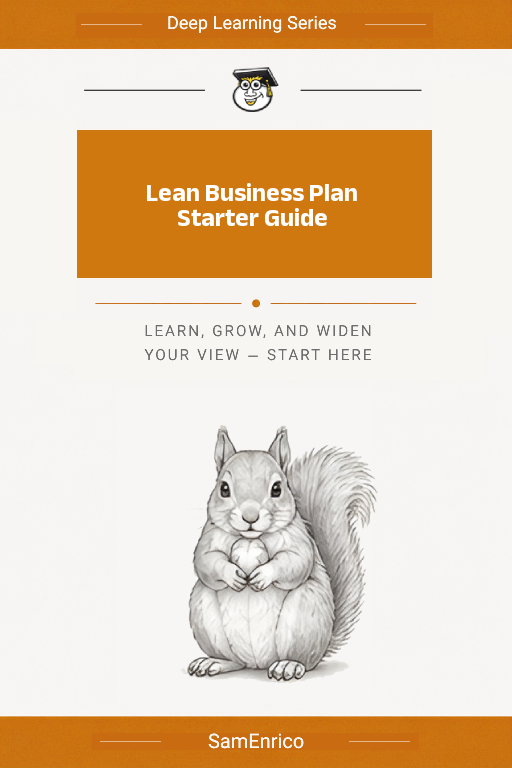
Non-FictionFirst 30 DaysLean Planning
Lean Business Plan Starter Guide eBook
Stop writing 50 page plans nobody reads. Use lean
Stop writing 50 page plans nobody reads. Use lean methodology to test assumptions and pivot quickly.
Formats
Free sample
Chapter 1: The $50,000 Mistake...--–- The entrepreneur had never built a product before. He did everything “right.” He registered an LLC, hired a lawyer, commissioned market research, and spent six months writing a 50-page business plan complete with five-year financial projections, a SWOT analysis, and a mission statement that took three days to perfect. The plan cost him $50,000 in legal fees, consulting, and his own time. It was beautiful. It was bound in leather.
It was also completely useless.Eighteen months after that first fateful check was written, he launched. The website went live at 9:00 AM. By 9:00 PM, exactly zero customers had bought anything. By the end of the first week, he had three sign-ups—two of which were his parents. The product solved a problem he had assumed existed.
The market research report had said so. The focus group had nodded along. But when real money needed to leave real wallets, nobody moved.He had fallen into the oldest trap in entrepreneurship: the Illusion of Certainty.The Illusion of Certainty The Illusion of Certainty is the belief that writing things down makes them true. It is the seductive whisper that says, “If I just research a little more, plan a little longer, and polish a little harder, I can predict the future.” You cannot. No one can.Traditional business plans were invented for a world that no longer exists.
They were designed for stable markets, predictable competitors, and customers who behaved rationally. In that world—think a new factory in 1985 or a franchise restaurant in 1990—you could reasonably forecast demand. You had historical data. You knew your competitors. You knew the regulations.
You knew the customer.Startups do not operate in that world.Startups operate in extreme uncertainty. You do not know if the customer actually has the problem. You do not know if they will pay for your solution. You do not know which features matter and which are noise. You do not know which channel will acquire customers profitably.
You do not know anything with certainty. And a 50-page plan that pretends otherwise is not strategy. It is fiction.The entrepreneur with the leather-bound plan had written 50 pages of assumptions dressed up as facts. He had projected revenue curves based on “if we capture 1% of the market”—a number pulled from nowhere. He had calculated customer acquisition costs before ever buying an ad.
He had forecasted churn rates before a single customer had signed up. Every number was a guess. Every page was a hypothesis. But because it was written down, formatted beautifully, and bound in leather, he believed it.This is the danger of the traditional business plan. It gives you the feeling of progress while delivering none of the evidence.
You can spend months “planning” and never learn a single thing about whether anyone will actually buy what you are building.The No One Reads It Reality There is a second problem with the 50-page plan, and it is even more damning than the first: nobody reads it.Venture capitalists and angel investors receive hundreds of business plans per month. The average time they spend on a single plan? Two to three minutes. They do not read your mission statement. They do not care about your 10-page market analysis.
They skip directly to two sections: the financials and the team slide. That is it. Everything else is noise.Your co-founders will not read it either. They will nod when you hand it to them, promise to review it over the weekend, and then never open the document again. Your employees will not read it.
Your advisors will not read it. The only person who reads the 50-page business plan is the person who wrote it—and even they only read it because they feel guilty about the time they spent writing it.Here is the uncomfortable truth: business plans are not decision-making tools. They are anxiety-reduction tools. You write them because you are scared. You are scared of the unknown.
You are scared of failure. So you write 50 pages of made-up numbers to convince yourself that you are in control. But you are not in control. You are just busy.The Lean Startup movement, popularized by Eric Ries in his bestselling book of the same name, emerged precisely because of this dysfunction. Ries observed that the most successful startups were not the ones with the thickest plans.
They were the ones that learned the fastest. They built something small, measured what happened, and learned whether to continue or change direction. They replaced planning with experimenting. They replaced forecasting with measuring. They replaced opinion with evidence.The Definition Shift: From Plan to Hypothesis The single most important shift you will make in this book is this: stop managing a static document and start managing a living hypothesis.A business plan is a document you write once and then defend.
It is static. It is brittle. It assumes you were right on day one and never need to change. A hypothesis, by contrast, is a statement you test. You can be wrong.
You can be partially right. You can learn and adjust. A hypothesis is alive.Here is what a traditional business plan says: “We will build X, sell it through Y channel, at Z price, and achieve $1M in revenue by month 12.” That is not a plan. That is a guess disguised as confidence.Here is what a lean hypothesis says: “We believe that [customer segment] has [problem]. We believe that [solution] will solve this problem.
We will know we are right when [metric] reaches [threshold] within [timeframe].”Notice the difference. The lean hypothesis includes a clear condition for success. It includes a metric. It includes a timeframe. It is falsifiable.
You can run an experiment and know, within days or weeks, whether you are on the right track or whether you need to change course.This is the heart of the lean methodology. You do not write a 50-page plan. You write a one-page Lean Canvas (Chapter 4) that captures your riskiest assumptions. You then design experiments (Chapter 5) to test those assumptions as quickly and cheaply as possible. You measure the results.
You learn. And then you decide: pivot or persevere?The Pivot vs. Persevere Mindset Most entrepreneurs treat a change in direction as failure. They raised money based on one plan. They hired people based on one vision.
They told their families about one idea. Changing course feels like admitting defeat. So they double down. They spend more money. They work more hours.
They add more features. They do everything except ask the one question that matters: is anyone actually buying?This is the sunk cost fallacy in action. The sunk cost fallacy is the cognitive bias that causes you to continue investing in something simply because you have already invested in it, even when the evidence says you should stop. “We have already spent six months on this feature, so we cannot abandon it now.” Yes, you can. The six months are gone.
They are not coming back. The only question that matters is: given what you know now, would you start this project today? If the answer is no, you should stop.The lean…
This is the end of the free sample. Get the eBook to keep going. Buy now
About this book
Details
- Author
- Sizemore Ellyn
- Publisher
- SamEnrico
- Language
- English
- Genre
- Non-Fiction, First 30 Days, Lean Planning
- Released
- 2026-05-30
- Pages (approx.)
- 145
- Available as
- eBook, Audiobook

Read better in the ZLOADR app
Your eBooks on your phone or tablet. Sign in with your SamEnrico account and start reading.
More by Sizemore Ellyn
 HRT For Women With Celiac Disease CourseSizemore Ellyn$11.99
 Road Rage Prevention For FamiliesSizemore Ellyn$11.99
 Gene Editing Investment GuideSizemore Ellyn$11.99
 Assertiveness for Parent Child DynamicsSizemore Ellyn$11.99
 Acupuncture for Lumbar PainSizemore Ellyn$11.99
 Love, Loss, and the Beautiful Game: The Divorce That Shook Women's FootballSizemore Ellyn$11.99
 Understanding Pes PlanusSizemore Ellyn$17.99
 How to Start a Cable Jointing Material Business (Beginners Guide)Sizemore Ellyn$11.99
 Christmas Pop Up GuideSizemore Ellyn$12.99
 Unity 3D EngineerSizemore Ellyn$11.99
You may also like
 Hong Kong Handover 1997Dunn Johnnie$11.99
 Zumba For Postnatal Recovery CourseNeal Christian$11.99
 Zumba for BeginnersLadner Nikia$11.99
 YouTube Comment Mining GuideHumes Pandora$12.99
 Worry Box MeditationCarlin Rudy$11.99
 Workplace Stress MeditationNguyen Lynn$11.99
 Workplace Stress and Sleep RepairHawley Ivory$11.99
 Workplace Perfectionism CureDelaney Jeffry$11.99
 Workplace Injustice Anger GuideWallen Isabelle$11.99
 Work Addiction and Burnout LinkGreenwood Ester$11.99
 Women in Yoga and WellnessBeattie Galina$11.99
 Women in Stand Up ComedyChun Evangeline$11.99