
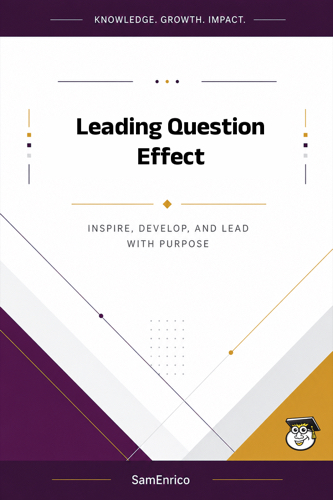
Leading Question Effect eBook
Teaches how detective wording alters witness state
Teaches how detective wording alters witness statements.
Formats
Free sample
Chapter 1: The Memory Thief...--–- The woman in the blue coat was certain. Absolutely, positively, beyond-any-doubt certain. She had watched the robbery unfold from forty-seven feet away, standing in line at the coffee shop across the street. The man had a beard. He was wearing a dark hoodie.
He had fled in a silver sedan. She gave her statement to the first officer on scene, then repeated it to the detective two hours later, then testified to it six months after that. Three different versions. Three different sets of details. And when the defense attorney played the recordings side by side in court, the woman in the blue coat burst into tears.
Not because she had lied. Because she had been telling the truth each time—and that was the problem.This is not a book about lying. It is not about deception detection, body language, or the subtle tells that give away a guilty conscience. Those books exist already, and many of them are quite good. This book is about something more disturbing: the fact that honest people, trying their hardest to be accurate, will reliably report things that never happened.
Not because they are confused, not because they are stupid, and certainly not because they are malicious. Because the questions we ask them rewrite their memories in real time.The woman in the blue coat was not an unusual case. She was the rule. Her memory had been stolen—not by time, not by trauma, not by the natural decay that afflicts all human recollection. Her memory had been stolen by the very people trying to preserve it.
The first officer asked, "Did you see the beard?" The detective asked, "How fast was the silver sedan going?" The prosecutor asked, "You were standing at the coffee shop, weren't you?" Each question was reasonable. Each question was asked in good faith. And each question planted a seed that grew into a false certainty.By the time she took the stand, the woman in the blue coat had incorporated eleven details into her testimony that never appeared in her original account. She had added a beard that might not have existed. She had upgraded "a car" to "a silver sedan." She had convinced herself she was standing at the coffee shop when her receipt placed her forty-seven feet away, at a bus stop.
The jury believed her. The defendant was convicted. Three years later, DNA evidence exonerated him. The real perpetrator had no beard, drove a black truck, and had been caught on a different security camera altogether.The woman in the blue coat attended the exoneration hearing. She apologized to the man she had helped convict.
She said she didn't understand how she could have been so wrong. No one explained it to her. No one told her that the problem wasn't her memory—it was the questions.This is the single most dangerous myth in investigative interviewing: that human memory works like a video camera. We believe that events are recorded in our brains, stored intact, and then played back when we retrieve them. We believe that forgetting is simply a matter of the recording degrading over time.
We believe that if someone remembers something vividly and confidently, it must be true.All of these beliefs are wrong. And until you unlearn them, every question you ask is a weapon pointed at the truth.The Video Camera That Never Existed Let us begin with a simple experiment. Read the following sentence: "The car raced down the highway, its engine roaring as it approached the intersection."Now, without looking back, answer this question: Did you see the word "raced" or the word "sped"?If you are like most people, you probably feel uncertain. You might think you saw "raced," but you are not entirely sure. Now try a different question: "Did you see the word 'roaring' or the word 'screaming'?"Again, uncertainty.
This is normal. Our memories are not photographs. They are rough sketches, and the act of recalling them fills in missing details with whatever seems plausible.But here is where it gets disturbing. What if I told you that the original sentence contained neither "raced" nor "sped"? That it used the word "moved"?
What if I told you that "roaring" and "screaming" were never there—that the engine simply "hummed"? Would you believe me?Many people would not. They would swear they saw "raced" or "roaring" because the questions I asked suggested those words were present. This is the misinformation effect in miniature, and it was first documented in the 1970s by a cognitive psychologist named Elizabeth Loftus.Loftus did something radical. She showed participants a film of a car accident, then asked them a simple question: "How fast were the cars going when they smashed into each other?" Other participants were asked the same question but with different verbs: "hit," "contacted," "bumped," or "collided." The verb alone changed the speed estimates by more than ten miles per hour.
People who heard "smashed" estimated an average of forty-one miles per hour. People who heard "contacted" estimated thirty-two miles per hour. The film was identical. The only difference was a single word.But Loftus did not stop there. A week later, she brought the same participants back and asked a new question: "Did you see any broken glass?" There was no broken glass in the film.
Yet people who had heard the word "smashed" were more than twice as likely to report seeing broken glass as those who had heard "contacted." The verb had not only changed their speed estimates—it had created a false memory.This is not a subtle effect. It is not something that happens only to confused or suggestible people. It happens to everyone. It happens to police officers, to judges, to psychologists who study memory for a living. It happens to you.
And it happens every time you ask a question that contains an assumption, a presupposition, or a suggestion.The Architecture of Forgetting To understand why questions have this power, we must first understand how memory actually works. The video camera model is intuitive but catastrophically wrong. Human memory is not a storage system. It is a reconstruction system.When you experience an event, your brain does not record it like a camera. Instead, it encodes fragments: a flash of color, a sound, a emotional feeling, a sequence of actions.
These fragments are stored in different parts of the brain—visual information in the occipital lobe, sounds in the temporal lobe, emotions in the amygdala, sequences in the prefrontal cortex. When you later try to remember the event, your brain gathers these fragments and weaves them together into a coherent story. Gaps are filled with inferences, expectations, and—most importantly—information you have encountered since the event occurred.This is why two people can witness the same event and remember different things. This is why eyewitness testimony is notoriously unreliable. And this is why the questions you ask matter so much.
Each question provides new information that your brain will use to fill the gaps in the next reconstruction.Consider what happens when a detective asks, "What color was the jacket?" The…
This is the end of the free sample. Get the eBook to keep going. Buy now
About this book
Details
- Author
- Archuleta Exie
- Publisher
- SamEnrico
- Language
- English
- Genre
- Non-Fiction, True Crime, Interrogation
- Released
- 2026-06-07
- Pages (approx.)
- 149
- Available as
- eBook, Audiobook

Read better in the ZLOADR app
Your eBooks on your phone or tablet. Sign in with your SamEnrico account and start reading.
More by Archuleta Exie
 Zero Based Peg System GuideArchuleta Exie$11.99
 Anger De escalation for Train StaffArchuleta Exie$11.99
 Ectopic Fertility AfterArchuleta Exie$11.99
 Social Smoking Cessation GuideArchuleta Exie$11.99
 Keto Mental Clarity FocusArchuleta Exie$11.99
 Spironolactone PCOSArchuleta Exie$11.99
 Nightmare Processing For ChildrenArchuleta Exie$11.99
 The Frost King's Gambit: Charles XII's Lost Victory at PoltavaArchuleta Exie$11.99
 The Clockwork Visionary: Jacques de Vaucanson and the Automaton RevolutionArchuleta Exie$11.99
 A Collector's Handbook to the Daihatsu CharadeArchuleta Exie$11.99
 How to Produce Speaker Bags, Covers and CasesArchuleta Exie$11.99
 How to Produce Glitter SprayArchuleta Exie$11.99
You may also like
 Sam Sheppard Interrogation TapesHedges Ofelia$11.99
 Suspect Interrogation MethodsDusty Elston$11.99
 Gacy Police Interrogation TacticsBerryman Annalee$11.99
 Police Interview with GacyEmery Amada$11.99
 Antwerp Heist Interrogation TapesOlmstead Twila$11.99
 Antwerp Diamond Police InterrogationHook Ina$11.99
 Psychopathy in Interrogation TapesHamblin Venice$11.99
 Scott Peterson Interrogation TapesEscalante Leda$11.99
 Antwerp Diamond Heist Interrogation RoomSwanson Benjamin$11.99
 The John Wayne Gacy Police Interrogation TechniquesCarrion Lulu$11.99