
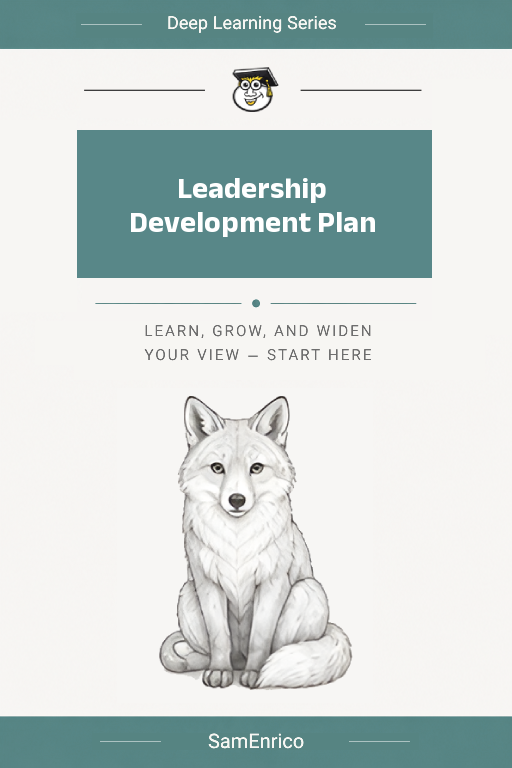
Non-FictionProfessional's Cheat SheetLeadershipManagement Skills
Leadership Development Plan eBook
Build PDP focused on leadership competencies inclu
by Manzo Adele
Build PDP focused on leadership competencies including team management and strategic thinking skills.
Formats
Free sample
Chapter 1: The Measurement Paradox--You have probably read a dozen leadership books. You have highlighted passages, dog-eared pages, and nodded along with stories about great leaders who transformed struggling teams into high-performing machines. You might even have a shelf full of these books right now, gathering dust, their lessons absorbed but never actually used. There is a word for that. It is called the knowing-doing gap, and it is the single largest predictor of leadership failure.Here is the uncomfortable truth: reading about leadership does not make you a leader.
Sitting through a training seminar does not make you a leader. Even understanding what great leaders do does not make you a leader. What makes you a leader is a plan. Not a vague intention. Not a New Year’s resolution.
A written, measured, accountable plan that turns abstract aspirations into daily behaviors.This chapter exists because most leaders treat their own development as an afterthought. They track their team’s KPIs obsessively. They monitor quarterly revenue, customer satisfaction scores, and project timelines with religious fervor. But when asked about their own growth as a leader, they offer vague platitudes: “I want to be better at strategy” or “I need to delegate more” or “I should work on my listening skills.”These are not plans. These are wishes.
And wishes do not produce results.The central argument of this chapter—and of this entire book—is brutally simple: You cannot improve what you do not measure. If you are not tracking your leadership development with the same rigor you apply to your business metrics, you are not developing. You are just hoping. And hope is not a strategy.The Accidental Leader Let me tell you about Sarah. She was a brilliant software engineer.
She wrote elegant code, solved problems that stumped her entire team, and delivered projects ahead of schedule. Her manager noticed. When the team lead position opened up, Sarah was the obvious choice. She was promoted.Within six months, Sarah was miserable. Her former peers, now direct reports, resented her.
She found herself working twelve-hour days trying to do her old job and her new job simultaneously. Her team missed deadlines for the first time in years. In her quarterly review, her new boss said something that haunts her to this day: “You’re a great engineer. But you’re not leading anyone.”Sarah is not unusual. She is the rule.Research consistently shows that forty percent of new leaders fail within the first eighteen months of promotion.
Not because they are incompetent. Not because they lack intelligence. But because they were never taught how to lead. They were promoted for technical excellence and then left to figure out people management, strategic thinking, and team dynamics on their own. This is the phenomenon this book calls accidental leadership: becoming a leader by default rather than by design.The accidental leader has no plan.
They react to problems rather than anticipating them. They manage tasks rather than developing people. They confuse busy-ness with productivity. And eventually, they burn out, quit, or get managed out.The alternative is intentional leadership: the deliberate, measured, systematic development of leadership capabilities over time. Intentional leaders do not leave their growth to chance.
They write plans. They track progress. They seek feedback. They treat leadership as a craft to be mastered, not a title to be occupied.The difference between accidental and intentional leadership is not talent. It is not charisma.
It is not even experience. It is a Leadership Development Plan—an LDP. And by the end of this chapter, you will have written the first draft of yours.The Performance Review Trap Before we build your LDP, we need to understand why most leadership development fails. The culprit is hiding in plain sight: the annual performance review.The performance review is a ritual performed by organizations around the world. Once a year, your manager sits down with you, reviews your accomplishments, notes your areas for improvement, assigns you a rating, and then ties that rating to your bonus.
On the surface, this seems reasonable. But the performance review is actually a terrible tool for development. Here is why.First, the performance review is backward-looking. It evaluates what you did last year. But leadership development is about what you will do next year.
By the time you receive your review, the year is already over. You cannot change the past. You can only change the future.Second, the performance review is judgmental. Its primary purpose is to evaluate you, not to help you grow. When you are being judged, you become defensive.
You justify your failures. You explain away your shortcomings. This is the opposite of the openness required for genuine development.Third, the performance review is annual. Leadership skills do not improve on an annual cadence. They improve daily, weekly, monthly.
A once-a-year conversation cannot possibly provide the feedback loop necessary for behavior change. Imagine trying to learn a language by receiving feedback once a year. It is absurd.Fourth, the performance review is owned by HR. It is a compliance document, not a development tool. Most leaders fill out their self-assessments fifteen minutes before the deadline, motivated by the desire to get it off their plate rather than by genuine curiosity about their growth.The performance review is not your fault.
It is a structural feature of how organizations manage talent. But it is also a trap. If you wait for your annual review to think about your development, you will never develop.The LDP is the opposite of the performance review in every way. It is forward-looking: it asks where you want to go, not where you have been. It is supportive: it is a tool you create for yourself, not a judgment imposed by others.
It is continuous: it lives with you every day, not once a year. And it is owned by you: it is your plan, not HR’s.If the performance review is a rearview mirror, the LDP is a GPS. One shows you where you have been. The other guides you where you want to go.The L-OS Framework: Your Leadership Operating System Now we get to the mechanics. The LDP in this book is built on a proprietary framework called the L-OS Model (Leadership Operating System).
Think of it as the code that runs your leadership behaviors. If you want to change your outputs, you must change your code.The L-OS Model has four components, arranged in a specific sequence. You cannot skip steps. You cannot reorder them. Each component builds on the one before it.Component One: Goal Every development plan starts with a goal.
Not a vague aspiration like “be a better leader,” but a specific, measurable, time-bound goal. Examples: “Increase the percentage of my direct reports who say they receive regular coaching from 40% to 80% within 90 days.” Or: “Reduce the time I spend on operational tasks from 20 hours per week to 10 hours per week within 60 days.”The goal answers the question: What specific outcome do I want?Component Two: Attitude Shift Here is where most leadership books get it wrong. They focus exclusively on behavior. “Do these five things,”…
This is the end of the free sample. Get the eBook to keep going. Buy now
About this book
Details
- Author
- Manzo Adele
- Publisher
- SamEnrico
- Language
- English
- Genre
- Non-Fiction, Professional's Cheat Sheet, Leadership, Management Skills
- Released
- 2026-05-30
- Pages (approx.)
- 148
- Available as
- eBook, Audiobook

Read better in the ZLOADR app
Your eBooks on your phone or tablet. Sign in with your SamEnrico account and start reading.
More by Manzo Adele
 TM Book Reading GuideManzo Adele$11.99
 Spanish Green Tax Credits GuideManzo Adele$11.99
 The Newborn Sleep HandbookManzo Adele$11.99
 Men's PCSK9 Inhibitor GuideManzo Adele$11.99
 Innocence Project Georgia CasesManzo Adele$11.99
 The Silent General: How Bill Belichick’s Obsession with Details Built a DynastyManzo Adele$11.99
 The Fall of the Golden Arm: How Lance Armstrong's Empire CrumbledManzo Adele$11.99
 Job Offer LMIA for GraduatesManzo Adele$12.99
 Windshield Chip RepairManzo Adele$11.99
 Understanding Chromosome 16, Trisomy 16qManzo Adele$17.99
 How to Become a Calender-operator HelperManzo Adele$11.99
You may also like
 Hong Kong Handover 1997Dunn Johnnie$11.99
 Zumba For Postnatal Recovery CourseNeal Christian$11.99
 Zumba for BeginnersLadner Nikia$11.99
 YouTube Comment Mining GuideHumes Pandora$12.99
 Worry Box MeditationCarlin Rudy$11.99
 Workplace Stress MeditationNguyen Lynn$11.99
 Workplace Stress and Sleep RepairHawley Ivory$11.99
 Workplace Perfectionism CureDelaney Jeffry$11.99
 Workplace Injustice Anger GuideWallen Isabelle$11.99
 Work Addiction and Burnout LinkGreenwood Ester$11.99
 Women in Yoga and WellnessBeattie Galina$11.99
 Women in Stand Up ComedyChun Evangeline$11.99