
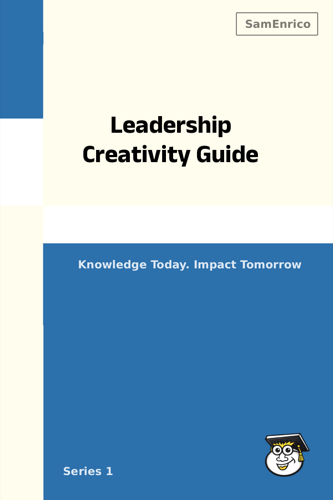
Non-FictionSelf-HelpLeadership
Leadership Creativity Guide eBook
Foster innovative culture and inspire creative tea
Foster innovative culture and inspire creative teams as a manager.
Formats
Free sample
Chapter 1: The Decency Dividend...--–- It was 10:47 on a Tuesday morning when I killed my team’s best idea. I didn’t know it at the time. I thought I was being efficient. A junior designer named Maya had stayed up all night prototyping a radical new feature for our flagship product. Her hands trembled slightly as she clicked through the mockup.
The room was silent. Then she finished, and I opened my mouth.“That’s not how we do things here,” I said.The silence that followed was different from the silence before. This one had weight. Maya nodded, closed her laptop, and didn’t speak again for the rest of the meeting. She transferred to another department three months later.
Eight months after that, a competitor launched the exact feature Maya had prototyped. They called it “a breakthrough in user experience.” Their stock jumped 14 percent in a week.I tell you this story not because I am proud of it, but because it taught me something I have never forgotten: creativity does not die from a lack of ideas. It dies from a lack of safety. And the person holding the match is almost always the manager.This book is called The Leadership Creativity Guide because the subtitle—How Managers Build the Cultures and Rituals That Unleash Collective Genius—promises a specific thing: not abstract theories about innovation, but concrete, repeatable, manager-sized actions that turn quiet teams into bold ones. This first chapter is the foundation upon which everything else rests.
If you read only one chapter, make it this one. If you implement only one practice from this entire book, make it the one you are about to learn.Because here is the truth that the bestsellers don’t always say out loud: most managers are unintentional idea killers. We don’t mean to be. We are under pressure to ship, to hit numbers, to avoid embarrassment. So we say things like “That’s interesting, but…” and “Have we considered the budget?” and “Let’s put a pin in that.” Each phrase is a small, polite murder.
And after enough of them, the team stops bringing ideas altogether. They learn that safety is an illusion. They learn to keep their mouths shut and their heads down. And you, the manager, are left wondering why your “innovation initiative” produced nothing but crickets.There is another way. It is not softer.
It is harder, actually, because it requires you to change your own behavior before you demand change from anyone else. But it works. And it begins with a single, measurable, daily practice: the Decency Audit.The Myth of the Creative Genius Before we build the new thing, we have to tear down the old story. The old story says that creativity belongs to a select few—the visionaries, the geniuses, the lone inventors who toil in garages until they emerge with a billion-dollar idea. Steve Jobs in his turtleneck.
Einstein with his hair. The lone wolf who needs no one and answers to nothing.This story is seductive because it absolves managers of responsibility. If creativity is a magical trait that you either have or you don’t, then my job as a manager is simply to find the geniuses and get out of their way. But the research tells a different story. Teresa Amabile, a professor at Harvard Business School, spent decades studying what actually drives everyday creativity in organizations.
Her conclusion, published in The Progress Principle, is almost heretical in its simplicity: people are most creative when they feel safe, supported, and reasonably treated. Not when they are pressured. Not when they are scared. Not when they are competing for survival. When they feel safe.This is not just academic.
Google spent years and millions of dollars on Project Aristotle, an ambitious study to identify what made their most effective teams successful. They looked at everything: who went to school together, how often they socialized outside work, whether they were introverts or extroverts. The single most predictive factor, the one that towered above all others, was psychological safety. Teams where members felt safe to take risks, to admit mistakes, to ask naive questions, to disagree with the boss—those teams generated more innovative ideas, caught more errors before launch, and retained top talent at dramatically higher rates.Let me say that again because it is the entire thesis of this book: the single most predictive factor of team innovation is not IQ, not experience, not resources. It is psychological safety.So why don’t more managers prioritize it?
Because psychological safety feels soft. It feels like “everyone gets a trophy” and “no one can be criticized.” That is a misunderstanding. Psychological safety is not the absence of accountability. It is the presence of a specific kind of accountability—the kind where you can be honest without being destroyed. The kind where Maya could have shown her radical prototype and I could have said, “I see problems with this, but I am so glad you brought it,” rather than shutting her down entirely.What Psychological Safety Actually Is (And Is Not)Because this term appears in every chapter of this book, we need to be precise about what it means.
I will use Amy Edmondson’s operational definition throughout: Psychological safety is the belief that the team is safe for interpersonal risk-taking.Let me unpack that.“The belief” matters. Psychological safety is not an objective state; it is a shared perception. You can believe your team is safe even if your manager is occasionally harsh, as long as you believe the harshness is directed at the work and not at you. Conversely, you can believe your team is unsafe even if no one has ever yelled at you, because you have watched a colleague be humiliated for a mistake.“The team is safe” means the unit, not just individual relationships. You might feel safe with your direct manager but unsafe with the broader leadership team.
When we talk about psychological safety in this book, we are talking about the immediate team—the people you work with every day.“For interpersonal risk-taking” is the crucial phrase. An interpersonal risk is any action that could make you look ignorant, incompetent, negative, or disruptive. Asking a question about something everyone else seems to understand. Admitting you made a mistake. Disagreeing with a senior colleague.
Proposing an idea that might fail. These are all interpersonal risks because they expose you to potential judgment, embarrassment, or retaliation.Here is what psychological safety is not:It is not comfort. A psychologically safe team can have difficult, uncomfortable conversations.It is not low standards. Psychological safety is orthogonal to accountability; you can have high standards and high safety simultaneously.It is not agreement. Safety means you can disagree without fear, not that everyone must agree.It is not therapy.
Your manager is not responsible for your emotional well-being, but they are responsible for the conditions under which you work.Here is what psychological safety is:The absence of humiliation. No one is publicly shamed for a mistake or an unpopular opinion.The presence of curiosity. Questions are welcomed, not punished.The norm of vulnerability. Leaders admit what…
This is the end of the free sample. Get the eBook to keep going. Buy now
About this book
Details
- Author
- Lankford Devona
- Publisher
- SamEnrico
- Language
- English
- Genre
- Non-Fiction, Self-Help, Leadership
- Released
- 2026-06-07
- Pages (approx.)
- 131
- Available as
- eBook, Audiobook

Read better in the ZLOADR app
Your eBooks on your phone or tablet. Sign in with your SamEnrico account and start reading.
More by Lankford Devona
 Parenting After Fertility TreatmentLankford Devona$11.99
 Body Language For Actors CourseLankford Devona$11.99
 OCD School Accommodation GuideLankford Devona$11.99
 Survey Cultural Adaptation Using AILankford Devona$11.99
 The Silent Harvest: How a Killer Fungus Nearly Wiped Out the WorldLankford Devona$11.99
 Whispers of the Vanishing Ones: The Last Speakers of the YaghanLankford Devona$11.99
 Understanding Camurati–engelmann DiseaseLankford Devona$17.99
 How to Start a Fancy Hosiery Business (Beginners Guide)Lankford Devona$11.99
 Lithuanian Master Degree GuideLankford Devona$12.99
 Working Papers as Publication ProxyLankford Devona$12.99
 Cryptography LawLankford Devona$11.99
You may also like
 Hong Kong Handover 1997Dunn Johnnie$11.99
 Zumba For Postnatal Recovery CourseNeal Christian$11.99
 Zumba for BeginnersLadner Nikia$11.99
 YouTube Comment Mining GuideHumes Pandora$12.99
 Worry Box MeditationCarlin Rudy$11.99
 Workplace Stress MeditationNguyen Lynn$11.99
 Workplace Stress and Sleep RepairHawley Ivory$11.99
 Workplace Perfectionism CureDelaney Jeffry$11.99
 Workplace Injustice Anger GuideWallen Isabelle$11.99
 Work Addiction and Burnout LinkGreenwood Ester$11.99
 Women in Yoga and WellnessBeattie Galina$11.99
 Women in Stand Up ComedyChun Evangeline$11.99