
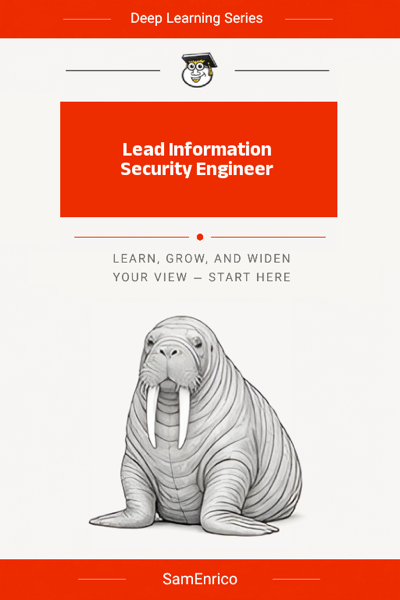
Lead Information Security Engineer eBook
A Coursebook on Lead Information Security Engineer
A Coursebook on Lead Information Security Engineer
Formats
Free sample
Chapter 1: The Architect of Trust...--The first time I realized I wasn't a senior engineer anymore happened at 2:47 AM on a Tuesday, standing in a cold server room that smelled like burned capacitors and regret.I was six months into my first Lead Information Security Engineer role at a mid-sized fintech company. The senior engineer on call had paged me—not because he couldn't solve the problem, but because he was afraid to make the decision. A database had been leaking customer PII for forty-seven minutes. The fix was simple: cut network access to the affected cluster. The consequence was terrifying: three microservices would go offline, including the payment gateway.The senior engineer understood the technical fix. What he didn't understand was the risk calculation—which business impact was worse, the leak or the outage? That was my job now. Not knowing more than him. Not being smarter than him. Being willing to make the call when the answer wasn't in any runbook.That night changed how I thought about my role. I wasn't just the person who knew the most about security. I had become something else entirely: the Architect of Trust. The person responsible for deciding what the organization could trust—which systems, which people, which automated processes—and what it couldn't.This chapter is about making that shift. It's not a promotion story. It's a transformation story. And if you're reading this book, you're either in the middle of that transformation or about to begin it.What This Chapter Will Do For You By the end of this chapter, you will:Understand exactly how a Lead Engineer differs from both a Senior Engineer and an Engineering Manager Complete a self-assessment of your current team's technical debt and security maturity Identify your personal readiness gaps for leading without authority Build a 30-60-90 day transition roadmap tailored to your specific context Learn the five tactics of influence that don't require a title change Let's start with the mistake almost every new Lead Engineer makes.The Identity Trap: Why Titles Don't Transform You I've watched dozens of engineers get promoted to Lead and immediately fail. Not because they lacked technical skill—they were brilliant. Not because they didn't work hard—they worked harder than anyone. They failed because they believed the title would do the work for them.Here's the truth that no promotion letter will tell you: The title "Lead" gives you responsibility without authority. Your manager has authority (budgets, hiring, firing, promotions). Your Senior Engineers have authority over their specific components (they can rewrite a service, deprecate an API, choose a framework). You have responsibility for the security posture of entire systems, but you cannot force anyone to do anything.This is the Identity Trap. It feels like you've been given a sword, but what you've actually been given is a shield—and you're expected to protect everyone while they ignore your instructions.The Three-Way Distinction That Will Save Your Career Early in my transition, I created a mental model that saved me from the Identity Trap. It's simple but profound:Role Primary Focus Source of Authority Success Metric Senior Engineer Component/service depth Technical expertise Uptime, performance, security of owned service Lead Engineer Cross-system trust boundaries Influence, consensus, data Security posture without direct control Engineering Manager People development, process Organizational hierarchy Team health, delivery velocity, retention Notice what the Lead Engineer lacks: organizational hierarchy. You can't fire anyone. You can't give raises. You can't reassign people to different teams. You have the same formal authority as the junior engineer who started last month.But you have something else: scope.The Senior Engineer thinks about a single service. The Lead Engineer thinks about trust boundaries between services, data flows across the entire system, and enterprise risk that no single component owner can see.That database leak at 2:47 AM? The Senior Engineer knew how to stop the leak. The Lead Engineer knew whether stopping the leak was worth breaking payments. Different scope. Different responsibility. Different identity.The Architect of Trust Defined Here's how I want you to think about your role from this moment forward: You are the Architect of Trust.Every system makes trust assumptions. The auth service trusts the identity provider. The payment service trusts the auth service's tokens. The database trusts that the application server is who it claims to be. The CEO trusts that the security team will catch breaches before they become headlines.Your job is to design, validate, and continuously reassess these trust assumptions. When they're correct, the organization runs smoothly and securely. When they're wrong—when trust is misplaced—breaches happen.This is a architectural role. Not a managerial one. Not a purely technical one. Architectural. You're designing the invisible structure of relationships between systems, teams, and data. That structure is what I call the web of trust, and you are its chief engineer.The Scope Shift: From Components to Boundaries One of the hardest adjustments new Lead Engineers face is learning to see boundaries instead of components.Before (Senior Engineer mindset): "The authentication service needs to validate JWTs with a 5-minute expiration and rotate signing keys weekly."After (Lead Engineer mindset): "The trust boundary between our auth service and the payment service relies on shared secrets stored in two different vaults with different rotation schedules. This creates a window of vulnerability between rotations that attackers could exploit."Do you see the difference? The Senior Engineer thinks about making a service secure in isolation. The Lead Engineer thinks about the gaps between services where trust is transferred.Exercise: Map Your Trust Boundaries Take out a piece of paper (or open a blank document). Draw your organization's primary systems as circles. Now draw arrows between them representing trust relationships—Service A trusts Service B to correctly authenticate users. Service B trusts Service C to not expose API keys.Where are the arrows? Those are your responsibility. Not the circles. The arrows.Most Senior Engineers become experts in one or two circles. Lead Engineers own the arrows.Why This Shift Is So Uncomfortable Here's what no one tells you about owning the arrows: You can't control both ends of most arrows.You might be responsible for the trust relationship between the payments team's service and the customer data team's service. But you don't manage either team. You don't control their code review standards. You don't decide their release schedules. You can't see their internal Slack channels.This is why the Architect of Trust role feels impossible at first. You're responsible for something you cannot directly control.The solution is not to gain control. The solution is to learn influence without authority.Influence Without Authority: The Five Core Tactics After interviewing over fifty successful Lead Engineers, I've distilled their influence strategies into five repeatable tactics. You will use these daily.Tactic 1: The Data Advantage Senior Engineers win arguments with intuition. "I think this is risky." Lead Engineers win arguments with data. "Over the last six months, we've seen four incidents related to this pattern, each averaging three hours of remediation time at $12,000 per hour. The fix costs two developer days. The math is clear."Data transforms you from an opinion-haver to a truth-teller. You're not asking for compliance; you're pointing at reality. This works because no one can argue with a well-measured fact—and if they try, you've exposed a deeper problem.How to build your data advantage:Instrument everything (logging, metrics, tracing)Create weekly reports on security…
This is the end of the free sample. Get the eBook to keep going. Buy now
About this book
Details
- Author
- Mackie Latosha
- Publisher
- SamEnrico
- Language
- English
- Genre
- Non-Fiction, Informative, Educational
- Released
- 2026-05-11
- Pages (approx.)
- 160
- Available as
- eBook, Audiobook

Read better in the ZLOADR app
Your eBooks on your phone or tablet. Sign in with your SamEnrico account and start reading.
More by Mackie Latosha
 Dismissive Partner ConfidenceMackie Latosha$11.99
 Emotional Regulation For Chronic PainMackie Latosha$11.99
 Egyptian Construction MagnateMackie Latosha$11.99
 Infidelity and Sex AddictionMackie Latosha$11.99
 The Tokyo Strangler: Japan's Silent Serial KillerMackie Latosha$11.99
 How to Become a Steamer TenderMackie Latosha$11.99
 Asana Workflow TemplatesMackie Latosha$12.99
 Learn to Play the Guitarrón (Mexicano)Mackie Latosha$11.99