
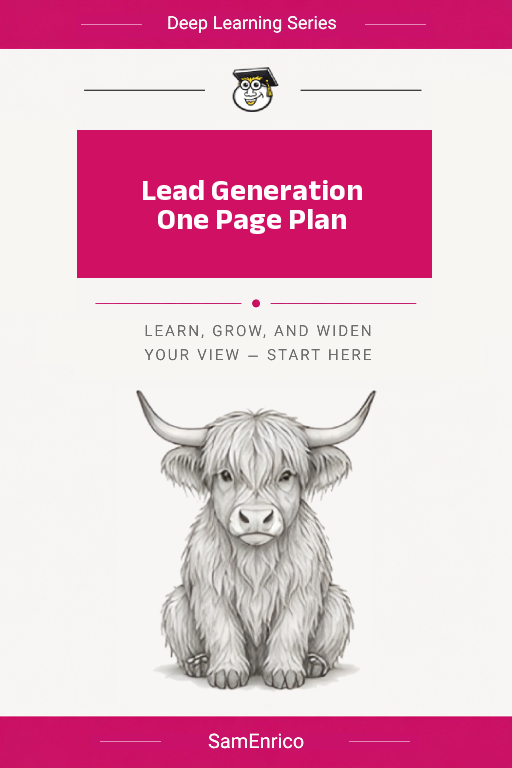
Non-FictionBusiness BriefMarketing Strategy
Lead Generation One Page Plan eBook
Summarize lead generation strategy on one page. Le
Summarize lead generation strategy on one page. Lead magnets, landing pages, and follow up sequences.
Formats
Free sample
Chapter 1: The Slot Machine Lie--–- Most business owners are gambling addicts. They just don’t know it yet.Pull the lever. Post on Linked In. Pull the lever again. Run a Facebook ad.
Pull the lever. Send a newsletter. Pull the lever. Change the website color. Pull the lever.
Wait. Hope. Lose. Repeat.That is not marketing. That is a slot machine habit.And like any gambling addiction, it feels productive while quietly draining you dry.The author of this book knows because he lived it.
For three years, he woke up every morning, checked his analytics dashboard like a prayer candle, and celebrated meaningless victories. Five thousand new Instagram followers. A tweet that got 200 retweets. A blog post that 1,000 people supposedly read. He felt like a marketer.
He looked like a marketer. He was going broke like an amateur.The turning point came on a Tuesday afternoon. He had just finished a call with a “growth consultant” who charged him $4,700 for a 47-page report full of jargon: attribution modeling, multi-touch funnels, omnichannel synergy. The report’s final recommendation? “Consider diversifying your traffic sources and implementing a more robust lead scoring algorithm.”Translation: We have no idea what’s wrong, but we need to sound smart.That night, he sat on his living room floor with a single piece of paper and a black marker.
He drew three horizontal lines. He wrote three words in each section: BEFORE. DURING. AFTER. And then he asked himself the simplest question he had never asked: What actually has to happen for a stranger to become a customer?That question changed everything.This book is the answer to that question, refined over five years and tested on more than 200 businesses.
It is not another collection of tactics. It is not a swipe file of “50 ways to get more leads.” It is a framework. A skeleton. A single page that forces you to see the truth your analytics dashboard hides: your marketing is probably broken in one of exactly three places, and you have been trying to fix the wrong one.This chapter reveals the three-phase funnel that replaces gambling with predictability. You will learn why most businesses are trying to fix their “During” when their “Before” is bleeding out.
You will diagnose exactly where your own funnel is leaking. And you will never look at a marketing dashboard the same way again.Let us begin with the lie that keeps you pulling the lever.The Slot Machine Fallacy Walk onto the floor of any casino. What do you hear? The chime of coins. The whir of spinning reels.
The occasional scream of a jackpot winner. Now walk into the office of any small business owner. What do you hear? The click of a mouse refreshing analytics. The sigh of another campaign that “didn’t quite take off.” The whisper of “maybe next time.”Same sound.
Same result. Different building.The slot machine fallacy is the belief that marketing is a probabilistic game of luck rather than a deterministic system of cause and effect. Pull the lever enough times, and eventually you will hit. Post enough times, and eventually something will go viral. Run enough ads, and eventually one will convert.
This fallacy persists because it feels true. After all, every successful business has a story about the one post that exploded or the one ad that changed everything.But stories are not strategies. Survivorship bias is not a business plan.Here is what the data actually shows. According to a study of 2,500 businesses by the marketing analytics firm Databox, companies that use a structured, documented funnel are 463 percent more likely to report successful lead generation than those that “try things and see what sticks.” Four hundred sixty-three percent. That is not a slight advantage.
That is the difference between drowning and swimming.The slot machine fallacy survives because it is comfortable. It requires no hard decisions. No saying no. No committing to a single path. You can post on Instagram, Tik Tok, Linked In, Facebook, and Twitter simultaneously and feel busy.
You can run Google Ads, Facebook Ads, Linked In Ads, and retargeting simultaneously and feel strategic. You can write blog posts, record podcasts, film You Tube videos, and send newsletters simultaneously and feel productive.But busy is not effective. Strategic is not correct. Productive is not profitable.The author learned this the expensive way. In year two of his business, he was running seven “marketing experiments” simultaneously.
He had a Facebook group, a weekly newsletter, a podcast, a You Tube channel, a blog, an Instagram account, and a Linked In presence. He was exhausted. He was proud. He was making less money than his teenage daughter earned babysitting.The problem was not effort. The problem was focus without a framework.The Three-Phase Funnel: Before, During, After Every marketing effort, regardless of industry, channel, or budget, follows the same invisible architecture.
Strangers become aware. Aware becomes interested. Interested becomes leads. Leads become customers. Customers become promoters.
That is not theory. That is physics.But most business owners collapse these distinct phases into a single blur. They treat “getting attention” the same as “capturing leads” the same as “making sales.” They measure “engagement” as if a like on Instagram is even remotely equivalent to an email address. They celebrate traffic as if visitors who bounce in two seconds are somehow valuable.The three-phase funnel forces separation. It forces clarity.
It forces you to admit where you are actually failing.Phase 1: BEFORE (Attraction)This is where strangers become aware of your existence. Nothing more. Nothing less. In this phase, someone who has never heard of you sees your headline, scrolls past your post, clicks your ad, or hears your name in conversation. They are not a lead.
They are not a prospect. They are a ghost passing through your digital neighborhood.The goal of the BEFORE phase is singular: get the right stranger to take the next step. That step is usually a click. Click to read the article. Click to watch the video.
Click to visit the landing page. Click to learn more. The BEFORE phase is not about conversion. It is about attention with direction.Most businesses fail in BEFORE because they optimize for the wrong metrics. They celebrate reach when they should measure relevance.
They celebrate impressions when they should measure click-through rate. They celebrate followers when they should measure the cost to acquire a click.Phase 2: DURING (Capture and Nurture)This is where interested strangers become identifiable leads. In the capture sub-phase, someone gives you permission to follow up, typically by providing an email address in exchange for a lead magnet. In the nurture sub-phase, you deliver value over time through an automated sequence that builds trust and demonstrates expertise.The goal of the DURING phase is twofold: capture the contact information of someone who has raised their hand, then nurture that person until they are ready to hear a sales proposition.Most businesses fail in DURING because they rush. They capture the email address and immediately pitch.
Or they capture the email address and never follow up at all. Or they follow up with generic, salesy nonsense that insults the…
This is the end of the free sample. Get the eBook to keep going. Buy now
About this book
Details
- Author
- Demarco Ashlee
- Publisher
- SamEnrico
- Language
- English
- Genre
- Non-Fiction, Business Brief, Marketing Strategy
- Released
- 2026-05-30
- Pages (approx.)
- 134
- Available as
- eBook, Audiobook

Read better in the ZLOADR app
Your eBooks on your phone or tablet. Sign in with your SamEnrico account and start reading.
More by Demarco Ashlee
 Senior Gamer Spending PatternsDemarco Ashlee$11.99
 Party Conversation StartersDemarco Ashlee$11.99
 Non Organic Food Toxin GuideDemarco Ashlee$11.99
 Body Scan For Dental AnxietyDemarco Ashlee$11.99
 The Boundary Setting ConversationDemarco Ashlee$11.99
 The Alchemist and the Elephant: A Journey Through Ancient African ScienceDemarco Ashlee$11.99
 How to Become a Oil PumperDemarco Ashlee$11.99
 Apple Recruiting GuideDemarco Ashlee$12.99
 Equity TraderDemarco Ashlee$11.99
 Understanding Pterygia Mental Retardation Facial DysmorphismDemarco Ashlee$17.99
You may also like
 Hong Kong Handover 1997Dunn Johnnie$11.99
 Zumba For Postnatal Recovery CourseNeal Christian$11.99
 Zumba for BeginnersLadner Nikia$11.99
 YouTube Comment Mining GuideHumes Pandora$12.99
 Worry Box MeditationCarlin Rudy$11.99
 Workplace Stress MeditationNguyen Lynn$11.99
 Workplace Stress and Sleep RepairHawley Ivory$11.99
 Workplace Perfectionism CureDelaney Jeffry$11.99
 Workplace Injustice Anger GuideWallen Isabelle$11.99
 Work Addiction and Burnout LinkGreenwood Ester$11.99
 Women in Yoga and WellnessBeattie Galina$11.99
 Women in Stand Up ComedyChun Evangeline$11.99