
Non-FictionInformativeEducational
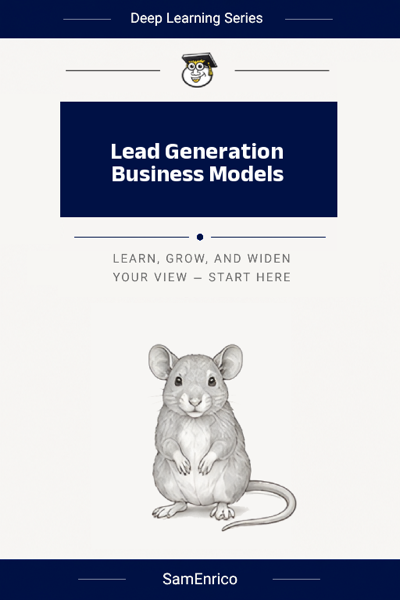
Lead Generation Business Models eBook
A Coursebook on Lead Generation Business Models
A Coursebook on Lead Generation Business Models
Formats
Free sample
Chapter 1: The Pipeline Lie...--Most entrepreneurs and sales leaders believe a seductive falsehood. They believe that lead generation is a game of volume—that if they just make more calls, send more emails, or run more ads, the pipeline will fill itself. They believe that somewhere out there, a magical technique or a forgotten script holds the key to unlimited prospects. They believe that their problem is one of effort, not architecture.This belief is wrong. And it is expensive.The truth is that most lead generation fails not because people aren't working hard enough, but because they are working within a broken system.
They are running harder and harder on a treadmill that was never designed to go anywhere. They are treating lead generation as a collection of random tactics—a cold call here, a Linked In message there, a referral request when they remember—rather than as an engineered process with predictable inputs and measurable outputs.This chapter dismantles the Pipeline Lie. It introduces the fundamental shift from activity-based randomness to architecture-based predictability. By the time you finish reading, you will understand why specialization beats generalization, why defining your Ideal Customer Profile is not a marketing exercise but an operational necessity, and why the difference between a "lead" and a "contact" determines whether you scale or stagnate.Let me tell you a story.In 2016, I walked into the headquarters of a mid-sized B2B Saa S company outside Chicago. They had forty-seven salespeople, a six-figure monthly marketing budget, and a CEO who was losing sleep.
Their problem was not a lack of effort. Their SDRs were making an average of sixty calls per day. Their marketing team was publishing two blog posts per week, running Linked In ads, and attending three trade shows per quarter. Their sales closers were working nights and weekends.Their pipeline was empty. Not completely empty—they had leads.
They had hundreds of names in their CRM. But month after month, they were missing quota by thirty to forty percent. The CEO showed me their numbers: two million dollars in target annual recurring revenue, but only 1.2 million closed in the past twelve months.I asked him a simple question: "What is your definition of a lead?"He paused. Then he said, "Anyone who gives us their email address."This is the Pipeline Lie in action. This CEO believed that if he could just get more email addresses—more volume, more activity, more noise—the revenue would follow.
He had confused activity with progress, volume with quality, and tactics with a system.Over the next ninety days, we rebuilt everything. We stopped hiring more SDRs. We stopped running more ads. Instead, we defined a single operational definition of a "lead." We broke their sales roles into specialized functions. We documented an Ideal Customer Profile that eliminated sixty percent of their existing "leads" from consideration.
And we built a reverse funnel that told them exactly how many prospects needed to enter the top to hit their revenue goal.Twelve months later, that same company had reduced their sales headcount from forty-seven to twenty-two. Their revenue had grown from 1.2 million to 3.1 million. Their SDRs were making fewer calls—not more—but their conversion rates had tripled.What changed? Not effort. Architecture.The Difference Between a Tactic and a Business Model Before we go any further, we need to establish a distinction that will run through every chapter of this book.
It is the distinction between a lead generation tactic and a lead generation business model.A tactic is a discrete action. Sending a hundred cold emails is a tactic. Running a Facebook ad is a tactic. Asking a customer for a referral is a tactic. Tactics are not bad—they are necessary.
But tactics alone do not constitute a system.A business model, by contrast, is a repeatable, scalable, and measurable process that connects inputs to outputs. A lead generation business model answers five questions:Who exactly are we targeting? (ICP)What roles will perform which activities? (Specialization)How do we measure success at each stage? (Metrics)What technology supports the workflow?
(Tech stack)How do we improve the system over time? (Feedback loops)Most organizations invest heavily in tactics and almost nothing in the business model that connects them. They buy a new CRM and call it a strategy. They hire an SDR and call it growth. They run a webinar and call it pipeline generation.This is backwards.The tactical layer—the scripts, the sequences, the tools—matters only insofar as it operates within a well-designed business model.
A brilliant script executed in a broken system still fails. A mediocre script executed in a well-designed system can be measured, improved, and eventually optimized.Think of it this way: a tactic is a single chess move. A business model is the entire chessboard, the rules of the game, and the strategy that guides each move. You can have the most powerful queen on the board, but if you have no strategy, you will lose to someone who understands the game.The companies that scale lead generation predictably are not the ones with the cleverest cold emails or the most aggressive SDRs. They are the ones that have built a business model that turns random activity into routine output.
They have engineered predictability.The Critical Definition: What Is a Lead?One of the most destructive inconsistencies in sales and marketing is the casual use of the word "lead." I have seen CRMs where a "lead" could mean anything from a person who attended a webinar to someone who answered a cold call with "not interested" to a customer who asked for a contract renewal.This ambiguity destroys pipeline accuracy, misallocates resources, and creates endless conflict between sales and marketing. And it is completely avoidable.For the remainder of this book, we will use a single, operational definition:A "Lead" is a contact who has been both (a) matched to the Ideal Customer Profile (ICP) and (b) positively qualified via the BANT framework (Budget, Authority, Need, Time).Let me break this down.Part (a): Matched to ICP. This means the contact belongs to a company and occupies a role that fits your documented ideal customer profile. ICP is not a vague persona like "marketing director at a tech company." It is a specific set of firmographic (industry, company size, revenue), technographic (existing tools, stack compatibility), and behavioral (recent triggers, buying intent) attributes. We will build your ICP later in this chapter.Part (b): Positively qualified via BANT.
This means a live conversation has confirmed that the contact has Budget (or access to it), Authority to make or influence the decision, a clear Need that your solution addresses, and a Timeframe that is within your sales cycle.Everything that does not meet both criteria is not a Lead. It is a Prospect or a Contact. Prospects are not worthless—they are future opportunities that require further nurturing or qualification. But calling a prospect a lead creates false confidence and distorts your metrics.Consider the difference in practice. A typical marketing-qualified lead (MQL) might be someone who downloaded an e Book from your website.
That person has shown interest, but you do not yet know if they have budget, authority, a real need, or…
This is the end of the free sample. Get the eBook to keep going. Buy now
About this book
Details
- Author
- Escalante Tatum
- Publisher
- SamEnrico
- Language
- English
- Genre
- Non-Fiction, Informative, Educational
- Released
- 2026-05-09
- Pages (approx.)
- 141
- Available as
- eBook, Audiobook

Read better in the ZLOADR app
Your eBooks on your phone or tablet. Sign in with your SamEnrico account and start reading.
More by Escalante Tatum
 Resume Latin America GuideEscalante Tatum$11.99
 Cocaine Recovery Yoga GuideEscalante Tatum$11.99
 Aurora Borealis NightEscalante Tatum$11.99
 Forgiveness After Addiction HarmEscalante Tatum$11.99
 Benzo Withdrawal Insomnia Solutions CourseEscalante Tatum$11.99
 Chunking for ProgrammingEscalante Tatum$11.99
 CRE Construction Loan GuideEscalante Tatum$11.99
 Sergey Brin FlyingEscalante Tatum$11.99
 Woman in Special ForcesEscalante Tatum$11.99
 The Troll King's Last BargainEscalante Tatum$11.99
 The Silk Road Gambit: How an Ancient Trader Built the World's First Casino EmpireEscalante Tatum$11.99
 The Green Book of Wealth: How Black America’s Secret Financial Networks Built EmpiresEscalante Tatum$11.99
You may also like
 Hong Kong Handover 1997Dunn Johnnie$11.99
 Zumba For Postnatal Recovery CourseNeal Christian$11.99
 Zumba for BeginnersLadner Nikia$11.99
 YouTube Comment Mining GuideHumes Pandora$12.99
 Worry Box MeditationCarlin Rudy$11.99
 Workplace Stress MeditationNguyen Lynn$11.99
 Workplace Stress and Sleep RepairHawley Ivory$11.99
 Workplace Perfectionism CureDelaney Jeffry$11.99
 Workplace Injustice Anger GuideWallen Isabelle$11.99
 Work Addiction and Burnout LinkGreenwood Ester$11.99
 Women in Yoga and WellnessBeattie Galina$11.99
 Women in Stand Up ComedyChun Evangeline$11.99