
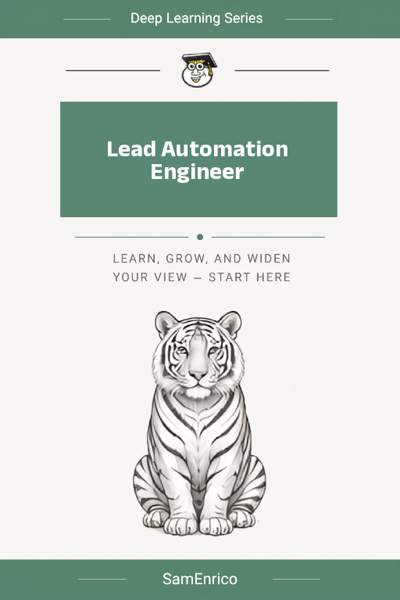
Non-FictionInformativeEducational
Lead Automation Engineer eBook
A Coursebook on Lead Automation Engineer
by Wilhelm Ilda
A Coursebook on Lead Automation Engineer
Formats
Free sample
Chapter 1: The Broken Promotion--–- Maria had been a Senior Automation Engineer for four years. She wrote beautiful tests—resilient, well-architected, fast. Her Page Object Models were the envy of the QA organization. She could debug a flaky test in fifteen minutes flat. When the Lead Automation Engineer left for a startup, Maria was the obvious choice to replace him.Three months later, she was drowning.Her test suite had grown from 400 to 1,200 scripts.
The CI pipeline took forty-seven minutes to run. Developers had stopped running tests locally because the suite was too slow. Product managers were angry about delayed releases. Her team of five automation engineers had three open positions she couldn't fill, and the two junior engineers she did have kept asking questions she didn't have time to answer.The worst part? A production bug had shipped last week—a simple null pointer exception that should have been caught by a unit test.
But no one had written that unit test because "automation owns testing."Maria sat at her desk at 8:47 PM, staring at a failing test that had passed four hours earlier. She had no idea why. She had no idea what to do tomorrow.She was a brilliant Senior Engineer. But she was failing as a Lead.This book is for Maria. And for you, if you've ever felt the weight of a team, a pipeline, and a product on your shoulders—expected to know everything, fix everything, and somehow get faster results with less control.The promotion to Lead Automation Engineer is not a reward for being the best test writer.
It is a complete career transformation. And most engineers never receive the training, the mindset shift, or the frameworks to survive it.This chapter will give you those frameworks.The Hidden Lie of the Automation Career Ladder The software industry has a dirty secret. We promote our best individual contributors into leadership roles, then we act surprised when they struggle. We call it the "Peter Principle"—people rise to their level of incompetence—but that's a convenient excuse for a failure of training and onboarding.The truth is more specific. When you move from Senior to Lead Automation Engineer, every rule of success changes.
The skills that made you invaluable as an individual contributor become liabilities as a leader.Here's the comparison:As a Senior Automation Engineer, success looks like:Writing clean, maintainable test code Mastering new automation tools and frameworks Debugging flaky tests efficiently Achieving high test coverage Running fast, reliable test suites As a Lead Automation Engineer, success looks like:The team writes clean code without your direct involvement Junior engineers master tools faster than you did The team debugs flaky tests without escalating to you The team decides what coverage is economically valuable The team optimizes its own pipeline Notice the pattern? Your individual skills become invisible. Your success is now measured by what happens when you are not in the room.This is not a small shift. It is a complete inversion of your professional identity. And most organizations provide zero support for this transition.
They hand you a team, a pipeline, and a pile of technical debt, and they say, "Good luck."This chapter is your support. We're going to rebuild your mental model of what it means to be a Lead, then give you a concrete framework for the first thirty days—the most dangerous period for any new Lead.The Fundamental Identity Shift: From Doer to Multiplier Let me introduce you to a concept that will reframe everything you do. It comes from management research, but it applies perfectly to technical leadership.There are two types of contributors in any organization:The Doer produces value directly. Every hour the Doer works, they create one hour of output. Write a test script, fix a bug, refactor a framework—that's Doer work.
Seniors are highly effective Doers.The Multiplier produces value indirectly. Every hour the Multiplier works, they increase the output of everyone else on the team. Write a test harness that ten engineers use, mentor a junior who becomes self-sufficient, create a shared library that eliminates duplicate work—that's Multiplier work.Here's the math that changes everything:If you are a Senior Doer, working 40 hours a week, your maximum output is 40 units of value (assuming 1 unit per hour).If you are a Lead Multiplier, working 40 hours a week on enabling a team of five engineers, and you increase each engineer's output by just 10%, your output is 5 engineers × 40 hours × 0.10 = 20 additional units per week. Plus your own direct contributions. You have doubled your impact without touching your own productivity.But here's the trap.
Multiplier work is harder to see. It doesn't show up in pull requests. It doesn't appear on dashboards. It feels like "wasting time" when you could be coding.Maria fell into this trap. She kept writing tests because that was comfortable.
That was measurable. That was how she had always proven her value. Meanwhile, her team floundered. Her pipeline degraded. Her product shipped bugs.The first step to becoming a successful Lead is to stop measuring your success by your own commits.
Start measuring it by the productivity of your entire quality organization.The Three Levers of Lead Influence If you're not writing tests, what are you actually doing? This is the most common question from new Leads. The answer is that you have three levers to pull. Each lever is more powerful than the last, and each requires different skills.Lever One: Architecture (The System)You design the systems that generate tests automatically. This is the most technical part of the Lead role, and it's where most new Leads start because it feels familiar.Examples of architectural leverage:Building a shared test library that manual QA can use without writing code Creating a Data-as-a-Service layer (Chapter 5) that eliminates data setup duplication Designing a CI/CD quality gate that makes flaky test decisions automatically (Chapter 6)Establishing API contract testing that catches bugs before UI tests even run (Chapter 3)Architectural leverage is powerful because it scales infinitely.
One good library can serve a hundred engineers. One good pipeline can run ten thousand tests. But architecture alone cannot make a team self-sufficient. That requires the second lever.Lever Two: Process (The Way We Work)You design the workflows, standards, and rituals that guide how the team operates. This is where you stop being a "tech lead" and start being an engineering leader.Examples of process leverage:Establishing code review standards focused on resilience, not elegance (Chapter 7)Creating a flaky test quarantine protocol with owners and SLAs (Chapter 2)Implementing bug bashes and test-a-thons to build team cohesion (Chapter 7)Defining the definition of "done" to include testability requirements (Chapter 8)Process leverage is powerful because it changes behavior without your direct intervention.
A good process runs itself after a few weeks of reinforcement. But the most powerful lever is the third.Lever Three: People (The Who)You develop the engineers on your team so they become independent and eventually replace you. This is the hardest lever for technical people to pull because it requires emotional intelligence, patience, and a willingness to let go of control.Examples of people leverage:Pair programming with juniors until they can…
This is the end of the free sample. Get the eBook to keep going. Buy now
About this book
Details
- Author
- Wilhelm Ilda
- Publisher
- SamEnrico
- Language
- English
- Genre
- Non-Fiction, Informative, Educational
- Released
- 2026-06-02
- Pages (approx.)
- 146
- Available as
- eBook, Audiobook

Read better in the ZLOADR app
Your eBooks on your phone or tablet. Sign in with your SamEnrico account and start reading.
More by Wilhelm Ilda
 Capital Gains Tax Downsizing ManualWilhelm Ilda$11.99
 Sleep Tracking Memory GuideWilhelm Ilda$11.99
 Exam Cram Last Minute GuideWilhelm Ilda$11.99
 Digital Planner Funnel Development CourseWilhelm Ilda$11.99
 Meningococcal Vaccine RaceWilhelm Ilda$11.99
 The Great Unraveling: How a Single Trade Collapsed the Commodities MarketWilhelm Ilda$11.99
 The Stone Mapmakers: Unraveling the Mysteries of the Amazon's Ancient GeoglyphsWilhelm Ilda$11.99
 Ultimate Handbook Guide to Pakanbaru : (Indonesia) Travel GuideWilhelm Ilda$11.99
 Global Town Hall Q and A GuideWilhelm Ilda$12.99
 Financial Advisor Mental HealthWilhelm Ilda$12.99
 Understanding Cholangitis, Primary SclerosingWilhelm Ilda$17.99
You may also like
 Hong Kong Handover 1997Dunn Johnnie$11.99
 Zumba For Postnatal Recovery CourseNeal Christian$11.99
 Zumba for BeginnersLadner Nikia$11.99
 YouTube Comment Mining GuideHumes Pandora$12.99
 Worry Box MeditationCarlin Rudy$11.99
 Workplace Stress MeditationNguyen Lynn$11.99
 Workplace Stress and Sleep RepairHawley Ivory$11.99
 Workplace Perfectionism CureDelaney Jeffry$11.99
 Workplace Injustice Anger GuideWallen Isabelle$11.99
 Work Addiction and Burnout LinkGreenwood Ester$11.99
 Women in Yoga and WellnessBeattie Galina$11.99
 Women in Stand Up ComedyChun Evangeline$11.99