
Non-FictionCapital & Valuation RegisterTax Strategy
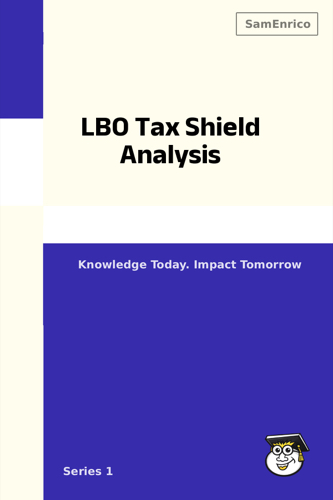
LBO Tax Shield Analysis
Models the tax benefits of leveraged buyout intere
Models the tax benefits of leveraged buyout interest deductions and net operating losses.
Formats
About this book
Free sample
Chapter 1: The Billion-Dollar Question--Every private equity professional has experienced some version of this moment. You are sitting in a conference room, surrounded by seventeen pages of dense financial projections, a debt schedule that took three days to build, and an investment committee that expects a decision in ninety minutes. The model says the deal works. The IRR clears the hurdle. The exit multiple is conservative.
But somewhere in the back of your mind, a question lingers—one that almost no one asks out loud, and that almost no model answers correctly.Where, exactly, is the value coming from?Not the top-line revenue growth. Not the cost synergies. Not the multiple expansion that everyone hopes for but no one can control. The question cuts to something more fundamental, more structural, and—for better or worse—more reliable than any operational projection. The question is about the debt itself.
Specifically, about the tax benefits that debt creates, and whether those benefits are being modeled correctly, valued appropriately, or understood at all.This book exists because the answer, in the vast majority of LBO models, is no.The Three Sources of LBO Value To understand why the tax shield matters—and why it is so frequently mishandled—we must first understand the broader architecture of value creation in leveraged buyouts. For decades, researchers and practitioners have converged on a framework that identifies three distinct sources of LBO value. These are not theoretical abstractions. They are the levers that determine whether a deal generates a 15 percent IRR or a 25 percent IRR, whether a fund beats its benchmark or quietly closes its doors.Let us name them clearly, because we will return to them throughout this book.The first source is corporate governance improvements. This is the most widely understood benefit of the LBO structure.
When a private equity sponsor acquires a company, it typically installs new management, aligns incentives through equity ownership, and imposes the discipline of regular board oversight. But the most powerful governance mechanism is the debt itself. High leverage forces management to focus on cash flow, to eliminate waste, and to…
This is the end of the free sample. Get the eBook to keep going. Buy now
Contents
- Chapter 1
- Chapter 2
- Chapter 3
- Chapter 4
- Chapter 5
- Chapter 6
- Chapter 7
- Chapter 8
- Chapter 9
- Chapter 10
- Chapter 11
- Chapter 12
Details
- Author
- Hodges Conrad
- Publisher
- SamEnrico
- Language
- English
- Genre
- Non-Fiction, Capital & Valuation Register, Tax Strategy
- Released
- 2026-06-10
- Pages (approx.)
- 133
- Available as
- eBook, Audiobook

Read better in the ZLOADR app
Your eBooks on your phone or tablet. Sign in with your SamEnrico account and start reading.
More by Hodges Conrad
 Therapeutic Touch PracticeHodges Conrad$11.99
 Teen Anticipatory Grief GuideHodges Conrad$11.99
 DNA Evidence ReconstructionHodges Conrad$11.99
 Make Habits Obvious GuideHodges Conrad$11.99
 Ted Bundy Bite MarkHodges Conrad$11.99
 Self Hypnosis for Water DrinkingHodges Conrad$11.99
 Emotional Validation for PartnersHodges Conrad$11.99
 The Scholars of the Sahara: Timbuktu's Lost Library of LightHodges Conrad$11.99
 Letters from the Front: How a Japanese Talk Show Host Kept Hope Alive During WWIIHodges Conrad$11.99
 How to Produce PET Bowl StandsHodges Conrad$11.99
 How to Produce Custom Engineered Components For OemsHodges Conrad$11.99
 Old English Sheepdogs: Bobtail BreedHodges Conrad$11.99
You may also like
 Hong Kong Handover 1997Dunn Johnnie$11.99
 Zumba For Postnatal Recovery CourseNeal Christian$11.99
 Zumba for BeginnersLadner Nikia$11.99
 YouTube Comment Mining GuideHumes Pandora$12.99
 Worry Box MeditationCarlin Rudy$11.99
 Workplace Stress MeditationNguyen Lynn$11.99
 Workplace Stress and Sleep RepairHawley Ivory$11.99
 Workplace Perfectionism CureDelaney Jeffry$11.99
 Workplace Injustice Anger GuideWallen Isabelle$11.99
 Work Addiction and Burnout LinkGreenwood Ester$11.99
 Women in Yoga and WellnessBeattie Galina$11.99
 Women in Stand Up ComedyChun Evangeline$11.99