
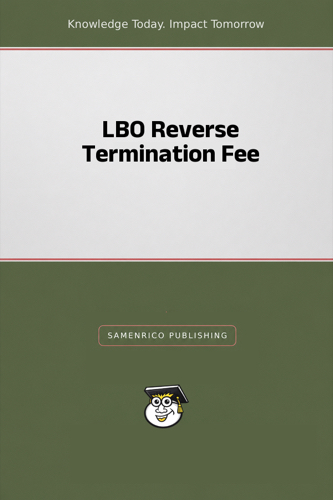
Non-FictionCapital & Valuation RegisterBreakup Fee
LBO Reverse Termination Fee eBook
Breakup fee payable by buyer for failing to close.
by Pike Kimbery
Breakup fee payable by buyer for failing to close.
Formats
Free sample
Chapter 1: The Empty Suit...--–- The phone rang at 11:47 PM on a Tuesday. The caller was the general counsel of a mid-sized manufacturing company that had, six months earlier, agreed to sell itself to a prominent private equity firm for $850 million. The deal was supposed to close the next morning. Instead, the general counsel delivered a message that would become painfully familiar to a generation of sellers: the buyer’s lenders had pulled out. There was no financing.
The private equity fund had no obligation to write the check. And the merger agreement contained a “financing condition” that allowed the buyer to walk away for free.The seller had spent six months and $4 million on legal fees, banker fees, and internal management distraction. It had turned down two other bidders. Its customers, nervous about the ownership change, had delayed orders. Its key plant manager had taken a job elsewhere, assuming the company would be sold.
And now, with nothing more than a telephone call, the buyer was gone. No penalty. No damages. No nothing.The general counsel asked: “Can we sue them?”The answer, then and now, depends entirely on a single question: who, exactly, is “them”?This book is about the clause that was invented to answer that question – the reverse termination fee. But before we can understand the solution, we must understand the problem.
And the problem begins with a legal entity that has no employees, no offices, no assets, and sometimes not even a bank account, yet signs purchase agreements for billions of dollars. That entity is the special purpose vehicle, or what insiders call the “shell buyer.” And it is the most important character in modern private equity that almost no one outside the industry understands.The Invention of the Shell Buyer The shell buyer is not a loophole or a trick. It is a deliberate, essential feature of the leveraged buyout structure. When a private equity firm decides to acquire a company, it does not sign the purchase agreement in its own name. Instead, it creates a new legal entity – typically a limited liability company or a corporation with “Acquisition Sub” or “Holdings” in its name – for the exclusive purpose of being the buyer.
This entity has no operations, no historical financial statements, and no assets other than two pieces of paper: an equity commitment letter from the private equity fund and a debt commitment letter from a syndicate of banks.Why go through this exercise? The reasons are several, and they reveal much about how private equity thinks about risk.First, liability isolation. The private equity fund itself – the partnership that manages billions of dollars from pension funds, endowments, and wealthy families – does not want to be directly exposed to claims arising from the acquisition. If the target company turns out to have environmental contamination, product liability, or a pension shortfall, those claims should attach to the acquired company, not to the fund. By creating a shell buyer that will merge into the target, the fund ensures that the only entity that ever signed the purchase agreement disappears upon closing, replaced by the operating company.Second, regulatory convenience.
In many jurisdictions, a change of control of a regulated entity (banks, insurers, defense contractors) requires government approval. If the private equity fund itself were the buyer, the fund’s entire portfolio might be subject to regulatory review. By using a shell buyer that owns nothing else, the fund limits the scope of regulatory scrutiny to the single transaction.Third – and most importantly for our purposes – the shell buyer creates a legal firewall between the private equity fund’s assets and the obligations of the purchase agreement. The shell buyer signs the merger agreement. The shell buyer makes the representations and warranties.
The shell buyer agrees to pay the purchase price. And the shell buyer, if something goes wrong, is the entity that gets sued. The problem, as the manufacturing company’s general counsel discovered at 11:47 PM, is that the shell buyer has nothing to pay a judgment.The Three Documents That Rule LBOs Every LBO rests on three documents that work together, and sometimes against each other. Understanding these documents is essential to understanding the reverse termination fee.The first document is the Equity Commitment Letter. This is a contract between the private equity fund (the general partner) and the shell buyer, in which the fund promises to contribute a specific amount of equity – typically 30% to 40% of the purchase price – to the shell buyer at closing.
The equity commitment letter is usually enforceable only by the shell buyer, not by the seller. That means if the fund refuses to contribute the equity, the shell buyer can sue the fund. But the seller cannot. The seller is a third party to that contract, and under traditional contract law principles, third parties cannot enforce promises made to someone else.The second document is the Debt Commitment Letter. This is a contract between a syndicate of banks (or, in larger deals, a group of institutional lenders) and the shell buyer, in which the banks promise to lend a specific amount – typically 60% to 70% of the purchase price – to the shell buyer at closing.
Like the equity commitment letter, the debt commitment letter is enforceable only by the shell buyer. The seller has no standing to sue the banks if they refuse to fund. And the banks, unlike the private equity fund, have no reputational constraint: they will happily sign commitment letters and then walk away if market conditions change, citing any number of conditions precedent that were never truly satisfied.The third document is the Merger Agreement. This is the only document signed by the seller. It contains the price, the closing conditions, the representations and warranties, the indemnification provisions, and – critically – the termination provisions.
The merger agreement is signed by the shell buyer, not by the private equity fund, not by the banks. The seller’s only counterparty is an empty entity.The Mismatch That Changes Everything Imagine you are selling your house. The buyer signs a contract to purchase it for $1 million. The buyer puts down a $100,000 deposit. If the buyer walks away for any reason, you keep the deposit.
That is the standard real estate model, and it works because the buyer is a real person with real assets.Now imagine a different scenario. The buyer is a newly created LLC with no bank account. The buyer signs a contract to buy your house for $1 million, but makes no deposit. The buyer tells you: “Don’t worry – my wealthy uncle has promised to give me the money, and a bank has promised to lend me the rest.” You have no direct contract with the uncle or the bank. If the uncle changes his mind or the bank pulls its commitment, the LLC has no money and you have no remedy.
That is the LBO model.The mismatch is not merely theoretical. It is baked into the very structure of how closing conditions are defined. A typical merger agreement lists the seller’s conditions to closing: the buyer must have obtained regulatory approvals, no material adverse change must have occurred, the representations must be true. These are binary…
This is the end of the free sample. Get the eBook to keep going. Buy now
About this book
Details
- Author
- Pike Kimbery
- Publisher
- SamEnrico
- Language
- English
- Genre
- Non-Fiction, Capital & Valuation Register, Breakup Fee
- Released
- 2026-06-06
- Pages (approx.)
- 149
- Available as
- eBook, Audiobook

Read better in the ZLOADR app
Your eBooks on your phone or tablet. Sign in with your SamEnrico account and start reading.
More by Pike Kimbery
 NVC For Refugee Support Staff GuidePike Kimbery$11.99
 Forgiveness After Betrayal ManualPike Kimbery$11.99
 The 4-7-8 Breathing GuidePike Kimbery$11.99
 Loving Kindness Retreat GuidePike Kimbery$11.99
 The Joyriders of Detroit: How Teenage Car Thieves Built a $2 Million EmpirePike Kimbery$11.99
 Bundling Pricing InflationPike Kimbery$12.99
 Daily HARO Query RoutinePike Kimbery$12.99
 How to Start a Acetylene Business (Beginners Guide)Pike Kimbery$11.99
 Understanding Sneddon's SyndromePike Kimbery$17.99
 Technician AssistantPike Kimbery$11.99
You may also like
 Hong Kong Handover 1997Dunn Johnnie$11.99
 Zumba For Postnatal Recovery CourseNeal Christian$11.99
 Zumba for BeginnersLadner Nikia$11.99
 YouTube Comment Mining GuideHumes Pandora$12.99
 Worry Box MeditationCarlin Rudy$11.99
 Workplace Stress MeditationNguyen Lynn$11.99
 Workplace Stress and Sleep RepairHawley Ivory$11.99
 Workplace Perfectionism CureDelaney Jeffry$11.99
 Workplace Injustice Anger GuideWallen Isabelle$11.99
 Work Addiction and Burnout LinkGreenwood Ester$11.99
 Women in Yoga and WellnessBeattie Galina$11.99
 Women in Stand Up ComedyChun Evangeline$11.99