
Non-FictionCapital & Valuation RegisterQuality Control
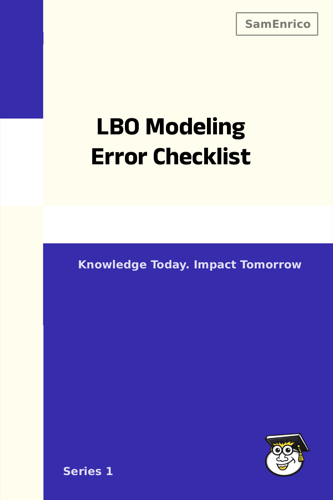
LBO Modeling Error Checklist Audiobook
Provides quality control steps to catch circularit
by Slone Elicia
Provides quality control steps to catch circularity and formula mistakes.
Formats
Free sample
Chapter 1: The Convergence Illusion--–- The managing director slid the term sheet across the table. “Run the model one more time,” he said. “If the IRR holds above 22%, we sign tomorrow.” The associate nodded, opened the file, and pressed F9. The screen flickered. The IRR changed from 22.4% to 18.1%.
No formulas had been altered. No inputs had been touched. The same model, on the same computer, with the same assumptions, produced a different answer. The deal died the next morning.This is not a story about a broken spreadsheet. It is a story about the most misunderstood feature in financial modeling: circularity.
Every LBO model contains it. Almost no one truly understands it. And when it breaks, it does not announce itself with error messages or warning flags. It simply produces the wrong number, quietly, confidently, and often with the full blessing of Excel’s calculation engine.The term “circular reference” strikes fear into the hearts of most Excel users. They have been taught that circles are mistakes, that formulas should never refer to their own output, that a cell containing its own address is the spreadsheet equivalent of dividing by zero.
But in LBO modeling, circularity is not a bug. It is a feature. The entire transaction dynamics depend on it: debt drives interest, interest reduces cash, cash repays debt, and lower debt reduces future interest. That loop is not an error. It is the economic reality of leveraged finance.The error occurs when that loop fails to converge to the correct answer—or when it converges to an answer that looks mathematically stable but is economically wrong.
This chapter introduces the central concept of the book: the convergence illusion, the dangerous belief that because Excel stopped iterating, the answer must be correct.The Anatomy of a Necessary Circle To understand why LBO models require circularity, we must first understand the timing mismatch between accounting and cash flow. Imagine a company with $100 million of debt at 5% annual interest. The debt agreement requires quarterly interest payments. The company generates $10 million of EBITDA each quarter. How much debt remains at year end?The naive answer calculates interest on the beginning debt balance: $100 million × 5% = $5 million of interest.
Net income after interest is $35 million (assuming a 40% tax rate and ignoring depreciation for simplicity). The company uses that cash to repay debt, leaving $65 million at year end.This answer is wrong. Why? Because…
This is the end of the free sample. Get the Audiobook to keep going. Buy now
About this book
Details
- Author
- Slone Elicia
- Publisher
- SamEnrico
- Language
- English
- Genre
- Non-Fiction, Capital & Valuation Register, Quality Control
- Released
- 2026-06-08
- Pages (approx.)
- 148
- Available as
- eBook, Audiobook

Listen in the VoxFlicks app
Audiobooks and audio dramas wherever you go. Sign in with your SamEnrico account and press play.
More by Slone Elicia
 Belgian Police Corruption AngleSlone Elicia$11.99
 Parental Addiction Memoir CollectionSlone Elicia$11.99
 Bariatric Surgery Protein First HandbookSlone Elicia$11.99
 Dairy Free Calcium Sources HandbookSlone Elicia$11.99
 The Silent War: How a Coffee Giant Poisoned the MarketSlone Elicia$11.99
 The Seed Vault Heist: How a Forgotten Arctic Bunker Saved the World's CropsSlone Elicia$11.99
 Understanding Cataract Congenital Autosomal DominantSlone Elicia$17.99
 Timeline And Milestones ProposalSlone Elicia$12.99
 Business Credit for ImmigrantsSlone Elicia$12.99
 HennaSlone Elicia$11.99
 How to Become a Mixing-tank OperatorSlone Elicia$11.99
You may also like
 Hong Kong Handover 1997Dunn Johnnie$11.99
 Zumba For Postnatal Recovery CourseNeal Christian$11.99
 Zumba for BeginnersLadner Nikia$11.99
 YouTube Comment Mining GuideHumes Pandora$12.99
 Worry Box MeditationCarlin Rudy$11.99
 Workplace Stress MeditationNguyen Lynn$11.99
 Workplace Stress and Sleep RepairHawley Ivory$11.99
 Workplace Perfectionism CureDelaney Jeffry$11.99
 Workplace Injustice Anger GuideWallen Isabelle$11.99
 Work Addiction and Burnout LinkGreenwood Ester$11.99
 Women in Yoga and WellnessBeattie Galina$11.99
 Women in Stand Up ComedyChun Evangeline$11.99