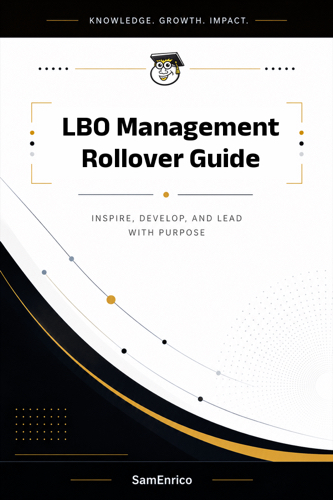
LBO Management Rollover Guide
Models management equity rollovers, incentive plan
by Keane Renda
Models management equity rollovers, incentive plans, and alignment structures.
Formats
About this book
Free sample
Chapter 1: The Alignment Coefficient--–- Private equity has a dirty secret. It is not about financial engineering. It is not about multiple expansion. It is not about tax shields or cheap debt or the magic of leverage. Those things help, of course.
But the single most predictive variable for whether an LBO will deliver a 3x return or a 7x return is something far more mundane and far more human: whether the management team has enough skin in the game.This is not a theory. It is a mathematical fact hiding in plain sight.Let me tell you about two deals. Both were mid-market LBOs in the industrial services sector. Both closed within six months of each other. Both had the same sponsor size, the same debt structure, the same EBITDA multiple at entry.
On paper, they were twins. In reality, they could not have been more different.Deal A was led by a CEO named Michael. He had been with the company for twelve years. When the sponsor came calling, Michael rolled over 100 percent of his existing equity—every single share he owned. Then he reached into his personal savings and invested another $2 million in new cash.
His liquid net worth at the time was approximately $2.5 million. He was betting almost everything he had.Deal B was led by a CEO named David. David was talented, charismatic, and cautious. At closing, he cashed out 40 percent of his pre-deal equity, taking $3 million off the table to fund a second home, his children's private school tuitions, and a comfortable cushion. He rolled over the remaining 60 percent but invested no new cash.
His liquid net worth was roughly $4 million. He was betting a meaningful amount but keeping plenty in reserve.Three years later, Deal A exited at 11x EBITDA. Michael walked away with $18 million after taxes. Deal B exited at 7x EBITDA. David walked away with $6 million.What happened?
The debt was the same. The market conditions were similar. The operational plans were comparable on paper. The difference was not in the spreadsheet. It was in the psychology, the commitment, the alignment—and…
This is the end of the free sample. Get the eBook to keep going. Buy now
Contents
- Chapter 1
- Chapter 2
- Chapter 3
- Chapter 4
- Chapter 5
- Chapter 6
- Chapter 7
- Chapter 8
- Chapter 9
- Chapter 10
- Chapter 11
- Chapter 12
Details
- Author
- Keane Renda
- Publisher
- SamEnrico
- Language
- English
- Genre
- Non-Fiction, Capital & Valuation Register, Management Incentives
- Released
- 2026-06-12
- Pages (approx.)
- 113
- Available as
- eBook, Audiobook

Read better in the ZLOADR app
Your eBooks on your phone or tablet. Sign in with your SamEnrico account and start reading.
More by Keane Renda
 Body Scan for Tension HeadachesKeane Renda$11.99
 Reiki for Pets GuideKeane Renda$11.99
 Daubert Standard OdontologyKeane Renda$11.99
 The Senior Body Image GuideKeane Renda$11.99
 Toxicology ReconstructionKeane Renda$11.99
 Empathy for Customer SupportKeane Renda$11.99
 Self Hypnosis for Falling AsleepKeane Renda$11.99
 The Daring Threads of Down Under: How Australia and New Zealand Revolutionized Fashion (1950-1980)Keane Renda$11.99
 Anansi and the Weaver of Fate: A Love Woven in ShadowsKeane Renda$11.99
 How to Start a Mailing List Publishing BusinessKeane Renda$11.99
 Pekingese: Ancient Chinese BreedKeane Renda$11.99
 Program Delivery InstructionsKeane Renda$12.99