
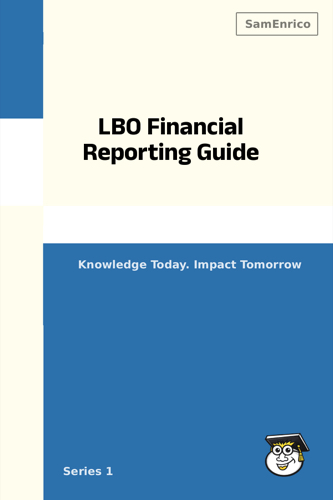
Non-FictionCapital & Valuation RegisterFinancial Reporting
LBO Financial Reporting Guide
Covers portfolio company reporting, covenant track
Covers portfolio company reporting, covenant tracking, and investor updates.
Formats
About this book
Free sample
Chapter 1: The Day After...--The Day After the deal closes is when the real work begins.You have just survived the frenzy of an LBO transaction—months of due diligence, endless model iterations, lender negotiations, and a closing that felt like crossing a finish line. The investment banker has collected her fee. The lawyers have filed the final documents. The private equity sponsor has wired the equity. And you, the portfolio company finance leader, are left holding a 400-page credit agreement, a 12-month forecast that was built for deal approval (not operations), and a sponsor who expects you to hit numbers that were carved into stone during the auction.If you came from a corporate finance background—a stable, investment-grade company with a revolving credit line that never got tested—welcome to a different universe.
In an LBO‑backed company, cash is not a buffer; it is a weapon. Debt is not a cost of capital; it is a constraint. And your primary audience is no longer "shareholders" (who care about earnings per share) but two demanding masters: the lender (who cares about debt service and covenant compliance) and the sponsor (who cares about equity value creation and exit readiness).Most finance professionals spend years learning how to close an LBO. Almost no one teaches you what to do the day after. This chapter closes that gap.The Radical Shift: From Net Income to Cash Flow If you remember only one concept from this entire book, make it this: in an LBO, net income is an accounting fiction.
Cash Flow Available for Debt Service (CFADS) is the truth.Let us explain why.In a typical public company, management is rewarded for growing earnings per share (EPS). The board cares about net income. Analysts build models off GAAP net income. Debt is usually investment grade, meaning the company can roll it over indefinitely. Cash flow matters, but net income drives stock price.In an LBO, the capital structure is inverted.
The company carries a heavy debt burden—often 4x to 7x EBITDA. That debt amortizes (pays down principal) on a schedule, not…
This is the end of the free sample. Get the eBook to keep going. Buy now
Contents
- Chapter 1
- Chapter 2
- Chapter 3
- Chapter 4
- Chapter 5
- Chapter 6
- Chapter 7
- Chapter 8
- Chapter 9
- Chapter 10
- Chapter 11
- Chapter 12
Details
- Author
- Loftis Ulysses
- Publisher
- SamEnrico
- Language
- English
- Genre
- Non-Fiction, Capital & Valuation Register, Financial Reporting
- Released
- 2026-06-09
- Pages (approx.)
- 152
- Available as
- eBook, Audiobook

Read better in the ZLOADR app
Your eBooks on your phone or tablet. Sign in with your SamEnrico account and start reading.
More by Loftis Ulysses
 Sleep Habit FormationLoftis Ulysses$11.99
 Emotional Culture ChangeLoftis Ulysses$11.99
 Reconstruction of HypothermiaLoftis Ulysses$11.99
 Cortisol Awakening Response CARLoftis Ulysses$11.99
 Paleodontology ForensicsLoftis Ulysses$11.99
 Self Hypnosis for Visualization SleepLoftis Ulysses$11.99
 Empathy for RefugeesLoftis Ulysses$11.99
 The Moonlit Pact of Otohime and the Dragon KingLoftis Ulysses$11.99
 The Black Market Heart: Canada's Organ Trafficking ConspiracyLoftis Ulysses$11.99
 Pygmy Marmosets: Smallest MonkeyLoftis Ulysses$11.99
 How to Produce PET Shampoo and ConditionerLoftis Ulysses$11.99
 How to Start a Maize Starch Business (Beginners Guide)Loftis Ulysses$11.99
You may also like
 Hong Kong Handover 1997Dunn Johnnie$11.99
 Zumba For Postnatal Recovery CourseNeal Christian$11.99
 Zumba for BeginnersLadner Nikia$11.99
 YouTube Comment Mining GuideHumes Pandora$12.99
 Worry Box MeditationCarlin Rudy$11.99
 Workplace Stress MeditationNguyen Lynn$11.99
 Workplace Stress and Sleep RepairHawley Ivory$11.99
 Workplace Perfectionism CureDelaney Jeffry$11.99
 Workplace Injustice Anger GuideWallen Isabelle$11.99
 Work Addiction and Burnout LinkGreenwood Ester$11.99
 Women in Yoga and WellnessBeattie Galina$11.99
 Women in Stand Up ComedyChun Evangeline$11.99