
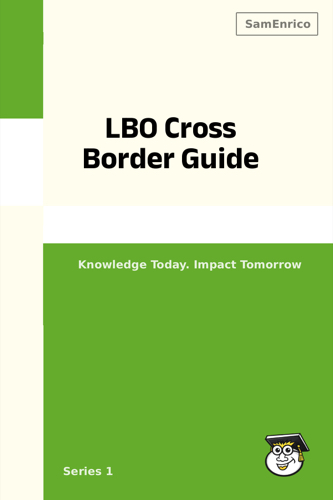
Non-FictionCapital & Valuation RegisterCross Border
LBO Cross Border Guide eBook
Examines FX hedging, jurisdictional tax issues, an
Examines FX hedging, jurisdictional tax issues, and regulatory constraints in cross border LBOs.
Formats
Free sample
Chapter 1: The Graveyard of Certainty--–- On a Tuesday morning in March 2019, a mid-tier London private equity firm called Sterling Capital Partners wired $450 million to acquire a family-owned manufacturing company in Ohio. The deal model was pristine. The entry multiple was 8.5x EBITDA, debt was priced at LIBOR plus 450 basis points, and the projected IRR was 23.7 percent. Every associate and vice president who touched the model agreed that this was a textbook LBO. The only problem was that the model assumed the British pound would stay where it was.
Six months later, after Boris Johnson’s government rattled markets and the pound dropped 17 percent against the dollar, Sterling Capital’s carefully constructed debt service coverage ratio fell apart. The lenders triggered a covenant breach, the company missed an interest payment, and by March 2020—exactly one year after the triumphant closing—the portfolio company was in administration. The sponsor lost its entire equity check. The partners lost their carried interest. And the associates learned a brutal lesson that no MBA program had taught them: a domestic LBO model is not a cross-border LBO model.
The difference is not marginal. It is existential.This chapter is called The Graveyard of Certainty because that is precisely where most cross-border LBOs end up—buried under the weight of assumptions that worked perfectly well in a single-currency, single-tax, single-regulator world. The purpose of this chapter is to debunk the most dangerous myth in international private equity: that a successful domestic LBO can be exported directly across borders with only minor adjustments to the spreadsheet. It cannot. The three frictions examined throughout this book—foreign exchange volatility, jurisdictional tax asymmetry, and regulatory veto power—do not merely reduce returns.
They fundamentally alter the calculus of whether a deal should be done at all.This chapter begins by dissecting why domestic LBO models fail internationally, introducing the concept of the Friction Gap. It then maps the global landscape of mature and growth markets, showing how different jurisdictions punish different sins. Finally, it introduces the book’s central analytical framework: the Deal Viability after Cross-Border Drag metric, or DVCBD, which will serve as the guiding star for every subsequent chapter. By the end of this chapter, the reader will understand why the Sterling Capital story is not an outlier but a warning—and how to avoid becoming the next cautionary tale.The Fallacy of the Portable Model The leveraged buyout model, as perfected by American private equity in the 1980s and codified in textbooks like Rosenbaum and Pearl’s Investment Banking, rests on a deceptively simple set of assumptions. A sponsor acquires a company using a combination of equity and debt, with the debt secured by the target’s assets and repaid from the target’s future cash flows.
The sponsor improves operations, expands margins, and exits after three to seven years at a higher multiple. The math works because the currency of revenue, the currency of debt, and the currency of equity are the same. The tax authority is singular. The regulators are predictable.Cross the border, and every single one of these assumptions becomes a variable rather than a constant.Consider the Sterling Capital case in more detail, because it illuminates all three frictions that this book will address. The sponsor was a UK fund, raising capital in pounds sterling from British limited partners.
The target was a US manufacturing company, generating revenue in dollars and paying taxes to the Internal Revenue Service. The debt was denominated in euros because a German bank offered the most favorable terms. Within this simple structure, three distinct risks emerged.First, foreign exchange risk. Sterling Capital’s debt service obligations were calculated in euros, but the target’s cash flow was in dollars, and the sponsor’s equity was in pounds. When the pound dropped 17 percent, the dollar value of the sponsor’s remaining equity cushion evaporated.
But the more damaging effect was on the debt service coverage ratio. The lenders had covenant the ratio of EBITDA to interest expense. EBITDA was in dollars. Interest expense was in euros. When the euro strengthened against the dollar, the interest expense in dollar terms rose without any corresponding increase in EBITDA.
The covenant tripped not because the company performed poorly, but because currencies moved.Second, tax risk. Sterling Capital had structured the acquisition using a Delaware holding company, believing that the US-UK tax treaty would allow interest payments to flow upstream without withholding tax. What the sponsor’s tax advisors failed to appreciate was that the German bank’s loan documents required interest to be paid from the German Op Co directly, triggering German withholding tax of 15 percent on each payment. The model had assumed a zero withholding rate. The actual rate added 150 basis points to the effective cost of debt.Third, regulatory risk.
When the covenant breach occurred, Sterling Capital attempted to inject additional equity to cure the default. But the company was in Ohio, and Ohio’s version of the Uniform Commercial Code gave secured creditors the right to block any equity infusion that would subordinate their position. The lenders exercised that right. The sponsor was legally prevented from saving its own investment.The Friction Gap These three risks—FX, tax, and regulation—create what this book calls the Friction Gap. The Friction Gap is the difference between the projected IRR in a domestic LBO model and the actual realized IRR in a cross-border LBO, attributable entirely to the friction of moving value across jurisdictional boundaries.
In Sterling Capital’s case, the projected IRR was 23.7 percent. The actual realized IRR was negative 100 percent. The Friction Gap was the entire equity check.The Friction Gap is not a theoretical construct. It can be measured, modeled, and—most importantly—mitigated. But mitigation requires first understanding that the gap exists.
The overwhelming majority of cross-border LBO failures documented in this book’s research share a common precursor: the deal team modeled the transaction as if it were domestic and then added a fudge factor for “international risk.” That fudge factor is almost always too small, and it is almost always applied to the wrong variables.A review of failed cross-border LBOs between 2015 and 2024 reveals a striking pattern. In deals where the sponsor conducted dedicated FX, tax, and regulatory diligence—what this book will later call Parallel Diligence in Chapter 12—the failure rate within three years was 12 percent. In deals where the sponsor relied on the domestic model plus a fudge factor, the failure rate was 43 percent. The difference is not subtle. It is the difference between a viable asset class and a gamble.The Three Frictions Defined Before proceeding further, it is essential to define the three frictions that this book will examine in depth.
Each friction will receive multiple chapters of dedicated treatment, but the reader deserves a clear framework from the outset.Foreign Exchange Volatility FX volatility is the most visible of the three frictions, but it is not necessarily the most damaging. It is visible because currency movements are public, daily, and often dramatic. A 10 percent currency move in a single quarter is not unusual. A 20 percent move over a twelve-month period is common in emerging markets. What makes…
This is the end of the free sample. Get the eBook to keep going. Buy now
About this book
Details
- Author
- Carson Darryl
- Publisher
- SamEnrico
- Language
- English
- Genre
- Non-Fiction, Capital & Valuation Register, Cross Border
- Released
- 2026-06-08
- Pages (approx.)
- 150
- Available as
- eBook, Audiobook

Read better in the ZLOADR app
Your eBooks on your phone or tablet. Sign in with your SamEnrico account and start reading.
More by Carson Darryl
 Swimming Kickboard DrillsCarson Darryl$11.99
 Domestic Violence Scene ReconstructionCarson Darryl$11.99
 Emotion Labeling GuideCarson Darryl$11.99
 Time Blocking for MeetingsCarson Darryl$11.99
 SMART For HR GuideCarson Darryl$11.99
 Self Hypnosis for Sleep TalkCarson Darryl$11.99
 Empathy for AutismCarson Darryl$11.99
 The Wirecard Scandal: Germany's Billion-Dollar IllusionCarson Darryl$11.99
 How to Produce PET Leash ExtensionsCarson Darryl$11.99
 How to Produce Dance ShoesCarson Darryl$11.99
 A Collector's Handbook to the Volkswagen 1500Carson Darryl$11.99
 Outland PR Application GuideCarson Darryl$12.99
You may also like
 Hong Kong Handover 1997Dunn Johnnie$11.99
 Zumba For Postnatal Recovery CourseNeal Christian$11.99
 Zumba for BeginnersLadner Nikia$11.99
 YouTube Comment Mining GuideHumes Pandora$12.99
 Worry Box MeditationCarlin Rudy$11.99
 Workplace Stress MeditationNguyen Lynn$11.99
 Workplace Stress and Sleep RepairHawley Ivory$11.99
 Workplace Perfectionism CureDelaney Jeffry$11.99
 Workplace Injustice Anger GuideWallen Isabelle$11.99
 Work Addiction and Burnout LinkGreenwood Ester$11.99
 Women in Yoga and WellnessBeattie Galina$11.99
 Women in Stand Up ComedyChun Evangeline$11.99