
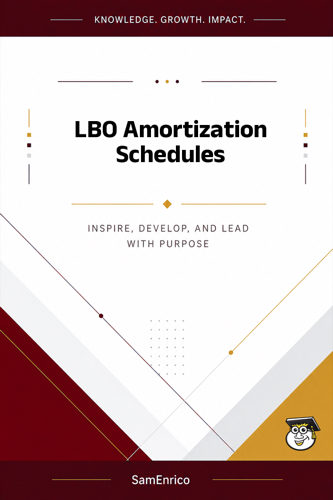
Non-FictionCapital & Valuation RegisterLoan Amortization
LBO Amortization Schedules
Provides term loan A, B, and C amortization templa
Provides term loan A, B, and C amortization templates.
Formats
About this book
Free sample
Chapter 1: The Invisible Lever--–- In the spring of 2019, a leveraged finance team at a European bank lost a €200 million mandate. Not on price. Not on execution speed. Not on relationship. They lost because their proposed amortization schedule added €18 million of debt service in year two that the borrower could not afford, while the winning bidder pushed the same principal payments into year four.
The underlying loan was identical. The interest rate was identical. The only difference was the timing of principal repayment. The losing team never understood what hit them.This story captures the central argument of this book: amortization schedules are not a passive reflection of debt terms—they are an active, often invisible lever that determines who wins and who loses in leveraged finance. Most finance professionals can build a basic amortization table.
Few understand how to design one that creates strategic advantage. This chapter introduces the foundational concepts, dismantles common misconceptions, and establishes a framework for thinking about amortization as a weapon rather than a chore.The Amortization Blind Spot in Finance Education Walk into any financial modeling training program, and you will find days devoted to three-statement integration, discounted cash flow analysis, and merger consequences. You will find hours on leveraged buyout mechanics, debt waterfalls, and internal rate of return calculations. You will find, if you are lucky, thirty minutes on amortization schedules—usually presented as a mechanical exercise in applying the PPMT function or building a simple loan table.This imbalance is not accidental. It reflects a widespread belief that amortization is a derived output rather than a design input.
The term sheet says 20% annual amortization, so the modeler applies 20% annual amortization. End of story.But in real-world leveraged finance, the term sheet does not arrive fully formed from a heavenly negotiation. Every percentage point, every step-up, every balloon, every PIK toggle is a choice—and choices have consequences. A TLA that amortizes at 10% in year one and 30% in year five produces a radically different cash flow profile than one that amortizes at 30% in year one and 10% in year five…
This is the end of the free sample. Get the eBook to keep going. Buy now
Contents
- Chapter 1
- Chapter 2
- Chapter 3
- Chapter 4
- Chapter 5
- Chapter 6
- Chapter 7
- Chapter 8
- Chapter 9
- Chapter 10
- Chapter 11
- Chapter 12
Details
- Author
- Kimbrell Olympia
- Publisher
- SamEnrico
- Language
- English
- Genre
- Non-Fiction, Capital & Valuation Register, Loan Amortization
- Released
- 2026-06-09
- Pages (approx.)
- 150
- Available as
- eBook, Audiobook

Read better in the ZLOADR app
Your eBooks on your phone or tablet. Sign in with your SamEnrico account and start reading.
More by Kimbrell Olympia
 Mobile Game Daily Login Break ManualKimbrell Olympia$11.99Mobile Game Daily Login Break ManualKimbrell Olympia$11.99
 Bariatric Surgery Partner Support GuideKimbrell Olympia$11.99
 Lactose Intolerance in Children GuideKimbrell Olympia$11.99
 Parental Addiction and HopeKimbrell Olympia$11.99
 Love in the Boardroom: The Secret Affair That Reshaped Corporate AmericaKimbrell Olympia$11.99
 Bark of the Lost Legion: The Roman Warhound Who Saved an EmpireKimbrell Olympia$11.99
 Understanding Cataract Congenital With MicrophthalmiaKimbrell Olympia$17.99
 How to Start a Potato Processing and Preserving Business (Beginners Guide)Kimbrell Olympia$11.99
 Business Credit for Minority OwnersKimbrell Olympia$12.99
 NIH Research Proposal GuideKimbrell Olympia$12.99
 Operations Support OutfitterKimbrell Olympia$11.99
You may also like
 Hong Kong Handover 1997Dunn Johnnie$11.99
 Zumba For Postnatal Recovery CourseNeal Christian$11.99
 Zumba for BeginnersLadner Nikia$11.99
 YouTube Comment Mining GuideHumes Pandora$12.99
 Worry Box MeditationCarlin Rudy$11.99
 Workplace Stress MeditationNguyen Lynn$11.99
 Workplace Stress and Sleep RepairHawley Ivory$11.99
 Workplace Perfectionism CureDelaney Jeffry$11.99
 Workplace Injustice Anger GuideWallen Isabelle$11.99
 Work Addiction and Burnout LinkGreenwood Ester$11.99
 Women in Yoga and WellnessBeattie Galina$11.99
 Women in Stand Up ComedyChun Evangeline$11.99