
Non-FictionSelf-HelpPublic LaundryCasual Socializing
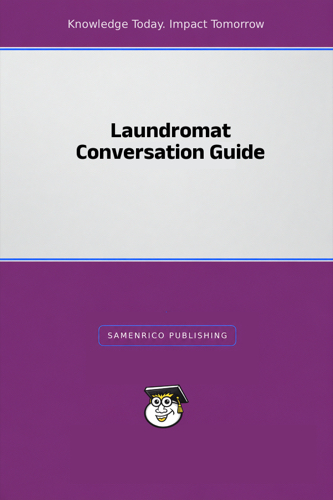
Laundromat Conversation Guide eBook
Pass folding time chatting with fellow laundry doe
Pass folding time chatting with fellow laundry doers without being creepy.
Formats
Free sample
Chapter 1: The Spiral Behind the Spin--–- The first time I tried to talk to someone at a laundromat, I opened my mouth and nothing came out. Not because I didn't have words—I had too many. They were all wrong. "Hot in here, right? I mean, the dryers.
Not you. I didn't mean you're hot. I meant the machines. The heat. From the dryers." The woman looked at me the way you'd look at a fire alarm that won't stop beeping for no reason.
She picked up her laundry basket, moved three machines down, and never made eye contact with me again. I spent the next 27 minutes of my wash cycle replaying those seven seconds of verbal disaster. That was ten years ago. I've since talked to over 500 strangers in laundromats across four cities. Some became friends.
Most became nothing—a nod of recognition on subsequent visits, a shared groan about a broken coin machine, nothing more. And that's the point. This book is not a promise that you'll leave every laundromat with a new best friend. It's a promise that you can stop feeling like a malfunctioning fire alarm every time you try to be human in public.Why This Chapter Exists This chapter exists to do one thing: convince you that your discomfort is not a personality flaw. It is a predictable, normal, even useful response to a genuinely strange social environment.
We will name the specific ways laundromats trigger social anxiety. We will look at the research on why 73% of laundromat visitors say they want to talk but don't know how. And we will reframe the laundromat not as a place of awkward obligation but as a low-stakes training ground for something larger: the lost art of talking to strangers in an age of loneliness.If you finish this chapter and still feel nervous, good. A little nervous means you care about not being creepy. The people who should worry are the ones who feel no nerves at all.
This book is for the nervous ones.The Geography of Awkwardness: What Makes Laundromats Different Let us list the specific ways a laundromat is unlike any other public space where conversation might happen.First, you cannot leave. At a coffee shop, you can throw away your cup and walk out. At a bus stop, the bus arrives. At a grocery store, you can abandon your cart in an aisle (please don't, but you can). At a laundromat, your clothes are locked inside a machine for a fixed amount of time.
You are a captive audience, and so is everyone else. That captive quality changes the math of social risk. If you say something awkward at a party, you can walk to the other side of the room. If you say something awkward at a laundromat, you are standing next to that person while your underwear spins in plain view for another 22 minutes.Second, your personal items are exposed. Not hidden in a shopping bag or a backpack.
Spinning behind a glass door. Underwear. Stained sheets. The shirt you spilled coffee on three days ago and forgot to pre-treat. A child's pajamas with cartoon characters.
These are intimate objects, and they are on display. Conversation in a laundromat happens in the shadow of this forced vulnerability. The person you're talking to knows what brand of detergent you buy. They know if you use fabric softener sheets or liquid. They know, approximately, how many socks you own and what colors you prefer.
That is a level of accidental intimacy that does not exist at a post office.Third, the social rules are unwritten and contradictory. At a gym, you know not to talk to someone in the middle of a set. At a library, silence is explicit. At a laundromat, there is no consensus. Some people treat it as a social space—they chat with regulars, share folding tables, ask for quarters.
Others treat it as a solitary chore—headphones in, eyes down, out as fast as possible. And you cannot tell which is which just by looking. Or rather, you can, but only after you learn the cues. That is Chapter 2. For now, know that the ambiguity itself is a source of anxiety.
You are not broken for feeling uncertain. The environment is legitimately uncertain.Fourth, the stakes are weirdly high and weirdly low at the same time. Low because you may never see this person again. High because if you do see them again (same neighborhood, same weekly laundry night), you have created a repeat interaction with someone who now has a first impression of you as "the person who said that thing about the dryer." This duality—stranger today, regular tomorrow—is the central tension of laundromat conversation. We will resolve it in Chapter 9.
For now, name it: you are not imagining the mixed signals.The 73 Percent: A Statistic That Should Infuriate You In 2021, the Laundromat Association (a real trade organization) surveyed 1,204 regular laundromat visitors across the United States. They asked a simple question: "Would you welcome a brief, friendly conversation with another laundromat visitor while you wait for your laundry?" Seventy-three percent said yes. Seventy-three percent. Then they asked a follow-up: "How often do you start such a conversation?" The number dropped to twelve percent. Twelve.Let me translate those numbers for you.
In any given laundromat on any given day, nearly three out of four people are open to talking. But only one out of eight actually starts the conversation. The gap between desire and action is sixty-one percentage points. That gap is not about personality. It is not about introversion versus extroversion.
It is about skill, permission, and fear. The same seventy-three percent who said yes are also afraid of being creepy. They are afraid of bothering someone. They are afraid of saying the wrong thing and then having to stand next to that person for the remaining nineteen minutes of the dry cycle.You are not alone in your silence. You are in the majority.
The silent majority, as it turns out, wants to speak.A brief methodological note for the skeptical reader: the survey defined "brief, friendly conversation" as two to five exchanges lasting under two minutes. Not a deep friendship. Not a phone number exchange. Just a moment of shared humanity. That is what seventy-three percent of people want.
That is the entire ambition of this book. We are not teaching you to be a charismatic extrovert. We are teaching you to close a very small gap between wanting to say something and actually saying it.Why "Low Stakes" Is Both True and Not Quite True Let me resolve a tension that appears throughout this book. In some chapters, I will tell you that laundromat conversations are low stakes—that failure costs nothing because you can simply never return to that laundromat, or because you will never see that person again. In other chapters, I will tell you that laundromat conversations matter deeply—that they can build community, fight loneliness, and become meaningful rituals.
Both are true, but not at the same time for the same person.Here is the distinction.For a stranger you have never seen before and may never…
This is the end of the free sample. Get the eBook to keep going. Buy now
About this book
Details
- Author
- Lancaster Valentine
- Publisher
- SamEnrico
- Language
- English
- Genre
- Non-Fiction, Self-Help, Public Laundry, Casual Socializing
- Released
- 2026-06-09
- Pages (approx.)
- 138
- Available as
- eBook, Audiobook

Read better in the ZLOADR app
Your eBooks on your phone or tablet. Sign in with your SamEnrico account and start reading.
More by Lancaster Valentine
 Habit Journaling WorkbookLancaster Valentine$11.99
 Nobel Laureates In Light MicroscopyLancaster Valentine$11.99
 Ecological Momentary AssessmentLancaster Valentine$11.99
 Maze Walking Concentration PracticeLancaster Valentine$11.99
 Echoes of the Ice Age: The First Explorers of the Frozen ReefsLancaster Valentine$11.99
 The Last Stand of the Black Prince: A Century of Unclaimed GloryLancaster Valentine$11.99
 Return on Investment AnalystLancaster Valentine$11.99
 Currency Conversion Optimization GuideLancaster Valentine$12.99
 Freemium Device FragmentationLancaster Valentine$12.99
 Understanding GoutLancaster Valentine$17.99
 How to Become a Kick-press OperatorLancaster Valentine$11.99
You may also like
 Hong Kong Handover 1997Dunn Johnnie$11.99
 Zumba For Postnatal Recovery CourseNeal Christian$11.99
 Zumba for BeginnersLadner Nikia$11.99
 YouTube Comment Mining GuideHumes Pandora$12.99
 Worry Box MeditationCarlin Rudy$11.99
 Workplace Stress MeditationNguyen Lynn$11.99
 Workplace Stress and Sleep RepairHawley Ivory$11.99
 Workplace Perfectionism CureDelaney Jeffry$11.99
 Workplace Injustice Anger GuideWallen Isabelle$11.99
 Work Addiction and Burnout LinkGreenwood Ester$11.99
 Women in Yoga and WellnessBeattie Galina$11.99
 Women in Stand Up ComedyChun Evangeline$11.99