
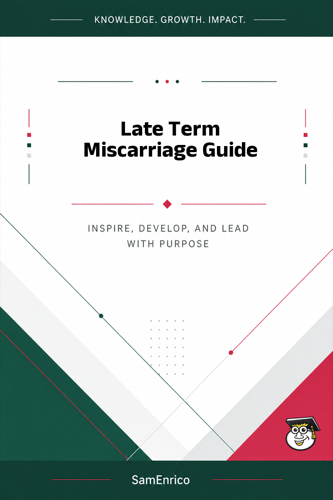
Non-FictionSelf-HelpLate Miscarriage
Late Term Miscarriage Guide eBook
Losing a pregnancy between 13 and 20 weeks carries
Losing a pregnancy between 13 and 20 weeks carries unique challenges.
Formats
Free sample
Chapter 1: The Threshold of Viability...--–- At thirteen weeks, your baby is no longer an embryo but a fetus—a word that sounds clinical and cold for something that now has fingers that can curl, a face that can frown, and a heartbeat that you may have heard on a Doppler just days ago. The threshold of viability is not a single moment but a spectrum, and somewhere between the first flutter of movement at sixteen weeks and the desperate fight for life in a NICU at twenty-four weeks lies the space this book occupies: the second trimester loss. Understanding where your baby is on that spectrum, what their body can and cannot do, and what your body is about to experience is not about detaching from the grief—it is about anchoring yourself in reality so that the terror of the unknown does not consume you.The term "viability" is one of the most misunderstood and emotionally charged words in reproductive medicine. Medically, viability refers to the point at which a fetus has developed enough lung function to have a reasonable chance of surviving outside the womb with intensive medical support. That threshold is generally considered to be around twenty-four weeks of gestation, though survival rates at twenty-four weeks hover around 50 to 60 percent, and even then, those survivors face months in the neonatal intensive care unit, often with long-term disabilities.
At twenty-three weeks, survival drops to roughly 30 percent. At twenty-two weeks, it falls below 10 percent. At twenty-one weeks and earlier, survival is virtually nonexistent—the lungs are simply too underdeveloped to exchange oxygen, no matter how advanced the medical technology.But here is the cruel paradox that defines the late miscarriage: your baby is not viable by any medical definition, yet your baby is undeniably, heartbreakingly real. At thirteen weeks, the baby's intestines have retracted from the umbilical cord into the abdomen. At fourteen weeks, the baby can make sucking motions and swallow amniotic fluid.
At fifteen weeks, the skeleton is calcifying—you can see the tiny ribs and skull on an ultrasound. At sixteen weeks, the baby can hear sounds outside the womb, though muffled, and may startle at loud noises. At seventeen weeks, the baby has unique fingerprints. At eighteen weeks, the baby yawns, hiccups, and has sleep-wake cycles. At nineteen weeks, the baby is covered in vernix caseosa, a waxy white coating that protects the skin from the amniotic fluid.
At twenty weeks, the baby is approximately six to seven inches long, about the size of a small banana, and has eyebrows, eyelashes, and sometimes even a fine layer of hair called lanugo.This is the gap that no one talks about. The baby is too real to dismiss as "just tissue" but too early to save. You may have felt the first fluttering movements—quickening—somewhere between sixteen and twenty weeks. You may have a name picked out. You may have started a registry.
You may have told your parents, your coworkers, your other children. And now you are being told that the pregnancy will end, that your body will go through labor, that you will deliver a baby who cannot survive. The words "miscarriage" and "stillbirth" fail to capture this in-between space. A first-trimester miscarriage is often described as a heavy period with cramping. A stillbirth at thirty weeks involves a fully formed baby, labor and delivery, and legal recognition.
But a loss at seventeen weeks—you will have contractions. Your water may break. You will push. You will hold a baby who looks like a baby but is too small for most funeral homes to cremate individually. And then you will go home with empty arms and a body that is producing milk for a baby who will never nurse.This chapter is about understanding that threshold—not to terrify you, but to prepare you.
The physical experience of a late miscarriage is fundamentally different from an early miscarriage. If you have lost a pregnancy in the first trimester, you may have experienced heavy bleeding, clotting, and cramping that felt like a very bad period. You may have passed the pregnancy tissue at home, in the bathroom, alone or with a partner nearby. A late miscarriage, by contrast, is a birth. It involves the same physiological processes as a full-term delivery: cervical dilation, uterine contractions, rupture of membranes, and the expulsion of the fetus and placenta.
The difference is not in the process but in the outcome. At forty weeks, labor ends with a crying baby placed on your chest. At seventeen weeks, labor ends with silence and a small, still body.Understanding this distinction is not morbid. It is survival. When you know what is coming, you can make informed decisions.
You can ask for pain management. You can request a private room. You can decide whether you want to see and hold your baby. You can plan for postpartum care that includes milk suppression, pelvic floor therapy, and screening for post-traumatic stress disorder. The women who go into a late miscarriage expecting an experience similar to an early miscarriage are the ones who are blindsided by the intensity of the contractions, the sight of a recognizable baby, the emotional weight of delivery.
This book is here to ensure that you are not blindsided.The Medical Definition of Late Miscarriage The medical community defines a miscarriage as the spontaneous loss of a pregnancy before twenty weeks of gestation. After twenty weeks, the same event is called a stillbirth or intrauterine fetal demise. This distinction is arbitrary—a baby lost at nineteen weeks and six days is a miscarriage; a baby lost at twenty weeks and one day is a stillbirth—but it has real consequences. Stillbirths are typically registered with a fetal death certificate, may be eligible for funeral leave or bereavement benefits, and are often covered by state-specific memorial programs. Late miscarriages fall into a bureaucratic gray zone.
Some states issue certificates of birth resulting in stillbirth for losses after twenty weeks, but not for losses at nineteen weeks. Some hospitals offer memory boxes and photography for losses after sixteen weeks; others do not. Some employers offer bereavement leave for stillbirth but not for miscarriage. The inconsistency adds another layer of pain to an already devastating experience.For the purposes of this book, we are focusing on the gestational window of thirteen weeks, zero days through twenty weeks, six days. We begin at thirteen weeks because that is the point at which the physical experience shifts from early miscarriage to late miscarriage.
By thirteen weeks, the fetus is too large to pass without contractions. The uterus has grown beyond the pelvis. The placenta is fully formed and attached. Passing the pregnancy tissue at home is not only more painful but also potentially dangerous—hemorrhage and infection are real risks. Most medical providers will recommend a surgical procedure (D&E, or dilation and evacuation) or medical induction (using medication to start labor) for losses at or beyond thirteen weeks.
This is not a recommendation based on convenience; it is a recommendation based on safety.We end the window at twenty weeks, six days because that is the cut-off used by most medical…
This is the end of the free sample. Get the eBook to keep going. Buy now
About this book
Details
- Author
- Gregg Xiomara
- Publisher
- SamEnrico
- Language
- English
- Genre
- Non-Fiction, Self-Help, Late Miscarriage
- Released
- 2026-06-08
- Pages (approx.)
- 148
- Available as
- eBook, Audiobook

Read better in the ZLOADR app
Your eBooks on your phone or tablet. Sign in with your SamEnrico account and start reading.
More by Gregg Xiomara
 Wholesaling CRM SetupGregg Xiomara$11.99
 Post Stroke Pain ReliefGregg Xiomara$11.99
 Code Refactoring CreativityGregg Xiomara$11.99
 Blue Zone Fish GuideGregg Xiomara$11.99
 Restructuring Anger for OCDGregg Xiomara$11.99
 Employer Social Media VettingGregg Xiomara$11.99
 Gambling and AnxietyGregg Xiomara$11.99
 The Desert Fox and the Desert Storm: Rommel’s Symphony of Sand and SteelGregg Xiomara$11.99
 Letters from Monte Cassino: Love and Loss in the Ruins of ItalyGregg Xiomara$11.99
 How to Produce Fabric SizingGregg Xiomara$11.99
 A Collector's Handbook to the Alfa Romeo B LongGregg Xiomara$11.99
 The Essential Guide to EuropeGregg Xiomara$11.99
You may also like
 Hong Kong Handover 1997Dunn Johnnie$11.99
 Zumba For Postnatal Recovery CourseNeal Christian$11.99
 Zumba for BeginnersLadner Nikia$11.99
 YouTube Comment Mining GuideHumes Pandora$12.99
 Worry Box MeditationCarlin Rudy$11.99
 Workplace Stress MeditationNguyen Lynn$11.99
 Workplace Stress and Sleep RepairHawley Ivory$11.99
 Workplace Perfectionism CureDelaney Jeffry$11.99
 Workplace Injustice Anger GuideWallen Isabelle$11.99
 Work Addiction and Burnout LinkGreenwood Ester$11.99
 Women in Yoga and WellnessBeattie Galina$11.99
 Women in Stand Up ComedyChun Evangeline$11.99