
Non-FictionSelf-HelpAcademic Communication
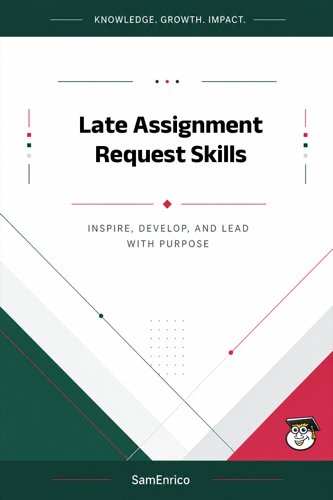
Late Assignment Request Skills eBook
Provides email templates and conversation scripts
Provides email templates and conversation scripts for deadline extensions.
Formats
Free sample
Chapter 1: The Apology Trap--You just missed a deadline. Your hands are sweating. Your cursor blinks on an empty email draft. And every instinct you have is about to make things worse.You type, "I'm so so sorry, please forgive me, this will never happen again."Then you hit send.Congratulations. You just activated the Apology Trap.What happens next is painfully predictable.
The professor or manager on the receiving end reads your message, feels a flicker of annoyance rather than sympathy, and either denies your request outright or grants it with visible reluctance. You walk away thinking you did the right thing—after all, you apologized, didn't you? But you didn't get what you actually wanted: a fair hearing, a gracious extension, and a preserved reputation.This chapter dismantles the single most common mistake in late request communication. It explains why emotional apologies fail, introduces a framework for understanding who is responsible for the missed deadline, and gives you a new way of thinking about every request you will ever make.By the end of this chapter, you will never start a late request with "I'm sorry" again.The Anatomy of a Failed Apology Let us examine what actually happens when you lead with an emotional apology. You are not alone in this behavior.
Psychologists have documented that when humans feel they have violated a social contract—and a deadline is precisely that, a social contract—their first instinct is to signal remorse. This signaling is evolutionarily ancient. In small tribal societies, remorse signaled submission to the group's rules and reduced the likelihood of ostracism.But you are not writing to a tribal elder. You are writing to a professor who has read four hundred emails this week, or a manager who is juggling six projects. Your apology does not signal submission.
It signals one thing only: you are focusing on your own feelings rather than on the receiver's problem.Consider two emails.Email A: "I'm so so sorry, I feel terrible, please forgive me for missing the deadline, I promise it will never happen again."Email B: "I missed the deadline for the project proposal. I have completed 80 percent of the work, including the financial analysis and the executive summary. May I submit the remaining 20 percent by tomorrow at 9 AM?"Which email gets a "yes" more often? The answer is Email B, and it is not close. Here is why.Email A asks the receiver to do emotional labor.
The receiver must read your apology, assess its sincerity, decide whether to forgive you, and then separately decide whether to grant the extension. That is two cognitive tasks instead of one. Most busy people will default to the path of least resistance, which is to deny the request or to respond with a curt "See syllabus policy."Email B, by contrast, asks the receiver to do one thing: evaluate a proposed solution. The receiver does not need to assess your emotional state, forgive you, or feel sympathy. They simply decide whether 48 hours is reasonable.
That decision takes three seconds.The Apology Trap is not about being polite versus being rude. It is about the difference between asking for forgiveness and asking for a solution. One centers your feelings. The other centers the work.The Locus of Control Framework Now that you understand why emotional apologies fail, you need a tool for diagnosing what actually caused the missed deadline. This tool is called the Locus of Control Framework, and it comes from decades of research in organizational psychology.Every missed deadline has a cause.
That cause is either internal to you or external to you. This distinction matters enormously because it determines how you should frame your request.Internal causes are factors within your control. They include procrastination, poor planning, overcommitment, underestimating task difficulty, distraction, fatigue, and simple forgetfulness. When you miss a deadline for an internal cause, you are responsible. There is no villain except your own choices.External causes are factors outside your control.
They include medical emergencies, family crises, technology failures, transportation breakdowns, weather events, and institutional errors like a crashed learning management system. When you miss a deadline for an external cause, you are not responsible, but you are still accountable.Here is the crucial distinction: responsibility is about fault. Accountability is about ownership. You can be accountable for solving a problem even when you are not at fault for creating it.The Locus of Control Framework gives you four possible combinations:Cause Type Your Responsibility Your Accountability Recommended Strategy Internal, acknowledged Full Full Honesty + solution Internal, denied Full None (you're lying)Do not send the request External, with evidence None Full Facts + documentation External, without evidence None Full (but harder to prove)Facts only, no over-explaining Most people get this wrong. They treat internal causes as if they were external ("The assignment was too hard" when they started too late) or external as if they were internal ("I should have anticipated the power outage" when no one could have).
The correct move is to be ruthlessly honest with yourself before you write a single word.If the cause was internal, your request must include honesty about the mistake and a proposed solution. Example: "I misjudged how long the research phase would take. I have completed the outline and half the draft. May I have until Friday to finish?"If the cause was external, your request must include calm, factual reporting and, if available, documentation. Example: "There was a power outage in my building from 6 PM to 10 PM last night.
I have attached a screenshot of the utility company's outage notification. May I submit by noon today?"Notice what is missing from both examples: the word "sorry."The Clarity-Concise-Kindness Framework The Apology Trap leads people to write long, rambling, emotionally charged emails. They think more words equal more sincerity. In reality, more words equal more annoyance.Every late request you ever write should follow the Clarity-Concise-Kindness Framework, which I will refer to as CCK throughout this book. This framework is not original to me.
It synthesizes decades of research on professional email communication, including studies showing that the most effective requests are under 150 words and contain a specific ask in the first sentence.Here is what CCK means in practice.Clarity means stating exactly what you need in the first sentence of your email. Do not bury the ask. Do not lead with apology. Do not provide context before the ask. The first sentence should be something like "I am requesting a 24-hour extension on the project proposal" or "May I submit the remaining portion of the assignment by Friday?"Concise means keeping your entire request under 150 words unless documentation is required.
One hundred fifty words is approximately four to six sentences. If you cannot state your situation in six sentences, you are over-explaining. The receiver does not need your life story. They need the facts.Kindness means being respectful without groveling. This is the hardest part for most people because they confuse kindness with self-abasement.
Kindness in professional communication sounds like this: "Thank you for your understanding" or "I appreciate you considering this request." It does not sound like this: "I know you probably hate me…
This is the end of the free sample. Get the eBook to keep going. Buy now
About this book
Details
- Author
- Bartels Alexander
- Publisher
- SamEnrico
- Language
- English
- Genre
- Non-Fiction, Self-Help, Academic Communication
- Released
- 2026-06-05
- Pages (approx.)
- 148
- Available as
- eBook, Audiobook

Read better in the ZLOADR app
Your eBooks on your phone or tablet. Sign in with your SamEnrico account and start reading.
More by Bartels Alexander
 The Wedding HostageBartels Alexander$11.99
 Bankruptcy And RoyaltiesBartels Alexander$11.99
 Couples Recovery After AddictionBartels Alexander$11.99
 Gaming Relapse Prevention PlanBartels Alexander$11.99
 Cat Phobia Pet ComfortBartels Alexander$11.99
 Meditation For Financial FearBartels Alexander$11.99
 Handling Adult Children's CriticismBartels Alexander$11.99
 The Banshee's Lament: Ireland's Wailing ProphetsBartels Alexander$11.99
 The Last Pharaoh's Curse: Cleopatra's Forgotten HeirBartels Alexander$11.99
 The Mineral Guide to Avalite (Chromian Variety of Illite.)Bartels Alexander$11.99
 How to Become a Aerial-photograph InterpreterBartels Alexander$11.99
 Indian Institute of TechnologyBartels Alexander$12.99
You may also like
 Hong Kong Handover 1997Dunn Johnnie$11.99
 Zumba For Postnatal Recovery CourseNeal Christian$11.99
 Zumba for BeginnersLadner Nikia$11.99
 YouTube Comment Mining GuideHumes Pandora$12.99
 Worry Box MeditationCarlin Rudy$11.99
 Workplace Stress MeditationNguyen Lynn$11.99
 Workplace Stress and Sleep RepairHawley Ivory$11.99
 Workplace Perfectionism CureDelaney Jeffry$11.99
 Workplace Injustice Anger GuideWallen Isabelle$11.99
 Work Addiction and Burnout LinkGreenwood Ester$11.99
 Women in Yoga and WellnessBeattie Galina$11.99
 Women in Stand Up ComedyChun Evangeline$11.99