
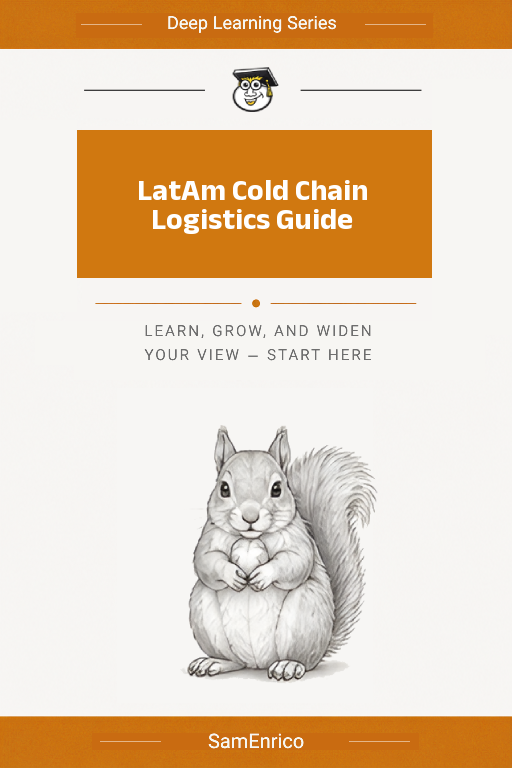
Non-FictionForecast & OutlookCold Chain
LatAm Cold Chain Logistics Guide
Project refrigerated warehouse demand, pharmaceuti
Project refrigerated warehouse demand, pharmaceutical distribution, and fruit export infrastructure.
Formats
About this book
Free sample
Chapter 1: The $25 Million Tomato--–- The pilot of the refrigerated truck didn't steal the insulin. He didn't crash the truck. He didn't even turn off the refrigeration unit. He simply parked in the shade. That single decision—made without malice, without warning, without any indication that something was wrong—destroyed $2.3 million worth of temperature-sensitive medicine destined for a diabetes clinic in Managua, Nicaragua.
The shade, it turned out, was on the east side of a warehouse. By 2 PM, the sun had moved. The truck sat in direct 37°C heat for five hours while the driver waited for a customs official who had gone home early because his daughter was sick. The refrigeration unit, designed to maintain 4°C, could not overcome the combined effect of solar radiation, poor insulation, and an undersized condenser. The internal temperature reached 18°C by hour three and 24°C by hour five.
Every vial was denatured. The clinic's patients received nothing. The exporter ate the loss. The driver kept his job—because, after all, he had followed every written procedure.This is not a story about bad people. It is a story about a bad system.
And until you understand that distinction, you will lose money in Latin American cold chain logistics. Not maybe. Not sometimes. You will lose money, and you will not even know why.The Arithmetic of Loss That No One Talks About Let me give you a number: 23 percent. That is the average annual loss rate for temperature-sensitive products moving through Latin American cold chains, according to aggregated data from the Inter-American Development Bank and three major cargo insurers who wished to remain anonymous.
Twenty-three percent. For fruit exporters, that number is closer to 30 percent for certain crops like raspberries and blackberries. For pharmaceutical distributors, it ranges from 2 to 7 percent of product value annually—which sounds small until you realize that 2 percent of a 10millionshipmentis10 million shipment is 10millionshipmentis200,000, and that happens multiple times per year.Here is the number that matters more: 0.2 percent. That is the loss rate for the same products moving through a well-managed cold chain in…
This is the end of the free sample. Get the eBook to keep going. Buy now
Contents
- Chapter 1
- Chapter 2
- Chapter 3
- Chapter 4
- Chapter 5
- Chapter 6
- Chapter 7
- Chapter 8
- Chapter 9
- Chapter 10
- Chapter 11
- Chapter 12
Details
- Author
- Paine Francesco
- Publisher
- SamEnrico
- Language
- English
- Genre
- Non-Fiction, Forecast & Outlook, Cold Chain
- Released
- 2026-05-29
- Pages (approx.)
- 144
- Available as
- eBook, Audiobook

Read better in the ZLOADR app
Your eBooks on your phone or tablet. Sign in with your SamEnrico account and start reading.
More by Paine Francesco
 Adult Child Relationship Self Esteem CoursePaine Francesco$11.99
 Podium Arrival RoutinePaine Francesco$11.99
 Burnout Prevention For Healthcare WorkersPaine Francesco$11.99
 Anger and Blame Cycle GuidePaine Francesco$11.99
 The Geo Arbitrage Travel Hacking IntegrationPaine Francesco$11.99
 The Silent Sentinel: The Untold Story of Cassandra of TroyPaine Francesco$11.99
 How to Become a Nuclear-fuels Research EngineerPaine Francesco$11.99
 Understanding Lymphatic FilariasisPaine Francesco$17.99
 Executive Summary Word Count GuidePaine Francesco$12.99
 Hospital HousekeepingPaine Francesco$11.99
You may also like
 Hong Kong Handover 1997Dunn Johnnie$11.99
 Zumba For Postnatal Recovery CourseNeal Christian$11.99
 Zumba for BeginnersLadner Nikia$11.99
 YouTube Comment Mining GuideHumes Pandora$12.99
 Worry Box MeditationCarlin Rudy$11.99
 Workplace Stress MeditationNguyen Lynn$11.99
 Workplace Stress and Sleep RepairHawley Ivory$11.99
 Workplace Perfectionism CureDelaney Jeffry$11.99
 Workplace Injustice Anger GuideWallen Isabelle$11.99
 Work Addiction and Burnout LinkGreenwood Ester$11.99
 Women in Yoga and WellnessBeattie Galina$11.99
 Women in Stand Up ComedyChun Evangeline$11.99