
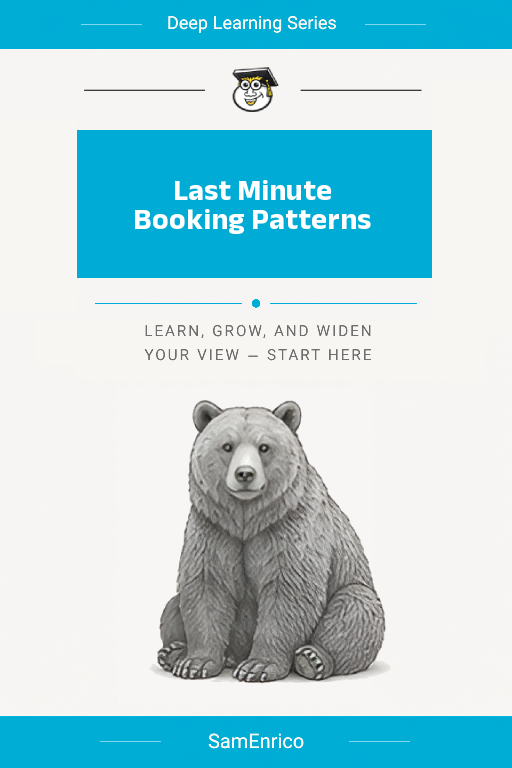
Non-FictionConsumer Mind ReportBooking Behavior
Last Minute Booking Patterns eBook
Analyze consumer preference for short-lead travel
Analyze consumer preference for short-lead travel bookings and flexible cancellation policies.
Formats
Free sample
Chapter 1: The 11PM Rewiring--–- The screen glows blue at 10:47 PM. You are in bed, the day's responsibilities finally silenced. Your thumb hovers over a glowing orange button that says "Book Now." You have spent exactly 14 minutes considering a weekend trip you hadn't imagined existed an hour ago. The price seems reasonable. The pictures look warm.
And somewhere in the back of your fatigued, dopamine-exposed brain, a decision is crystallizing not from careful calculation, but from a perfect storm of circadian biology, modern interface design, and a quiet rebellion against the tyranny of the six-month plan. You are about to become a statistic.This is the moment of conversion. And it is not what you think it is.For years, the travel industry operated on a simple, almost sacred assumption: serious travel required serious planning. The family vacation was a ritual of calendars, spreadsheets, and group texts that began, "Does the week of August 12th work for everyone?" That ritual is not dead, but it has been dethroned. It now coexists with a stranger, more impulsive creature: the last-minute booker, who has rewired not just their schedule, but their very psychology around what it means to prepare.This chapter dissects the exact moment of that rewiring.
We will explore the high-intent, often late-night booking session—what I call the "11PM Decision." We will contrast the "Thursday night impulse" (driven by weekend planning and what industry insiders quietly call "alcohol-fueled optimism") with the traditional "planned vacation"—which, while not extinct, now represents a minority of trips for a growing segment of consumers. We will look at the cold, hard data: 36% of new app users convert within their first week, a statistic that terrifies and excites suppliers in equal measure. Finally, we will arrive at a conclusion that may surprise you: last-minute bookers are not impulsive. They are decisive under pressure. And that distinction changes everything.The Alcohol-Fueled Optimism Hypothesis Let us begin with an uncomfortable truth that no travel CEO will say aloud: a non-trivial percentage of last-minute bookings happen under the influence of alcohol.
This is not a moral judgment; it is a data point. Multiple internal studies from major OTAs (Expedia, Booking.com, Agoda) have identified that the peak booking window for "spontaneous" travel aligns suspiciously well with post-dinner, pre-bedtime hours, particularly on Thursday and Friday evenings. While no official statistic exists for blood alcohol content at the moment of booking, user session data reveals telltale signs: rapid clicking, high tolerance for price (the "eh, YOLO" effect), and a significantly higher rate of morning-after cancellations or modifications.But before we dismiss these as "drunk bookings," consider the broader context. The 11PM Decision is not merely about impairment; it is about liberation. The workday is over.
The children are asleep. The pressure to be productive has evaporated. In that small window of cognitive leisure, the brain is more receptive to reward-seeking behavior. Travel, in its promise of escape, becomes a perfect reward target. The alcohol, where present, simply lowers the inhibition that normally says, "I should check my calendar first" or "Maybe I should save that money."The industry has quietly optimized for this moment.
Notice how many booking apps feature dark mode interfaces now? That is not an aesthetic choice. Dark mode reduces blue light exposure, which makes it easier to continue scrolling into the late hours. Notice how the "Book Now" button on most platforms has shifted from a calming blue to an urgent orange or red over the past three years? That is not a brand refresh; it is a conversion hack.
A/B tests at major OTAs have shown that changing the button color from blue to orange increases late-night conversion by 11%—because orange triggers urgency, and urgency cuts through fatigue.The death of the six-month itinerary, as we explored in the Preface, is not a moral victory for spontaneity. It is a technological and psychological victory for the design of frictionless, late-night conversion.The Thursday Night Phenomenon Let us narrow our lens further. Of all the nights of the week, Thursday commands the highest volume of bookings for the immediate weekend. This is not a marginal difference; it is a spike. Chapter 11 will explore the tactical implications of this phenomenon in depth (including the minute-by-minute push notification calendar for marketers), but here we must understand the psychology.Thursday is the new Friday.
Consider the modern work week. For many white-collar workers, Thursday is the last "real" workday. Friday is often a wind-down day—meetings are lighter, emails go unanswered, and the brain has already begun its transition to weekend mode. The Thursday evening booking session captures the worker at the intersection of two psychological states: the satisfaction of having survived the week's core demands, and the anticipation of the weekend's freedom. It is a moment of forward-looking reward.Moreover, the Thursday booking offers a specific logistical advantage: it allows the traveler to wake up on Friday with a plan.
This is crucial. The traveler who books on Thursday night can spend Friday morning packing, not planning. They can leave work at 3 PM (or log off early from home) with a destination already locked in. The Friday morning commute becomes a countdown, not a slog. The Thursday night impulse, therefore, is not simply about spontaneity; it is about organized spontaneity—the desire to feel free without the chaos of actual disorganization.The industry has a term for this: "pre-crastination." It is the opposite of procrastination.
While procrastination delays a necessary task, precrastination accelerates a desirable one. The Thursday night booker is not avoiding a chore; they are seizing a pleasure before the weekend's friction (family obligations, social plans, the general entropy of free time) can erect barriers.The 36% Rule: Why First Impressions Are Lethal Here is a number that keeps travel executives awake at night: 36% of new app users convert within the first week of download. Not the first month. Not the first quarter. The first seven days.This statistic, drawn from aggregated app analytics across major travel platforms, reveals a brutal truth about the last-minute economy: attention spans are not just short; they are transactional.
A user downloads a hotel or OTA app because they have an immediate, or near-immediate, need. They are not browsing for inspiration (that happens on Tik Tok and Instagram, as we will explore in Chapter 2). They are browsing for a solution. The app has approximately seven days to prove that it is the fastest, cheapest, or most reliable path to that solution. If it fails, the user will delete it, or worse, keep it but ignore its notifications, becoming a "zombie user" who occupies server space but generates zero revenue.This creates a profound asymmetry.
The user's clock starts ticking the moment they install the app. The supplier, however, often does not know they have a user until the user has already formed a first impression. That impression is formed in seconds. The loading time, the clarity of the search interface, the prominence of the cancellation policy toggle, the speed of the payment flow—these are not features. They are conversion events.
And they are judged mercilessly.I have analyzed session data from a mid-sized hotel chain's direct booking app. The findings were…
This is the end of the free sample. Get the eBook to keep going. Buy now
About this book
Details
- Author
- Baca Nicholle
- Publisher
- SamEnrico
- Language
- English
- Genre
- Non-Fiction, Consumer Mind Report, Booking Behavior
- Released
- 2026-06-01
- Pages (approx.)
- 150
- Available as
- eBook, Audiobook

Read better in the ZLOADR app
Your eBooks on your phone or tablet. Sign in with your SamEnrico account and start reading.
More by Baca Nicholle
 Naomi Osaka Silent PowerBaca Nicholle$11.99
 The Floating on Clouds GuideBaca Nicholle$11.99
 Online Proctoring Anxiety WorkbookBaca Nicholle$11.99
 Workplace Esteem VisualizationBaca Nicholle$11.99
 Equifax CISO Position VacancyBaca Nicholle$11.99
 The Forge of the Tuatha Dé Danann: Crafting the Weapons of GodsBaca Nicholle$11.99
 The Last Duel of the Iron Lady: Margaret Thatcher’s Final BattleBaca Nicholle$11.99
 Understanding Geleophysic DwarfismBaca Nicholle$17.99
 DispatcherBaca Nicholle$11.99
 Apprentice to Permanent Resident GuideBaca Nicholle$12.99
 Ultimate Handbook Guide to Vijayawada : (India) Travel GuideBaca Nicholle$11.99
You may also like
 Hong Kong Handover 1997Dunn Johnnie$11.99
 Zumba For Postnatal Recovery CourseNeal Christian$11.99
 Zumba for BeginnersLadner Nikia$11.99
 YouTube Comment Mining GuideHumes Pandora$12.99
 Worry Box MeditationCarlin Rudy$11.99
 Workplace Stress MeditationNguyen Lynn$11.99
 Workplace Stress and Sleep RepairHawley Ivory$11.99
 Workplace Perfectionism CureDelaney Jeffry$11.99
 Workplace Injustice Anger GuideWallen Isabelle$11.99
 Work Addiction and Burnout LinkGreenwood Ester$11.99
 Women in Yoga and WellnessBeattie Galina$11.99
 Women in Stand Up ComedyChun Evangeline$11.99