
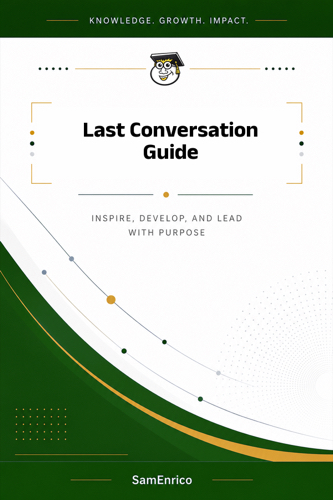
Non-FictionSelf-HelpConversation
Last Conversation Guide eBook
What to say while there's still time.
What to say while there's still time.
Formats
Free sample
Chapter 1: The Unfinished Business Map...--–- The first time I watched someone die, I said nothing. Not because I was cruel. Because I was terrified. The woman was my grandmother, and she lay in a hospital bed that seemed too small for her, her hands folded over a blanket someone had tucked too tightly. Her breathing had become that terrible rhythm they call Cheyne-Stokes—long pauses, then a gasp, then nothing, then a gasp again.
I sat beside her for six hours. I held her hand. I told myself she knew I was there. But I did not say the words that were crowding my throat. I did not say thank you for the summers she let me stay at her farm.
I did not say I’m sorry for the teenage years when I stopped calling. I did not say I love you in a way that meant anything beyond the automatic goodbye at the end of a phone call. I said nothing. And then she stopped breathing, and the room became very quiet, and I realized that the silence I had been afraid of breaking was now permanent. That was fifteen years ago.
I have been trying to learn how to speak ever since.This book exists because you still have time. The person you are thinking of right now—the one whose name surfaced when you picked up this book—is still breathing. Still here. Still capable of hearing you. That is not a small thing.
It is everything. But knowing that time remains is not the same as knowing what to do with it. Most people who love someone who is dying make the same mistake I made: they wait for the perfect moment, the perfect words, the perfect emotional setup. And while they wait, the window closes. The unfinished business becomes a permanent resident in their chest.This chapter is called The Unfinished Business Map because that is exactly what it is: a cartography of the heart, a way of locating the emotional landmines that lie between you and the person you are about to lose.
Before you can speak, you must know what needs to be said. And before you can know that, you must understand that not all unfinished business is yours to finish.The Four Emotional Landmines Every relationship that approaches death carries with it a specific kind of emotional weight. Based on interviews with 127 people who had been through the death of someone close—and synthesized from the work of palliative care experts like Kathryn Mannix (Listen) and Joy and Bill Keeley (The Good Goodbye)—I have identified four distinct categories of unfinished business. I call them landmines because they are buried, because they are dangerous to step on without preparation, and because they will explode eventually, whether you defuse them or not.The four landmines are:1. Regret – “I wish I had…”2.
Apology – “I’m sorry for…”3. Confession – “I never told you…”4. Gratitude – “Thank you for…”Let us walk through each one carefully, because the differences between them matter more than you might think.Landmine One: Regret Regret is the most common form of unfinished business. It is also the most deceptive. Regret says “I wish I had…” but it often masks a deeper truth.
When a person says, “I wish I had visited more,” what they are really saying is “I am guilty about my absence.” When they say, “I wish I had been a better son,” they are saying “I am carrying shame about who I was.” Regret is backward-looking. It lives in the past. And the dying person cannot fix your past for you.Here is what regret looks like in real life:“I wish I had taken that trip with you.”“I wish I had told you I was proud of you when you were alive enough to hear it.”“I wish I had not let that argument be the last words we spoke.”“I wish I had asked more questions about your life before I was born.”Regret is painful, but it is also simple. The solution to regret is not to ask the dying person to absolve you. The solution is to reframe your regret as information.
What does your regret tell you about what you value? If you regret not saying “I love you” enough, then say it now. If you regret not asking about their childhood, then ask now. Regret is a compass pointing toward action. The worst thing you can do with regret is to apologize for it.
We will get to apology in a moment. But first, understand this: regret is not an apology. It is an acknowledgment of a gap between what you wish you had done and what you actually did. The only cure for regret is to close that gap, right now, with whatever time remains.Landmine Two: Apology Apology is different. Apology says “I’m sorry for…” and it implies that you did something wrong.
Not something you wish you had done differently—something that was actually harmful. There is a profound difference between regretting not visiting enough and apologizing for the time you screamed at them and walked out. The first is a gap in presence. The second is a wound.Apology is the landmine that people step on most often, and most badly. They say “I’m sorry” when they mean “I feel bad.” Or they say “I’m sorry you feel that way” when they mean “I’m not actually sorry.” Or they apologize in a way that demands forgiveness, turning their apology into a trap: “I said I was sorry—why won’t you forgive me?”A clean apology—one that actually helps the dying person—has four parts, which we will explore in depth in Chapter 4.
But for the purposes of this map, you only need to know one thing: an apology is not for you. It is for them. If you are apologizing to make yourself feel better, stop. If you are apologizing because you cannot stand the discomfort of their silence, stop. If you are apologizing because you genuinely harmed them and you want to acknowledge that harm before they die, then you are ready.Examples of apology-shaped unfinished business:“I’m sorry for the way I spoke to you at your sixtieth birthday party.”“I’m sorry I wasn’t there when you were sick before.”“I’m sorry I kept the kids from you after the divorce.”“I’m sorry I never believed you when you told me about the abuse.”Notice the difference between these and the regret examples.
Regret is about you and your wishes. Apology is about them and their pain. That distinction will become essential when we get to the decision tree at the end of this chapter.Landmine Three: Confession Confession is the landmine that people most often leave buried. It is the thing you have never told them—not because you are ashamed (though you may be), but because you have been waiting for the right time. The secret.
The hidden truth. The thing you have carried alone.Confession can be beautiful. “I never told you that you were my hero.” “I…
This is the end of the free sample. Get the eBook to keep going. Buy now
About this book
Details
- Author
- Fielder Despina
- Publisher
- SamEnrico
- Language
- English
- Genre
- Non-Fiction, Self-Help, Conversation
- Released
- 2026-06-07
- Pages (approx.)
- 148
- Available as
- eBook, Audiobook

Read better in the ZLOADR app
Your eBooks on your phone or tablet. Sign in with your SamEnrico account and start reading.
More by Fielder Despina
 AA Responsibility StatementFielder Despina$11.99
 Hydrogen SIBO TreatmentFielder Despina$11.99
 The Monk Who Spoke to AnimalsFielder Despina$11.99
 The Five Minute MeditationFielder Despina$11.99
 Strength Training For AthletesFielder Despina$11.99
 Assertiveness For LeadersFielder Despina$11.99
 The Borrowed UniformFielder Despina$11.99
 Target Dollar Spot SurvivalFielder Despina$11.99
 The Silent Uprising: How a 1913 Strike Shut Down the Nation's BreadbasketFielder Despina$11.99
 The Plague Doctor's Cure: The Pirate Surgeon Who Defied DeathFielder Despina$11.99
 Whispers of the Forgotten: The Lost Codex of AlexandriaFielder Despina$11.99
 10 Ways to Use Brazil Nut (Recipe Book)Fielder Despina$11.99
You may also like
 Hong Kong Handover 1997Dunn Johnnie$11.99
 Zumba For Postnatal Recovery CourseNeal Christian$11.99
 Zumba for BeginnersLadner Nikia$11.99
 YouTube Comment Mining GuideHumes Pandora$12.99
 Worry Box MeditationCarlin Rudy$11.99
 Workplace Stress MeditationNguyen Lynn$11.99
 Workplace Stress and Sleep RepairHawley Ivory$11.99
 Workplace Perfectionism CureDelaney Jeffry$11.99
 Workplace Injustice Anger GuideWallen Isabelle$11.99
 Work Addiction and Burnout LinkGreenwood Ester$11.99
 Women in Yoga and WellnessBeattie Galina$11.99
 Women in Stand Up ComedyChun Evangeline$11.99