
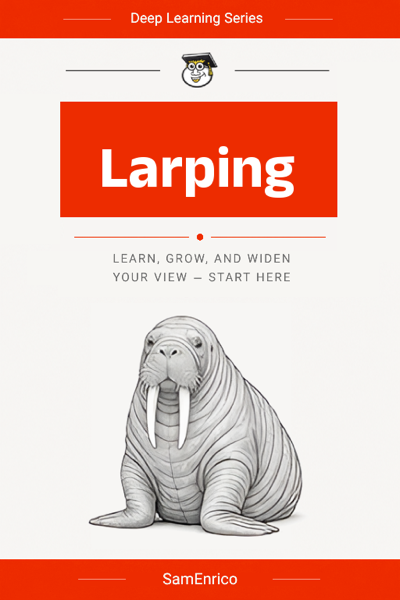
Non-FictionInformativeEducational
Larping eBook
A Coursebook on Larping
A Coursebook on Larping
Formats
Free sample
Chapter 1: The Foam Sword Paradox...--–- You are holding a book about pretending. Not the kind of pretending you did as a child, hiding under a blanket fort with a cardboard sword, convinced that the family cat was actually a dragon. That kind of pretending was instinctive, effortless, and socially acceptable only because you were young enough to be forgiven for having an imagination. Somewhere between elementary school and your first real job, the world taught you that pretending was something to outgrow. The blanket fort became a cubicle.
The cardboard sword became a spreadsheet. And the dragon? The dragon became a mortgage, a performance review, an inbox that never empties.But here is the secret that millions of live-action roleplayers have discovered: the longing to pretend never actually leaves. It only goes underground. It surfaces in the way you binge fantasy television shows, the way you lose yourself in open-world video games, the way you craft elaborate backstories for your tabletop RPG character, the way you people-watch at a Renaissance faire and feel a quiet ache that you are watching rather than participating.
That ache is not nostalgia for childhood. It is a legitimate, adult hunger for something that the modern world has systematically starved out of us: embodied, unmediated, consequence-light but meaning-heavy play.This book is not a permission slip to be childish. It is a field manual for reclaiming something that every human culture before ours understood as essential. Live-action roleplaying, or LARP, is not a niche hobby for people who cannot tell the difference between fantasy and reality. It is not a collection of socially awkward adults hitting each other with foam swords in the woods, although that does happen and it is frequently wonderful.
LARP is a hybrid art form that sits at the intersection of improvisational theater, tabletop gaming, costume design, martial arts, and community psychology. It is the closest thing we have to stepping inside a story and walking around.This chapter is called "The Foam Sword Paradox" because that simple object—a fake weapon made of foam, tape, and a fiberglass core—contains the central mystery of LARP. It is simultaneously ridiculous and profound. It is clearly not a sword. And yet, when you hold it, when you face another person who has agreed to the same rules, when you both commit to the shared fiction that this foam tube can kill or be killed by that foam tube, something remarkable happens.
You are no longer two strangers in a field. You are a knight and a goblin. You are protecting something. You are risking something. And for a few seconds or minutes, you believe it.
Not because you are delusional, but because you have chosen to believe. That choice—conscious, collaborative, adult—is the beating heart of LARP.If you are reading this book, you likely fall into one of three categories. First, you may be a complete newcomer who heard about LARP somewhere—a podcast, a friend, a You Tube video of a massive battle with hundreds of costumed players—and you are curious but also nervous. You are not sure if you belong. You are not sure if you are the "type" of person who does this.
Second, you may have attended a LARP once or twice, had a mixed experience, and want to understand what went right, what went wrong, and how to do it better. Third, you may be an experienced roleplayer looking to deepen your craft, move from player to plot team, or help run your own game. Wherever you stand, this book is designed as a coursebook. Each chapter builds on the last. By the end, you will have the knowledge to create a character, build a costume, choose a game, act immersively, handle safety tools, and even organize your own event.But first, we have to clear the ground.
Because before you can enjoy LARP, you have to unlearn a great deal of nonsense that society has taught you about what is embarrassing, what is childish, and what is worth your time as an adult.The Four Deadly Myths About LARPMyth number one: LARPers are people who cannot distinguish fantasy from reality. This is the most persistent and most easily disproven stereotype. It persists because the media loves to find the most extreme outlier—someone who genuinely believes they are a vampire or who has trouble holding down a job because they are too invested in their elf character—and present that person as representative. In reality, LARP requires a more sophisticated relationship with reality than almost any other hobby. You must hold two truths in your head simultaneously: this is a foam sword, and this is a magic blade.
Those two truths do not cancel each other out. They coexist. Professional actors do this every day. So do children on a playground. So do religious practitioners during ritual.
So do couples renewing their wedding vows. The human brain is extraordinarily good at maintaining parallel realities. LARP simply exercises that muscle in a social, recreational context.Myth number two: LARP is primarily about combat. This myth comes from the most visible images of LARP—battle photos, video montages of large clashes, and the natural human tendency to film the loudest thing happening. But combat-focused LARPs, often called boffer LARPs (a term we will define fully in a moment), are only one branch of a much larger tree.
Parlor LARPs involve no physical combat at all. They are essentially interactive murder mysteries or political dramas played in costumes, often indoors, over a single evening. Nordic LARPs focus on emotional exploration and difficult themes, sometimes with no combat mechanics whatsoever. Even within boffer LARPs, many players spend far more time negotiating, crafting, investigating, or gossiping than they do swinging a foam sword. The combat is the exclamation point, not the sentence.Myth number three: LARP is expensive.
This myth is partially true in the same way that "cooking is expensive" is partially true. You can spend thousands of dollars on a custom-made suit of leather armor, a hand-forged (foam) replica sword, and a weekend at a blockbuster event with professional sets and catering. Or you can spend fifty dollars at a thrift store, borrow a basic boffer from a game's loaner bin, and attend a one-day local game. Both are LARP. Both can be deeply satisfying.
The book will return to budgeting repeatedly, but for now, understand that LARP has a very low financial barrier to entry and a very high ceiling for those who want to invest. Do not let the existence of expensive options convince you that the cheap options are not "real" LARP.Myth number four: LARP is for people who have no social skills. This myth contains a kernel of irony, because LARP is one of the most socially demanding activities a person can do. You must read other people's emotional states, negotiate consent, improvise dialogue, remember rules, stay in character while also monitoring your own safety, and collaborate with strangers toward a shared narrative goal. Many LARPers describe the hobby as social skills boot camp.
Yes, some socially awkward people are drawn to LARP, just as some socially awkward people are drawn to book clubs…
This is the end of the free sample. Get the eBook to keep going. Buy now
About this book
Details
- Author
- Inman Lorinda
- Publisher
- SamEnrico
- Language
- English
- Genre
- Non-Fiction, Informative, Educational
- Released
- 2026-06-02
- Pages (approx.)
- 135
- Available as
- eBook, Audiobook

Read better in the ZLOADR app
Your eBooks on your phone or tablet. Sign in with your SamEnrico account and start reading.
More by Inman Lorinda
 Weekend Sleep MemoryInman Lorinda$11.99
 Nairobi Gig Economy Startup GuideInman Lorinda$11.99
 Etsy Digital Planner Competition AnalysisInman Lorinda$11.99
 Difficult Sales NegotiationsInman Lorinda$11.99
 Focus Recovery After InterruptionInman Lorinda$11.99
 Whispers of the Lost City: The Vanishing of AztlánInman Lorinda$11.99
 The Silk Road Heist: Marco Polo’s Lost FortuneInman Lorinda$11.99
 Understanding CholangiocarcinomaInman Lorinda$17.99
 Intranet Content GovernanceInman Lorinda$12.99
 Faith Leader on Mental BoardInman Lorinda$12.99
 Ultimate Handbook Guide to Patna : (India) Travel GuideInman Lorinda$11.99
You may also like
 Hong Kong Handover 1997Dunn Johnnie$11.99
 Zumba For Postnatal Recovery CourseNeal Christian$11.99
 Zumba for BeginnersLadner Nikia$11.99
 YouTube Comment Mining GuideHumes Pandora$12.99
 Worry Box MeditationCarlin Rudy$11.99
 Workplace Stress MeditationNguyen Lynn$11.99
 Workplace Stress and Sleep RepairHawley Ivory$11.99
 Workplace Perfectionism CureDelaney Jeffry$11.99
 Workplace Injustice Anger GuideWallen Isabelle$11.99
 Work Addiction and Burnout LinkGreenwood Ester$11.99
 Women in Yoga and WellnessBeattie Galina$11.99
 Women in Stand Up ComedyChun Evangeline$11.99