
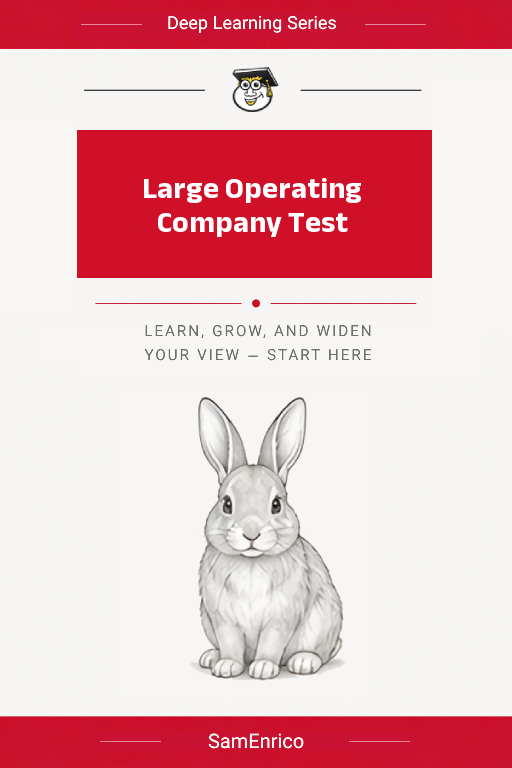
Non-FictionAnnual CheckupLarge OperatingTest
Large Operating Company Test eBook
Qualify for CTA large operating company exemption
by Bowman Jean
Qualify for CTA large operating company exemption using employee count, physical presence, and revenue tests.
Formats
Free sample
Chapter 1: The $10,000 Mistake--–- The certified public accountant had just finished reviewing the tax returns. He looked up at Maria, the founder of a thriving 45-person logistics company, and delivered the news with the casual tone of someone discussing the weather. "Good news," he said. "You don't have to file that new federal ownership report. Your company is too big to qualify.
Just check the exemption box and you're done."Maria trusted her CPA. He had handled her taxes for eleven years, saved her thousands in legitimate deductions, and never once steered her wrong. So she checked the box. She declared her company exempt from the Corporate Transparency Act's Beneficial Ownership Information reporting requirements under the "large operating company" exemption. She moved on with her life, confident that she had handled yet another government compliance matter efficiently and correctly.Eighteen months later, a letter arrived from the Financial Crimes Enforcement Network—Fin CEN.
It was not a gentle inquiry. It was a Notice of Proposed Penalty: 500perdayfor347days,totaling500 per day for 347 days, totaling 500perdayfor347days,totaling173,500 in civil fines, plus a referral to the Department of Justice for potential criminal prosecution. The reason? Maria's company did not actually qualify for the large operating company exemption. Her CPA had misunderstood the rules.
And Maria, as the company's beneficial owner, was personally liable.This story is true. The names have been changed, but the facts are drawn directly from enforcement actions that began in late 2025. Maria's mistake—trusting a well-meaning professional who had not studied the Corporate Transparency Act in depth—is about to be repeated thousands of times across the United States. This book exists to ensure that you are not one of those business owners.The Corporate Transparency Act went into full effect in 2024, and with it came a seismic shift in how American businesses report ownership information to the federal government. For the first time in history, tens of millions of corporations, limited liability companies, and similar entities must disclose their true human owners to Fin CEN, a bureau of the U.S.
Treasury Department best known for tracking money laundering and terrorist financing. The penalties for noncompliance are severe. The exceptions are narrow. And the most common path to avoiding the reporting requirement—the large operating company exemption—is also the most misunderstood.This chapter does three things. First, it tells you exactly what the Corporate Transparency Act is and why Congress passed it.
Second, it explains the 23 exemptions to the reporting requirement, with special focus on why the large operating company exemption is the only realistic option for most privately held, mid-market businesses. Third, it gives you the terrifying truth about what happens when you get the exemption wrong—not to scare you, but to arm you with the motivation to read the remaining eleven chapters of this book carefully.By the time you finish this chapter, you will know whether you are at risk, why your accountant or lawyer might already have given you bad advice, and precisely what is at stake for you personally—not just your company, but you as an individual owner or manager.The Corporate Transparency Act: A Brief History of Why This Exists To understand the large operating company exemption, you must first understand the problem Congress was trying to solve. The Corporate Transparency Act did not emerge from a vacuum. It was the product of nearly two decades of bipartisan concern about a specific vulnerability in the American financial system: the anonymous shell company.Here is how the vulnerability works. Before the CTA, anyone could form a corporation or LLC in any of the 50 states by filing simple paperwork with the secretary of state.
That paperwork typically required the name of the entity, the name of a registered agent (often a lawyer or a commercial service), and a mailing address. It did not require the names of the human beings who owned or controlled the entity. A person could walk into a Delaware office, pay a few hundred dollars, and walk out with a legal corporation that had no publicly traceable connection to its actual owner.That corporation could then open a bank account. It could buy real estate. It could wire funds internationally.
It could enter into contracts. And if that corporation was used to launder drug money, evade taxes, finance terrorism, or defraud elderly investors through a fake charity, law enforcement faced an enormous obstacle: they had to spend months or years peeling back layers of corporate entities to discover the human being who was actually pulling the strings.The numbers are staggering. A 2020 study by the FACT Coalition examined 29 major money laundering cases and found that anonymous shell companies were used in 70 percent of them. The Panama Papers investigation, which analyzed 11.5 million leaked documents, revealed how politically exposed persons, sanctioned individuals, and criminal networks used US shell companies to move billions of dollars. The United States, ironically, had become the world's premier haven for anonymous corporate structures—not because Americans were uniquely corrupt, but because the US was one of the few major economies without a centralized registry of beneficial ownership information.The Corporate Transparency Act changed that.
Buried inside the National Defense Authorization Act for Fiscal Year 2021 (a massive defense spending bill that passed with overwhelming bipartisan support), the CTA directed Fin CEN to create a national database of beneficial ownership information. Starting in 2024, most corporations, LLCs, and similar entities must report the names, addresses, dates of birth, and identification numbers of all "beneficial owners"—defined as any individual who directly or indirectly owns at least 25 percent of the entity or exercises substantial control over it.The database is not public. Law enforcement, financial regulators, and certain other authorized government agencies can access it. Banks can access it with customer consent. But your competitors, your neighbors, and the general public cannot look up your information.
This is an important distinction that will resurface in Chapter 10 when we discuss state-level registries that may be public.The CTA was supposed to take effect in 2022, then 2023, then finally January 1, 2024. Fin CEN pushed back deadlines multiple times as it built its filing system and responded to industry concerns. As of the publication of this book, the filing requirements are in full effect, and Fin CEN has begun active enforcement.The 23 Exemptions: Why Most Businesses Don't Qualify (But Think They Do)Congress recognized that requiring every single corporation and LLC in America to file ownership reports would be absurd overkill. A publicly traded company on the New York Stock Exchange already discloses its ownership to the Securities and Exchange Commission. A bank already reports its ownership to multiple federal banking regulators.
A small nonprofit already files detailed ownership information with the IRS as part of its tax-exempt application.Therefore, the CTA includes 23 specific exemptions. If your entity falls into any of these categories, you do not need to file a BOI report. Period. No forms, no deadlines, no penalties. You are simply exempt.Here are the exemptions, grouped logically:The Already-Transparent Entities (Exemptions 1-5):Issuers that are publicly traded companies registered with the SECGovernmental authorities at the federal, state, tribal, or local level Banks, credit unions, and bank holding companies Broker-dealers registered with…
This is the end of the free sample. Get the eBook to keep going. Buy now
About this book
Details
- Author
- Bowman Jean
- Publisher
- SamEnrico
- Language
- English
- Genre
- Non-Fiction, Annual Checkup, Large Operating, Test
- Released
- 2026-05-30
- Pages (approx.)
- 142
- Available as
- eBook, Audiobook

Read better in the ZLOADR app
Your eBooks on your phone or tablet. Sign in with your SamEnrico account and start reading.
More by Bowman Jean
 Zoo and Aquarium InsuranceBowman Jean$11.99
 Beginner Fitness for Desk WorkersBowman Jean$11.99
 Metta for Religious Trauma GuideBowman Jean$11.99
 SEC Enforcement Action LogBowman Jean$11.99
 Antwerp Diamond Heist Cold Case BreakBowman Jean$11.99
 The Forgotten Navigator: Ma Jun's Epic Voyage Through the South China SeasBowman Jean$11.99The Forgotten Navigator: Ma Jun's Epic Voyage Through the South China SeasBowman Jean$11.99
 The Forgotten Heir: The Untold Story of Louis XVIIBowman Jean$11.99
 Yard PersonBowman Jean$11.99
 FinCEN BOI Filing DeadlinesBowman Jean$12.99
 Understanding Diabetes Insipidus, Nephrogenic Type 1Bowman Jean$17.99
 How to Start a Hobby in Kart racingBowman Jean$11.99
You may also like
 Hong Kong Handover 1997Dunn Johnnie$11.99
 Zumba For Postnatal Recovery CourseNeal Christian$11.99
 Zumba for BeginnersLadner Nikia$11.99
 YouTube Comment Mining GuideHumes Pandora$12.99
 Worry Box MeditationCarlin Rudy$11.99
 Workplace Stress MeditationNguyen Lynn$11.99
 Workplace Stress and Sleep RepairHawley Ivory$11.99
 Workplace Perfectionism CureDelaney Jeffry$11.99
 Workplace Injustice Anger GuideWallen Isabelle$11.99
 Work Addiction and Burnout LinkGreenwood Ester$11.99
 Women in Yoga and WellnessBeattie Galina$11.99
 Women in Stand Up ComedyChun Evangeline$11.99