
Non-FictionSelf-HelpBreast Size
Large Chest Self Esteem eBook
Manage unwanted attention and back pain while acce
by Hull Sherron
Manage unwanted attention and back pain while accepting your body.
Formats
Free sample
Chapter 1: The Unseen Weight...–- You wake up before your alarm. Not from the light, not from a dream, but from the familiar ache that has become your morning companion. Your neck is stiff, your shoulders feel like they have been carrying bricks overnight, and somewhere between your shoulder blades, there is a knot the size of a fist that has not fully released in years. You take a breath, but it is shallow. Your chest feels tight, armored, as if your own rib cage is holding something back.This is not how bodies are supposed to feel.
And yet, if you are reading this book, you have likely accepted this as normal for so long that you have stopped noticing the individual sensations. They have merged into a single, low-frequency hum of discomfort that you carry from bed to shower to coffee to car to desk to dinner to couch to bed, day after day, year after year.But here is what you may not have realized: the physical weight on your chest and the social weight of unwanted attention are not separate problems. They are the same problem, wearing two different masks. The ache in your neck and the knot in your stomach when someone stares are two branches of the same root. And until you treat the root, you will keep trimming the branches, wondering why they always grow back.This chapter is an invitation to stop trimming branches.
This is where we name the full burden, validate that it is real, and give you the tools to start measuring what you have been carrying in silence. Because you cannot heal what you refuse to see. And you cannot change what you refuse to measure.The Secret That Pain Science Already Knows In the world of chronic pain research, there is a framework that has revolutionized how clinicians understand suffering. It is called the bio-psycho-social model. The name is dry, but the idea is radical: your pain is never purely physical, never purely psychological, and never purely social.
It is always all three, tangled together like headphones in a pocket.For decades, the medical model treated pain as a purely mechanical problem. Something was broken, you fixed it, the pain went away. But that model fails spectacularly for chronic pain, and it fails spectacularly for the large-chested experience. Because what is "broken" cannot be fixed with a single surgery or a single posture correction. What is "broken" is a system, and systems require systemic solutions.Let me translate the bio-psycho-social model into the language of your body.The biological burden is the weight itself.
Breast tissue is not weightless. A pair of D-cup breasts weighs between 15 and 23 pounds, depending on your band size and tissue density. That is the equivalent of strapping a small toddler to your chest and never, ever putting them down. That weight pulls your shoulders forward, shortens your pectoral muscles, forces your upper trapezius to work triple shifts, and compresses the discs in your cervical spine. Over time, this creates a predictable postural pattern called upper cross syndrome: rounded shoulders, a forward head, and a upper back that curves like a question mark.The psychological burden is what happens inside your mind as a result.
When your body is in pain, your brain becomes a threat detector. It scans for danger. It amplifies signals. It whispers, "Something is wrong with you." This is not weakness; it is survival wiring. Pain is an alarm system, and when the alarm rings all day, every day, your brain starts to assume that danger is everywhere, including inside your own skin.The social burden is the stares, the comments, the jokes, the unsolicited advice, the workplace microaggressions, the family members who think it is hilarious to point out your chest at Thanksgiving dinner, the strangers who feel entitled to an opinion about a body that is not theirs.
Each of these moments triggers the exact same stress response as physical pain: cortisol spikes, muscles guard, breath shallow. Your nervous system does not distinguish between a bulging spinal disc and a leering stranger. It only knows one thing: threat.And here is the cruel genius of the double burden: the physical weight pulls you forward, making your chest more prominent, which invites more social attention. The social attention makes you want to hide, so you slouch more, which worsens the physical pain. The pain makes you irritable and exhausted, which lowers your tolerance for social slights, which makes the attention feel even more devastating.
The cycle feeds itself, year after year, until you cannot remember what it felt like to stand upright without effort or walk into a room without scanning for eyes.You are not crazy. You are not weak. You are caught in a loop that was built around you, not by you.The Anatomy of the Forward Pull Let us get specific about what is happening inside your body, because knowledge is not just power—it is the first step out of helplessness. You do not need a medical degree to understand this. You just need a willingness to look at your own body with curiosity instead of judgment.The Weight That Never Rests Imagine holding a five-pound dumbbell in each hand, arms extended straight in front of you.
How long could you hold that position? Thirty seconds? A minute? Now imagine holding that position for sixteen hours a day, every day, for twenty years.That is what your upper back and neck are doing right now.Your breasts are not weightless appendages. They are attached to your chest wall, but their gravitational pull is forward and down.
To keep you upright, your posterior chain—the muscles along your back—must constantly counteract that pull. But here is the problem: the muscles designed for this job—the rhomboids, the middle and lower trapezius, the serratus anterior—are not the strongest muscles in your back. The strongest muscles are the upper trapezius and the levator scapulae, which run from your skull down the sides of your neck.So your body does the logical but destructive thing: it recruits the strong muscles to do a job they were never designed for. Your upper traps tighten. And tighten.
And tighten. They become rock hard, knotted, tender to the touch. They pull your shoulders up toward your ears, creating that "I am carrying the world on my shoulders" sensation that never fully goes away.Meanwhile, your pectoral muscles—your chest muscles—shorten. They adapt to the forward pull by becoming tight, thick, and inflexible. This is not a moral failing; it is simple biomechanics.
Muscles adapt to the position they spend the most time in. If you spend ten hours a day with your shoulders rolled forward, your pecs will shorten to match. And shortened pecs pull your shoulders even further forward. The cycle continues.Upper Cross Syndrome: The Posture That Pain Built The forward pull and the pectoral shortening create a predictable pattern that physical therapists call upper cross syndrome. The name comes from the shape of the imbalance: from the side, your body forms a cross of tight and weak muscles.Here is what that means for your daily…
This is the end of the free sample. Get the eBook to keep going. Buy now
About this book
Details
- Author
- Hull Sherron
- Publisher
- SamEnrico
- Language
- English
- Genre
- Non-Fiction, Self-Help, Breast Size
- Released
- 2026-06-07
- Pages (approx.)
- 158
- Available as
- eBook, Audiobook

Read better in the ZLOADR app
Your eBooks on your phone or tablet. Sign in with your SamEnrico account and start reading.
More by Hull Sherron
 Continuous Glucose Monitor GuideHull Sherron$11.99
 The Beginner's Candle GazingHull Sherron$11.99
 Restaurant Recall ProcedureHull Sherron$11.99
 Scripted Self Hypnosis Trance GuideHull Sherron$11.99
 AI Deck Export GuideHull Sherron$11.99
 The Analytical Creativity MethodHull Sherron$11.99
 Slovenian Pharma Contract ManufacturingHull Sherron$11.99
 Dreams About SchoolHull Sherron$11.99
 The Vault of Light: The Cathedral Heist of ChartresHull Sherron$11.99
 Seams of Power: The Untold Story of the First Black SupermodelHull Sherron$11.99
 Blood of the Standing Stones: The Druidic Wars of the BrigantesHull Sherron$11.99
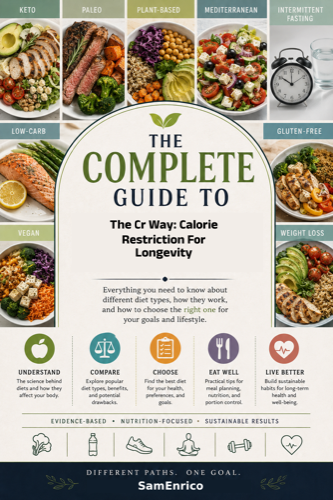 The Complete Guide to the Cr Way: Calorie Restriction For LongevityHull Sherron$11.99
You may also like
 Hong Kong Handover 1997Dunn Johnnie$11.99
 Zumba For Postnatal Recovery CourseNeal Christian$11.99
 Zumba for BeginnersLadner Nikia$11.99
 YouTube Comment Mining GuideHumes Pandora$12.99
 Worry Box MeditationCarlin Rudy$11.99
 Workplace Stress MeditationNguyen Lynn$11.99
 Workplace Stress and Sleep RepairHawley Ivory$11.99
 Workplace Perfectionism CureDelaney Jeffry$11.99
 Workplace Injustice Anger GuideWallen Isabelle$11.99
 Work Addiction and Burnout LinkGreenwood Ester$11.99
 Women in Yoga and WellnessBeattie Galina$11.99
 Women in Stand Up ComedyChun Evangeline$11.99