
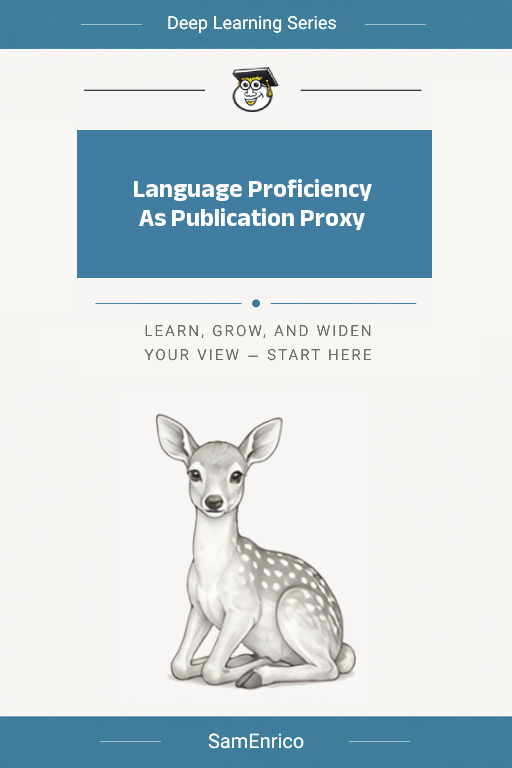
Language Proficiency As Publication Proxy eBook
Emphasize field-relevant language skills like clas
by Reedy Jamar
Emphasize field-relevant language skills like classical Chinese or statistical programming languages.
Formats
Free sample
Chapter 1: The Fluency Trap...–- The email arrived at 11:47 on a Tuesday night. Dr. Mei Lin, who had defended her dissertation fourteen months earlier, who had published two articles in respectable journals, who had spent six summers doing fieldwork in Hangzhou, and who had achieved near-native fluency in Mandarin—the kind of fluency that made taxi drivers ask her for directions—stared at her phone in disbelief."Thank you for your application to the Postdoctoral Fellowship in Modern Chinese Studies. After careful consideration, we have decided to move forward with another candidate."She had made it to the final two. The other candidate, she later learned from a sympathetic committee member, had weaker Mandarin by every measurable standard.
He stumbled through conference small talk. He needed subtitles for contemporary films. But he had spent two years in Taipei learning Classical Chinese—the language of Tang dynasty legal codes, of Song dynasty administrative records, of every significant pre-20th century text that had never been translated.He could read the archives. Mei Lin could not.The committee's internal notes, which the sympathetic member paraphrased, were brutal: "Candidate A has excellent modern language skills, but the project requires access to 12th-century judicial commentaries. Without Classical Chinese, she cannot do the work.
Candidate B can. Fluency in modern Mandarin is a nice-to-have. Fluency in Classical Chinese is a must-have for this project."Mei Lin had done everything right. She had followed the advice of her advisors, who had told her to prioritize conversational fluency. She had passed the OPI at Advanced High.
She had lived the language. And none of it mattered, because she had not learned the right language for her field's gatekeeping mechanisms.This book is for Mei Lin. And for the political scientist whose Python script failed to replicate, who lost the job to someone who could write a clean dplyr pipeline from memory. And for the philosopher who spent four years perfecting her spoken French, only to discover that the Hegel seminar required a translation exam in German. And for every scholar who has ever thought, "I am fluent—so why am I losing?"You are losing because you have misunderstood what "fluency" means in the context of academic hiring, publishing, and funding.
You have been trained to pursue expressive fluency—the ability to order coffee, chat with taxi drivers, and deliver conference small talk. But the committees that decide your career do not care about coffee. They care about extractive fluency: the ability to enter a closed linguistic system (an archive, a codebase, a genre of scholarly writing) and produce a verifiable artifact (a translation, a replication package, a peer-reviewed article).This chapter introduces the concept that will guide the rest of this book: the Publication Proxy.What Is a Publication Proxy?A Publication Proxy is a demonstrable proficiency in an obscure or technical linguistic system that committees use as a low-cost heuristic for predicting future research output. In plain English: hiring committees, admissions committees, fellowship panels, and journal editors do not have time to evaluate your entire scholarly potential. So they look for proxies—shortcuts that signal your ability to produce the kind of work they value.The most valuable proxies are not the most useful languages.
They are the hardest languages to fake.Consider the logic of the committee that rejected Mei Lin. They had two candidates. Both seemed smart. Both had good letters. Both had promising projects.
But one candidate could read a 12th-century legal commentary. The other could not. The committee did not need to read either candidate's dissertation to make a decision. They just needed to know: Does this person have the specific, difficult, time-consuming skill that our archives require?That skill—Classical Chinese literacy—became a proxy for the candidate's entire research potential. The committee assumed (correctly or not) that someone who had invested the hundreds of hours required to learn Classical Chinese was also someone who had the discipline, the patience, and the methodological rigor to complete a demanding archival project.
They did not need to test those qualities directly. They just looked for the proxy.The same logic applies across disciplines:In quantitative political science and economics: The ability to write a clean, reproducible R script (without relying on point-and-click interfaces) is a proxy for methodological rigor. A candidate who submits a Git Hub repository with a well-commented analysis pipeline signals that they understand transparency, replication, and computational thinking. A candidate who submits only a PDF of results signals nothing.In philosophy and intellectual history: The ability to pass a German translation exam (even with a dictionary, even with no speaking ability) is a proxy for access to the secondary literature that has never been translated. Journals in these fields explicitly require "reading knowledge" of German and French—not because they expect you to converse with German philosophers, but because they need to know you can verify a translation of Hegel against the original.In art history and archaeology: The ability to read French catalogues raisonnés is a proxy for access to the primary documentation of artworks.
A candidate who can navigate a 1960s French exhibition catalog without a translator signals that they can do the archival work that their peers cannot.In Sinology, Classics, and Near Eastern Studies: The ability to read the dead language of the canon (Classical Chinese, Latin, Ancient Greek, Akkadian) is the ultimate proxy. These languages are deliberately difficult. They require years of memorization. They filter out everyone except the most committed. A candidate who has passed the Latin translation exam at a Ph D program has already proven that they can endure the kind of sustained, unpleasant, detail-oriented work that dissertation research requires.The Publication Proxy is not a perfect heuristic.
It is, in fact, a deeply flawed one. It rewards people who have had the privilege of time, mentorship, and access to specialized training. It punishes people who have acquired the same research skills through different linguistic means (e.g., someone who has done fieldwork in modern Mandarin but never had access to a Classical Chinese tutor). It is arbitrary, historically contingent, and often unjust.But it is real. And ignoring it will not make it go away.Expressive Fluency vs.
Extractive Fluency To understand why the Publication Proxy works the way it does, you need to distinguish between two fundamentally different kinds of language proficiency:Expressive Fluency is what most language courses teach. It is the ability to produce and comprehend language in real-time, social contexts. Expressive fluency is what the Common European Framework of Reference (CEFR) measures at B2 ("can interact with a degree of fluency and spontaneity that makes regular interaction with native speakers quite possible without strain for either party"). Expressive fluency is what you practice when you watch foreign films, attend conversation tables, and use Duolingo.Expressive fluency is valuable. It makes fieldwork possible.
It builds relationships. It reduces the loneliness of living in a foreign country. It is also, for most academic careers, not a differentiator.Consider the market for Mandarin fluency among China Studies scholars. Ten years ago, having any Mandarin at all was a competitive advantage. Today, the majority of Ph Ds in the field…
This is the end of the free sample. Get the eBook to keep going. Buy now
About this book
Details
- Author
- Reedy Jamar
- Publisher
- SamEnrico
- Language
- English
- Genre
- Non-Fiction, Student's Shortcut
- Released
- 2026-06-01
- Pages (approx.)
- 133
- Available as
- eBook, Audiobook

Read better in the ZLOADR app
Your eBooks on your phone or tablet. Sign in with your SamEnrico account and start reading.
More by Reedy Jamar
 The Growth Mindset TeenReedy Jamar$11.99
 Senior Year Stress ManagementReedy Jamar$11.99
 Fasting for Gut HealthReedy Jamar$11.99
 Addressing Body Image With TeensReedy Jamar$11.99
 Run Game Imposition StrategyReedy Jamar$11.99
 Hillary Clinton First LadyReedy Jamar$11.99
 Habit Environment DesignReedy Jamar$11.99
 Entrepreneur Burnout PreventionReedy Jamar$11.99
 The Palace Gambit: How Trump’s Manhattan Tower Defied the OddsReedy Jamar$11.99
 The Opium Wars: China's Forgotten Battle Against the Global Drug TradeReedy Jamar$11.99
 The Last Oracle of Delphi: Cassandra’s Curse and the Fall of TroyReedy Jamar$11.99
 How to Become a Attendance ClerkReedy Jamar$11.99
You may also like
 Hong Kong Handover 1997Dunn Johnnie$11.99
 Zumba For Postnatal Recovery CourseNeal Christian$11.99
 Zumba for BeginnersLadner Nikia$11.99
 YouTube Comment Mining GuideHumes Pandora$12.99
 Worry Box MeditationCarlin Rudy$11.99
 Workplace Stress MeditationNguyen Lynn$11.99
 Workplace Stress and Sleep RepairHawley Ivory$11.99
 Workplace Perfectionism CureDelaney Jeffry$11.99
 Workplace Injustice Anger GuideWallen Isabelle$11.99
 Work Addiction and Burnout LinkGreenwood Ester$11.99
 Women in Yoga and WellnessBeattie Galina$11.99
 Women in Stand Up ComedyChun Evangeline$11.99