
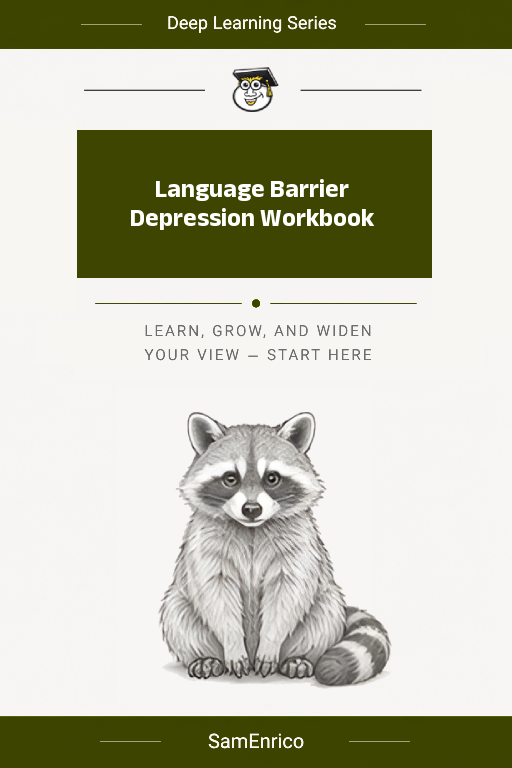
Non-FictionMental WealthGlobal Worker WellnessWorkbook
Language Barrier Depression Workbook eBook
Manage feelings of isolation and incompetence when
Manage feelings of isolation and incompetence when you can't speak fluently. Includes phrasebook scripts, non-verbal communication workarounds, and self-compassion for mistakes.
Formats
Free sample
Chapter 1: The Fluency Fallacy--–- You are not bad at languages. You are performing under impossible conditions, and no one has told you that yet.Every morning, you wake up knowing roughly the same amount of vocabulary as you did the day before. You have studied. You have practiced. You have repeated phrases into the mirror until your reflection looked bored.
And still, when a stranger asks you a simple question in the language you are trying to learn, your mind goes blank. Your mouth feels like it is filled with sand. Words that you know—absolutely know, because you passed the test last week—refuse to arrive.You apologize. You stumble. You watch the other person's face shift from curiosity to impatience to dismissal.
And then you walk away, replaying the moment like a horror film, telling yourself the same lie: I am not fluent. Therefore, I am not competent. Therefore, I am failing at being a person in this language.This chapter is here to tell you that the lie is not yours. It is a cultural myth, baked into how we talk about language learning, and it is making you depressed for no good reason.We call this myth the Fluency Fallacy. It is the belief that slow or halting speech equals low intelligence, low worth, or low competence.
It is the assumption that if you cannot speak quickly and effortlessly, you do not truly know the language. And it is completely, scientifically wrong.Let us take apart the Fluency Fallacy piece by piece. By the end of this chapter, you will have a new map of your own abilities—one that shows you are already far more competent than you feel.The Two Languages Living Inside Your Head Most language learners do not realize they have two separate systems operating in their brain. Psychologists and linguists call these Language Acquisition and Language Performance. They are not the same thing, and confusing them is the first step toward depression.Language Acquisition is everything you know passively.
It is the vocabulary you recognize when you see it written down. It is the grammar rule you can explain on a quiz. It is the understanding you have when someone speaks slowly and clearly. Acquisition is your library—all the books stored on the shelves, waiting to be opened.Language Performance is everything you can do actively, under pressure, in real time. It is retrieving the right word while a cashier stares at you.
It is conjugating a verb while making eye contact. It is forming a sentence while your heart races. Performance is the librarian—the part of you that has to find the right book, open it to the right page, and read it aloud, all while someone is tapping their foot.Here is the truth that most language courses hide from you: Acquisition almost always outpaces Performance. You can know a word (acquisition) long before you can say it smoothly (performance). You can understand a grammar rule perfectly on paper and still mess it up in conversation.
This is not a sign of failure. It is a sign of a healthy, normally functioning brain.The problem is that we judge ourselves almost entirely on Performance while ignoring the vast library of Acquisition we have already built. You might feel incompetent because you stumbled through ordering coffee. But that feeling ignores the fact that you understood the menu, you recognized the verb the barista used, and you knew what you wanted to say even if the execution was clumsy. That is competence.
It is just invisible competence.L1 Intrusive Thoughts: The Critic Who Speaks Your Mother Tongue There is a specific kind of self-talk that haunts language learners, and it feels different from ordinary anxiety. It comes in the voice of your native language—what linguists call your L1. We call these L1 Intrusive Thoughts.Here is how they work. You are trying to speak your second language (L2). You hesitate.
You say the wrong word. And in that split second of silence, your native language rushes in like an uninvited guest, whispering:"You sound like a child.""They are judging you.""In your real language, you would have made that joke perfectly.""Just stop trying. You are embarrassing yourself."These thoughts are intrusive because they are not happening in the language you are struggling with. They are happening in the language where you are fluent, witty, and fast. That contrast is painful.
Your L1 reminds you of who you used to be socially—quick, clever, confident—and then holds that image up against your current, halting self. The gap feels like a chasm.But here is the secret that best-selling language anxiety research has established: L1 Intrusive Thoughts are not truth. They are a neurological echo. Your brain defaults to your native language under stress because that pathway is myelinated (insulated and fast). The critical voice is not evaluating your actual competence.
It is just taking the easiest neural exit ramp.You can prove this to yourself. Think of a recent conversation where you felt ashamed of your language ability. Now ask yourself: Did the other person actually say anything critical? Or did I hear my own L1 voice putting words in their mouth? In almost every case, the harshest critic is the one inside your head, speaking your mother tongue.The Grammar Trap: Why High Test Scores Make Anxiety Worse This sounds counterintuitive, so please read it twice: High scores on grammar tests often increase speaking anxiety.
The more you know in theory, the more you expect from yourself in practice. And when real-life speech does not match your theoretical knowledge, the gap feels like a personal failure.Consider two learners. Learner A has studied for six months, knows about two hundred words, and has never taken a grammar test. Learner B has studied for two years, passed an intermediate exam with 90 percent accuracy, and knows two thousand words. Who do you think experiences more anxiety when ordering coffee?If you said Learner B, you are correct.
Learner B knows exactly how the sentence should sound. They can visualize the correct conjugation, the proper word order, the precise article. When they open their mouth and produce something less than perfect, they are not just making an error. They are failing against their own internal gold standard. Learner A, by contrast, has no gold standard.
They just try their best, and any communication feels like a win.This is called the Grammar Trap. The more you learn, the more opportunities your brain has to generate shame. Every error becomes evidence of incompetence because you know better. Except you do not actually know better in performance mode. You know better in acquisition mode.
Those are different systems.The solution is not to stop learning grammar. The solution is to separate your test-taking self from your conversation self. They are different people. One lives in a quiet room with no time limit. The other lives in the chaos of real life.
Expecting them to perform identically is like expecting a pianist who can read music perfectly to play the same piece flawlessly while the room is on fire.The Competence…
This is the end of the free sample. Get the eBook to keep going. Buy now
About this book
Details
- Author
- Wiseman Artie
- Publisher
- SamEnrico
- Language
- English
- Genre
- Non-Fiction, Mental Wealth, Global Worker Wellness, Workbook
- Released
- 2026-06-01
- Pages (approx.)
- 143
- Available as
- eBook, Audiobook

Read better in the ZLOADR app
Your eBooks on your phone or tablet. Sign in with your SamEnrico account and start reading.
More by Wiseman Artie
 MBSR Body Scan Beginners WorkbookWiseman Artie$11.99
 Estate Plan For Young Families HandbookWiseman Artie$11.99
 Cousteau's Amazon ExpeditionWiseman Artie$11.99
 AI Conformity Assessment ProceduresWiseman Artie$11.99
 Restless Leg Syndrome and Mental HealthWiseman Artie$11.99
 The Wyvern’s Apprentice: A Knight’s Unlikely MentorWiseman Artie$11.99
 Retirement SpecialistWiseman Artie$11.99
 Financial Services Talent FlowWiseman Artie$12.99
 How to Start a Burglar and Fire Alarm Monitoring Including Installation and Maintenance Business (BWiseman Artie$11.99
 Understanding Kaufman Oculocerebrofacial SyndromeWiseman Artie$17.99
You may also like
 Hong Kong Handover 1997Dunn Johnnie$11.99
 Zumba For Postnatal Recovery CourseNeal Christian$11.99
 Zumba for BeginnersLadner Nikia$11.99
 YouTube Comment Mining GuideHumes Pandora$12.99
 Worry Box MeditationCarlin Rudy$11.99
 Workplace Stress MeditationNguyen Lynn$11.99
 Workplace Stress and Sleep RepairHawley Ivory$11.99
 Workplace Perfectionism CureDelaney Jeffry$11.99
 Workplace Injustice Anger GuideWallen Isabelle$11.99
 Work Addiction and Burnout LinkGreenwood Ester$11.99
 Women in Yoga and WellnessBeattie Galina$11.99
 Women in Stand Up ComedyChun Evangeline$11.99