
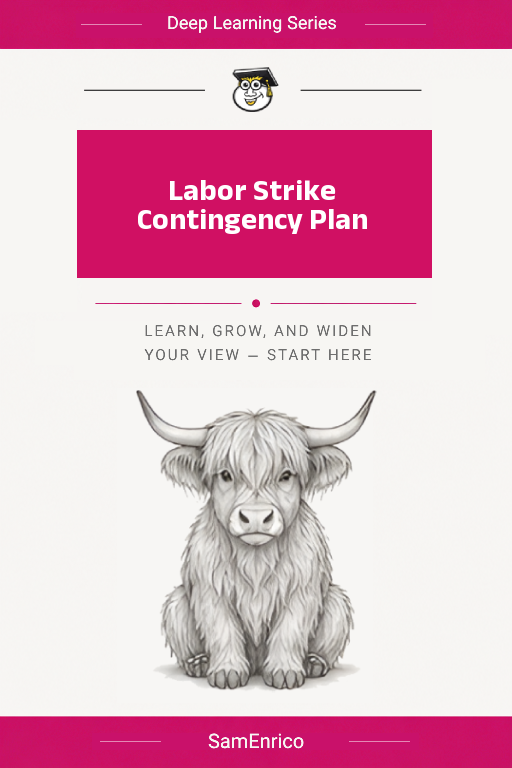
Non-FictionAnnual CheckupLabor RelationsStrike
Labor Strike Contingency Plan eBook
Prepare for port and warehouse labor strikes inclu
by Penny Jay
Prepare for port and warehouse labor strikes including inventory buffers and alternative routing strategies.
Formats
Free sample
Chapter 1: The Fragile Knot--–- The call came at 2:14 AM on a Tuesday, though Maya Chen would later swear the clock had stopped the moment she saw the sender’s name: “ILA Negotiations Update.” She was curled on a hotel bed in Savannah, three hours from home, having just finished a 14-hour day auditing a third-party logistics provider’s flood insurance. Her phone buzzed twice more before she could focus her eyes. The subject lines read: “Contract Rejected.” “Strike Authorization Vote Scheduled.” “30-Day Notice Filed.”She sat up slowly, the way you do when you already know the floor is going to tilt. For eighteen months, she had been warning her leadership team about this exact moment. The International Longshoremen’s Association had been negotiating since January.
The old contract expired at midnight on September 30. The two sides had not spoken in eleven days. Every supply chain publication had published the same charts: 45% of US East Coast container volume, $5 billion per day in economic activity, fourteen ports from Boston to Houston. And yet her CEO had called her “premature” in June. Her CFO had rejected her inventory request as “alarmist.” Her counterpart in Sales had openly mocked her in a Tuesday morning staff meeting, asking the room, “Does Maya have a crystal ball, or is she just trying to spend our bonus pool?”Now the crystal ball had turned into a ticking bomb.She swung her legs over the edge of the bed and opened her laptop.
The first thing she did was not panic. It was something she had drilled into her team a hundred times in simulations: stabilize the data before you touch the operations. She pulled up her “Strike Probability Matrix”—a tool she had built six months earlier using contract expiration calendars, historical strike frequencies, and real-time negotiation sentiment scraped from labor news feeds. For the ILA East Coast, her matrix had read “High” since August. She had annotated the file with yellow highlights: “Recommend 40% inventory pull-forward for Category A SKUs.
Recommend alternative routing agreements with Halifax and the West Coast by Sept 15.”She had sent that recommendation to her boss, the VP of Supply Chain, on August 4. He had forwarded it to the CEO with a one-line note: “Maya is concerned about the ILA situation.” The CEO had replied, “Let’s revisit after Labor Day.”It was now October 1. Labor Day had come and gone. The strike authorization vote was scheduled for October 7. If it passed, the earliest lawful work stoppage would be November 7—thirty days after the vote, per the National Labor Relations Act.
That gave her exactly thirty-seven days to execute a contingency plan that should have taken ninety.She opened a second window and began typing. Not an email. A checklist.The Math of a Single Point of Failure Modern supply chains are not fragile everywhere. They are fragile at specific, concentrated nodes—what network theorists call “choke points.” A choke point is any location or function where the flow of goods narrows so dramatically that a disruption at that single point can paralyze an entire system. For maritime logistics, the choke points are ports: narrow strips of concrete, water, and labor where 90% of global trade passes.
For distribution, the choke points are warehouses: buildings where inventory is received, stored, and shipped, often with no more than 48 hours of buffer.The ILA represents approximately 65,000 longshoremen across the East and Gulf Coasts. That sounds like a large number. But the actual choke point is far smaller. A single large container ship can carry 15,000 TEUs (twenty-foot equivalent units). Unloading that ship requires roughly 12 crane operators, 40 yard drivers, and 8 clerical staff.
Fifty people. Fifty people can delay $500 million worth of goods. That is the asymmetry at the heart of every labor strike: a small, highly skilled, highly organized workforce holds a lever that can stop an economy.The 2002 West Coast port lockout—a dispute between the ILWU and the Pacific Maritime Association—lasted eleven days. The economic impact was estimated at 1billionperday.Retailerslost1 billion per day. Retailers lost 1billionperday.Retailerslost3.8 billion in sales.
The White House invoked the Taft-Hartley Act to force an 80-day cooling-off period. And here is the detail that Maya had committed to memory: after the ports reopened, the backlog took six months to clear. Six months. Not because the labor was slow, but because the system’s capacity to absorb surge volume is finite. Trains, trucks, and warehouses all have ceilings.
The Bullwhip Effect—a small delay at the dock rippling outward into massive inventory shortages and production stoppages—is not a metaphor. It is a mathematical certainty.Maya calculated the Bullwhip for her own company, a $3.2 billion consumer electronics and toy manufacturer. She ran the numbers: if the East Coast ports shut down for thirty days, her company would lose access to 62% of its inbound container volume. Forty-three percent of that volume was Category A inventory—items that generated 78% of the company’s gross margin. Within ten days of a shutdown, her top three factories in Vietnam and China would run out of components.
Within fifteen days, her fulfillment center in New Jersey—which handled 40% of all e-commerce orders—would be shipping against empty shelves. Within thirty days, the company would miss Black Friday deliveries. The holiday season, which accounted for 34% of annual revenue, would be irreparably damaged.The cost of doing nothing, she had calculated, was 187millioninlostsales,187 million in lost sales, 187millioninlostsales,42 million in airfreight emergency shipments, and an unknown but significant brand penalty when angry customers posted videos of empty store shelves on Tik Tok.She had presented this number to the CFO on September 15. He had asked, “What’s the probability?” She had said, “Based on the Strike Probability Matrix, I’m at 62% for a work stoppage of at least seven days.” He had said, “That’s not high enough to spend $30 million on inventory.”Now, at 2:30 AM, she wondered if 62% had been too low.The Two Kinds of Strikers One of the most common mistakes in contingency planning is treating “labor strike” as a single phenomenon. It is not.
There are two fundamentally different strike scenarios, and they require fundamentally different responses. The book will refer to these repeatedly, so it is worth distinguishing them clearly.The first is the port strike. This involves longshoremen, crane operators, marine clerks, and other workers who control the gates between ocean vessels and landside transportation. When port workers strike, ships cannot unload. Containers sit on vessels at anchor or are diverted to other ports.
Warehouses become idle because no new inventory arrives. The crisis is measured in days before factories stop and weeks before store shelves empty. The surge—the chaotic period of recovery—begins after the strike ends, when a flood of delayed cargo arrives simultaneously.The second is the warehouse strike. This involves pickers, packers, forklift operators, and other workers who control distribution centers. When warehouse workers strike, ports may remain open, but finished goods cannot be sorted, stored, or shipped to customers.
Inbound inventory may pile up on yard trailers or be diverted to backup facilities. The crisis is measured in hours before customer orders stop shipping. The surge is immediate—because replacement labor is needed to…
This is the end of the free sample. Get the eBook to keep going. Buy now
About this book
Details
- Author
- Penny Jay
- Publisher
- SamEnrico
- Language
- English
- Genre
- Non-Fiction, Annual Checkup, Labor Relations, Strike
- Released
- 2026-05-29
- Pages (approx.)
- 145
- Available as
- eBook, Audiobook

Read better in the ZLOADR app
Your eBooks on your phone or tablet. Sign in with your SamEnrico account and start reading.
More by Penny Jay
 Double Depression Treatment GuidePenny Jay$11.99
 WeChat Moments Comparison CurePenny Jay$11.99
 Family Liaison in Executive Abduction GuidePenny Jay$11.99
 Congressional Ethics Rules GuidePenny Jay$11.99
 Gleason Score Interpretation ManualPenny Jay$11.99
 The Atlantic’s Silent Pioneers: How Cold War Submarines Launched AI’s First LeapPenny Jay$11.99
 Glitch in the System: The 2000 Election Night That Almost Broke AmericaPenny Jay$11.99
 China Library and Study SpacesPenny Jay$12.99
 Understanding Congenital Herpes SimplexPenny Jay$17.99
 Principal Electrical EngineerPenny Jay$11.99
 How to Become a Cd-storage-and-materials Make-up HelperPenny Jay$11.99
You may also like
 Hong Kong Handover 1997Dunn Johnnie$11.99
 Zumba For Postnatal Recovery CourseNeal Christian$11.99
 Zumba for BeginnersLadner Nikia$11.99
 YouTube Comment Mining GuideHumes Pandora$12.99
 Worry Box MeditationCarlin Rudy$11.99
 Workplace Stress MeditationNguyen Lynn$11.99
 Workplace Stress and Sleep RepairHawley Ivory$11.99
 Workplace Perfectionism CureDelaney Jeffry$11.99
 Workplace Injustice Anger GuideWallen Isabelle$11.99
 Work Addiction and Burnout LinkGreenwood Ester$11.99
 Women in Yoga and WellnessBeattie Galina$11.99
 Women in Stand Up ComedyChun Evangeline$11.99