
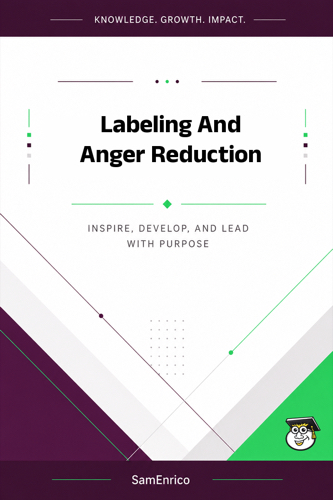
Labeling And Anger Reduction eBook
Stop attaching global negative labels to people wh
by Emmons Brady
Stop attaching global negative labels to people who upset you.
Formats
Free sample
Chapter 1: The 90-Second Lie--–- You have been told that some people are just “angry people.” That your temper is a personality flaw carved into you like a birthmark. That the best you can do is manage the damage—count to ten, punch a pillow, walk away before you say something unforgivable. These are comforting myths, because they absolve you of responsibility. If anger is a permanent feature of your character, then you are not to blame for the names you call people when you lose control. The label was inevitable.
The explosion was unavoidable. You were simply being yourself.This entire framework is wrong. Not slightly mistaken. Not missing a few nuance points. Fundamentally, catastrophically wrong.What you are about to read in this chapter will challenge something you have likely believed for years: that your anger is a reaction to what other people do.
The truth is the opposite. Your anger is not a reaction to their behavior. Your anger is a reaction to the label you attach to their behavior. And that distinction is the difference between a life spent apologizing for explosions and a life spent choosing your responses with surgical precision.Let us begin with a story.The Man Who Called His Wife a Monster James had been married for fourteen years. By any external measure, his marriage was successful: two healthy children, a comfortable home, careers that did not require constant triage.
But James had a secret that he confessed to a therapist after his wife threatened to leave him for the third time. The secret was this: approximately once every three weeks, usually on a Sunday evening when exhaustion had softened everyone’s patience, James would say something that he knew, even as the words left his mouth, would cause a four-day fight.The most recent incident had been over something trivial. His wife had forgotten to buy the specific brand of orange juice he liked. He had come home from a long run, opened the refrigerator, and seen the wrong carton. And in that moment, something in him flipped.
He did not say, “I’m disappointed you forgot the juice.” He did not say, “I’m frustrated because I was really looking forward to that.” What he said was: “You are so unbelievably selfish. You never think about anyone but yourself. Sometimes I wonder if you are even capable of caring about another human being.”His wife did not respond to the content of his complaint. No reasonable person would. She responded to the accusation.
“I’m selfish? I spent my entire Sunday driving your children to their activities while you went for a run. And I forgot one item from a grocery list of thirty things, and suddenly I’m a monster?”The fight escalated. By bedtime, they were not speaking. By Monday morning, she had canceled their date night.
By Tuesday, she was sleeping in the guest room. Four days of cold silence, all because of orange juice.When James replayed the incident with his therapist, he made a confession that will sound familiar to anyone who has ever been trapped in this cycle. “I knew even as I said it that she wasn’t selfish,” he admitted. “She’s one of the most generous people I know. But in that moment, the word just came out.
It felt true for about five seconds. Then I watched her face crumble, and I knew I had done it again.”The therapist asked a question that changed everything: “What did you feel, physically, in the three seconds between seeing the wrong juice and opening your mouth?”James closed his eyes and described it. A flash of heat in his chest. A clenching in his jaw. A sudden acceleration of his heartbeat.
A sense of pressure behind his eyes. And then, he said, “a story played in my head. It said: ‘She always does this. She never listens to you. She doesn’t respect you.’ And then the word ‘selfish’ came out.”The therapist nodded.
“You didn’t react to the juice,” he said. “You reacted to the story. And the story was built on a label you attached to her in that split second. You labeled her as ‘someone who disrespects you.’ And once you applied that label, your body responded as if she had physically attacked you.”The Neurobiology of a Label What happened to James in that kitchen was not a character flaw. It was a predictable neurological sequence that has been studied in laboratories for decades.
To understand why a simple label like “selfish” or “idiot” or “lazy” can trigger an explosion, you need to understand the architecture of the human brain.The brain processes the world through two distinct pathways. The first, called the low road by neuroscientist Joseph Le Doux, is fast, automatic, and emotional. It runs from your sensory organs directly to your amygdala—the almond-shaped cluster of neurons that serves as your brain’s threat detection center. The low road can process information in as little as 12 milliseconds. That is faster than a conscious thought.
That is faster than you can blink. The low road does not ask questions. It does not check for context. It only asks one thing: Is this a threat?The second pathway, called the high road, is slow, deliberate, and rational. It runs from your sensory organs to your thalamus, then to your cortex (the thinking part of your brain), and only then to your amygdala.
The high road takes 200 to 400 milliseconds—an eternity compared to the low road. But the high road can do something the low road cannot: it can override the threat response. It can say, “Wait, that’s not a tiger; that’s a yellow jacket. Wait, that’s not an enemy; that’s my wife who forgot the orange juice.”Here is the problem. The low road does not distinguish between physical threats and social threats.
To your amygdala, a global negative label—especially one applied to someone you love and depend on—looks exactly like a predator lunging at you from the bushes. When you call your partner “selfish,” your amygdala releases a cascade of stress hormones: cortisol, adrenaline, norepinephrine. Your heart rate spikes. Your blood pressure rises. Your muscles tense.
Your digestive system shuts down. Your prefrontal cortex—the very part of your brain you need for rational problem-solving—literally goes offline.This is not a metaphor. Under extreme stress, the prefrontal cortex reduces its activity by as much as 50%. You become, quite literally, less intelligent in the moment of anger. This is why people say things during fights that they would never say when calm.
It is not that they secretly believe those things. It is that the part of the brain responsible for impulse control and perspective-taking has been temporarily disconnected.James did not call his wife selfish because he secretly believed she was a selfish person. He called her selfish because his low road hijacked his high road in the 12 milliseconds between seeing the wrong orange juice and registering his disappointment. The label “selfish” was not a diagnosis. It was a neurological misfire.The 90-Second Myth (And Why It Matters)Here is…
This is the end of the free sample. Get the eBook to keep going. Buy now
About this book
Details
- Author
- Emmons Brady
- Publisher
- SamEnrico
- Language
- English
- Genre
- Non-Fiction, Self-Help, Labeling
- Released
- 2026-06-06
- Pages (approx.)
- 145
- Available as
- eBook, Audiobook

Read better in the ZLOADR app
Your eBooks on your phone or tablet. Sign in with your SamEnrico account and start reading.
More by Emmons Brady
 MDD and Anxiety ComorbidityEmmons Brady$11.99
 Rainbow Bridge Belief GuideEmmons Brady$11.99
 Alternative SRS AppsEmmons Brady$11.99
 Laura Davies Power WomanEmmons Brady$11.99
 Phone Free Family TimeEmmons Brady$11.99
 Plant Slant Eating GuideEmmons Brady$11.99
 Behavioral ActivationEmmons Brady$11.99
 The Lyceum of Aristotle: Seeds of Western ThoughtEmmons Brady$11.99
 Titian and the Venetian Glow: Painting Light into EternityEmmons Brady$11.99
 How to Produce HumidorsEmmons Brady$11.99
 Payment Gateway OptimizationEmmons Brady$12.99
 Customer Communication Price IncreasesEmmons Brady$12.99
You may also like
 Hong Kong Handover 1997Dunn Johnnie$11.99
 Zumba For Postnatal Recovery CourseNeal Christian$11.99
 Zumba for BeginnersLadner Nikia$11.99
 YouTube Comment Mining GuideHumes Pandora$12.99
 Worry Box MeditationCarlin Rudy$11.99
 Workplace Stress MeditationNguyen Lynn$11.99
 Workplace Stress and Sleep RepairHawley Ivory$11.99
 Workplace Perfectionism CureDelaney Jeffry$11.99
 Workplace Injustice Anger GuideWallen Isabelle$11.99
 Work Addiction and Burnout LinkGreenwood Ester$11.99
 Women in Yoga and WellnessBeattie Galina$11.99
 Women in Stand Up ComedyChun Evangeline$11.99