
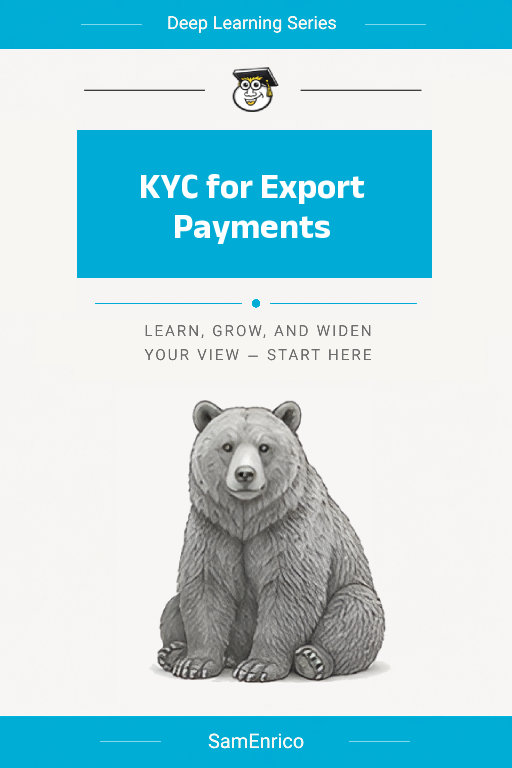
KYC for Export Payments eBook
Complete Know Your Customer requirements for cross
Complete Know Your Customer requirements for cross border payment providers as African exporter.
Formats
Free sample
Chapter 1: The Compliance Paradox--In the summer of 2024, a cocoa cooperative in rural Ghana lost $240,000. Not to fraud, not to theft, not to a failed harvest. They lost it to a bank in London that closed their payment provider’s correspondent account because of “reputational risk concerns.” The cooperative had done nothing wrong. Their paperwork was immaculate. Their beans were of the highest quality.
Their buyer in Switzerland was eager to pay. But the money never moved, because the bank decided that doing business with Africa was simply not worth the hassle.This story is not unusual. It is, in fact, the new normal. Across the continent, from the shea butter exporters of northern Nigeria to the tea growers of the Kenyan highlands to the cobalt miners of the Democratic Republic of Congo, a silent crisis is unfolding. The crisis is not about demand for African goods — that is rising.
It is not about quality — that has never been higher. It is about something far more mundane and far more consequential: the ability to prove who you are, where your money comes from, and why a bank should trust you enough to let a payment through.Welcome to the world of cross-border export payments, where the most valuable currency is not dollars or euros or even bitcoin. It is trust. And trust, in the twenty-first century, is manufactured through a process that the financial industry calls Know Your Customer. KYC, as it is universally known, has historically been viewed as a back-office burden — the tedious paperwork that compliance officers inflict on legitimate businesses.
But that view is not merely outdated; it is dangerous. In the post-Af CFTA era, under the shadow of de-risking, and with the rise of real-time payment systems like PAPSS, KYC has become something entirely different. It has become a strategic weapon. A competitive advantage. And for those who get it wrong, an existential threat.This chapter introduces the central organizing principle of this book: The Compliance Paradox.
The paradox is simple, brutal, and inescapable. More payment speed requires more trust. More trust requires better KYC. Better KYC traditionally takes more time. Therefore, speed and compliance appear to be locked in an eternal war, where improving one inevitably harms the other.But what if that war could end?
What if the very technologies and frameworks that seem to slow down payments — identity verification, source of funds checks, sanctions screening — could be harnessed to accelerate them? That is the promise of this book. That is the African Edge.The Compliance Paradox Defined Let us state the paradox explicitly, because it will appear in every chapter that follows.The Compliance Paradox: The faster a payment system operates, the more critical real-time KYC becomes. Yet traditional KYC processes are designed for a slower, paper-based world. The gap between the speed of modern payment rails and the speed of traditional compliance creates friction, delays, and lost revenue.
Resolving this gap requires not working harder at existing processes, but fundamentally reimagining what KYC means and how it is delivered.Consider the implications. Before the Pan-African Payment and Settlement System (PAPSS), a cross-border payment from Nigeria to Kenya might take three to five business days. That timeline, slow as it was, gave compliance teams time. Time to check sanctions lists. Time to verify invoices.
Time to call the exporter and ask clarifying questions. The system was slow, but it was predictable, and compliance could keep pace.PAPSS changes everything. Instant settlement in local currencies means that money moves in seconds, not days. This is a miracle for exporters who previously waited weeks for dollars to clear. But it is a nightmare for compliance teams who now have milliseconds to decide whether a transaction is legitimate or fraudulent.
The old methods — manual reviews, static rules, end-of-day batch processing — simply do not work at PAPSS speed. The Compliance Paradox demands something new.The same paradox appears in other contexts. Stablecoins settle in seconds, but verifying the source of crypto funds requires on-chain analytics that many African payment providers have never used. Mobile money moves instantly, but the KYC documentation for a small-scale trader in rural Tanzania may consist of nothing more than a phone number and a year of transaction history. The exporter wants speed.
The regulator demands safety. The compliance officer is caught in the middle.This book exists to get them out of the middle.The Four Pillars of Modern Export KYCBefore we dive into the specifics of thresholds, technologies, and regulations, it is worth stepping back to understand the four fundamental pillars upon which any modern KYC system for export payments must rest. These pillars will recur throughout the book, and each subsequent chapter will build upon one or more of them.Pillar One: Identity Verification. At its core, KYC is about answering a simple question: who are you? For an individual sole proprietor, this may mean verifying a government ID, a mobile money account, and a tax identification number.
For a corporate entity, it means tracing the beneficial ownership structure through shell companies and holding companies until you find the human beings who ultimately control the business. The challenge in Africa is that formal identity documents are not universal. The solution lies in alternative data — mobile money records, digital tax receipts, utility bills, and emerging systems like the Africa Entity Identifier (AEI) discussed in Chapter 3.Pillar Two: Risk Assessment. Once you know who someone is, you must decide how much risk they pose. This is not a moral judgment.
It is a statistical and regulatory calculation. Does the exporter operate from a high-risk jurisdiction? Are they transacting in a sensitive sector like minerals or timber? Are they a Politically Exposed Person (PEP)? The answers to these questions determine whether an exporter qualifies for Simplified Due Diligence (SDD) or requires Enhanced Due Diligence (EDD).
Chapter 5 provides a complete framework for making these determinations.Pillar Three: Transaction Monitoring. Identity is static. Behavior is dynamic. An exporter who has been legitimate for years can suddenly become a money launderer — or, more commonly, can appear suspicious due to a change in business patterns. Transaction monitoring is the ongoing process of watching payment flows for anomalies.
Traditional rules-based systems flag transactions that exceed fixed thresholds. Modern machine learning systems learn what normal looks like for each exporter and flag only what deviates from that pattern. Chapter 7 explains how to make the transition from rules to AI.Pillar Four: Regulatory Reporting. Finally, when something suspicious is found, you must report it to the relevant authorities. This is non-negotiable.
Failure to file a Suspicious Transaction Report (STR) when required can result in fines, license revocation, and even criminal charges. But reporting is not simply a matter of checking a box. Different countries have different forms, different timelines, and different thresholds. Chapter 6 navigates the local regulatory labyrinths of Nigeria, Kenya, Rwanda, Mozambique, and the broader SADC region.These four pillars — identity, risk, monitoring, reporting — form the architecture of everything that follows. Master them, and you master KYC.
Ignore any one, and your system will collapse.The De-Risking Crisis: Why Your Bank Might Leave You Tomorrow We cannot discuss KYC for export payments without confronting the elephant in the room. That elephant…
This is the end of the free sample. Get the eBook to keep going. Buy now
About this book
Details
- Author
- Matney Rebeca
- Publisher
- SamEnrico
- Language
- English
- Genre
- Non-Fiction, Business Brief, KYC
- Released
- 2026-05-30
- Pages (approx.)
- 151
- Available as
- eBook, Audiobook

Read better in the ZLOADR app
Your eBooks on your phone or tablet. Sign in with your SamEnrico account and start reading.
More by Matney Rebeca
 Walking Meditation for Joint ReplacementMatney Rebeca$11.99
 Dream Setting TrackerMatney Rebeca$11.99
 Dog Loss Grief GuideMatney Rebeca$11.99
 Mnemonics for Foreign Language VocabMatney Rebeca$11.99
 The Exam Prep PrimerMatney Rebeca$11.99
 OKRs for Research TeamsMatney Rebeca$11.99
 Altitude Nap GuideMatney Rebeca$11.99
 Compulsive Spending And Social MediaMatney Rebeca$11.99
 The Silent Witness: The Killing of Roberto Calvi and the Vatican’s Mafia SecretsMatney Rebeca$11.99
 The Cairo Scam: Love, Lies, and Gold in 1920s EgyptMatney Rebeca$11.99
 How to Produce Kitchen and Dining BenchesMatney Rebeca$11.99
 How to Start a Midwife (NHS) Business (Beginners Guide)Matney Rebeca$11.99
You may also like
 Hong Kong Handover 1997Dunn Johnnie$11.99
 Zumba For Postnatal Recovery CourseNeal Christian$11.99
 Zumba for BeginnersLadner Nikia$11.99
 YouTube Comment Mining GuideHumes Pandora$12.99
 Worry Box MeditationCarlin Rudy$11.99
 Workplace Stress MeditationNguyen Lynn$11.99
 Workplace Stress and Sleep RepairHawley Ivory$11.99
 Workplace Perfectionism CureDelaney Jeffry$11.99
 Workplace Injustice Anger GuideWallen Isabelle$11.99
 Work Addiction and Burnout LinkGreenwood Ester$11.99
 Women in Yoga and WellnessBeattie Galina$11.99
 Women in Stand Up ComedyChun Evangeline$11.99