
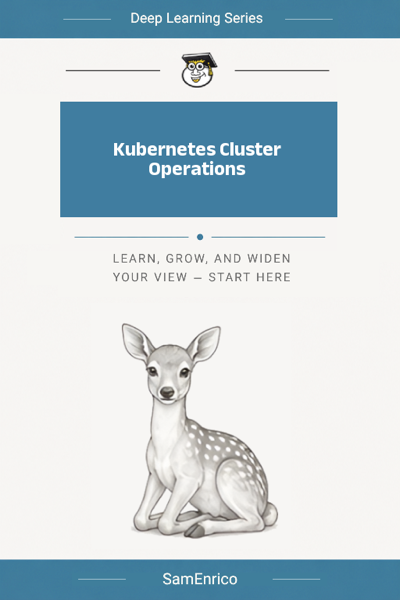
Kubernetes Cluster Operations eBook
A Coursebook on Kubernetes Cluster Operations
by Hulsey Maria
A Coursebook on Kubernetes Cluster Operations
Formats
Free sample
Chapter 1: The 2 AM Awakening...--It was 2:14 AM on a Tuesday when my phone erupted with the first of eighty-three consecutive alerts. The on-call rotation had been quiet for six months—too quiet, the kind of quiet that makes seasoned operators nervous. I rolled over, grabbed my laptop, and opened the dashboard. The cluster that had been running flawlessly for 347 days was now a red mosaic of failing health checks. API server: unreachable.
etcd: leader election in progress. Thirty-seven microservices: returning 503s. The payment processing team's pager had already gone off. So had the frontend team's. And the database team's.
The incident bridge was filling with sleepy, confused engineers asking the same question: “What just happened?”I had been running Kubernetes clusters for two years at that point. I had passed the CKA exam. I could write Helm charts in my sleep. But in that moment, staring at a dead control plane with no clear path to recovery, I realized something uncomfortable: I knew how to use Kubernetes, but I had no idea how to operate it when things went catastrophically wrong.This book is for everyone who has had that 2 AM awakening. It is not another “getting started” guide.
It will not teach you how to write your first Pod manifest or deploy a guestbook application. That knowledge is available elsewhere and is a prerequisite for what follows. Instead, this book is the field guide I wished I had that night—a practical, battle-tested coursebook on Kubernetes cluster operations for platform engineers, SREs, and Dev Ops professionals who are moving from “I can run kubectl” to “I am responsible for the cluster when it breaks.”The Quiet Crisis in Kubernetes Education The Kubernetes ecosystem has a dirty secret: we have produced thousands of application developers who can deploy containerized workloads, but we have produced comparatively few engineers who can operate production clusters at scale. The math is telling. According to the Cloud Native Computing Foundation’s 2024 survey, 79% of organizations are running Kubernetes in production, yet only 27% report having “mature” operational practices.
The gap between deployment ability and operational expertise is widening.This gap creates real business risk. A single misconfigured etcd cluster can bring down every application simultaneously. An uncontrolled rolling update can corrupt database schemas across sixty replicas. A poorly designed RBAC policy can expose secrets to every developer in the organization. The difference between a 50,000annualcloudbillanda50,000 annual cloud bill and a 50,000annualcloudbillanda500,000 bill is often not workload size—it is operational inefficiency.Consider the case of a mid-sized e-commerce company I consulted for.
Their engineering team had done everything “by the book.” They used managed Kubernetes, followed security best practices, and had extensive monitoring. Yet their monthly cloud bill was triple the industry average for their workload size. The culprit? They had never learned how to properly size worker nodes, configure cluster autoscaling, or analyze resource fragmentation. They were paying for capacity they could not use and wasting capacity they had already purchased.This book solves that problem by teaching cluster operations as a distinct discipline—one with its own tools, mental models, and failure modes.What This Book Is (And What It Is Not)Let me be explicit about the boundaries of this book.What this book is: A comprehensive coursebook on operating Kubernetes clusters in production.
It assumes you have already learned the fundamentals—you can define Pods, Deployments, Services, and Config Maps. You have passed a certification (CKA, CKAD) or equivalent. You are now moving into a platform engineering or SRE role where the cluster itself is your responsibility.What this book is not: An introduction to Kubernetes. It will not teach you how to write your first Pod spec or explain the difference between a Deployment and a Stateful Set at a beginner level. It will not walk you through installing Minikube on your laptop.
It assumes you already know those things.Why this matters: Most Kubernetes books try to be everything to everyone. They start with “What is a container?” and end with advanced service mesh patterns. This leaves the intermediate engineer with 300 pages of review before reaching new material. This book compresses that assumption. You are already a competent Kubernetes user.
Now you will become an expert operator.The table below maps your current knowledge to what this book adds:You Already Know This Book Teaches How to deploy a Pod Why that Pod stays Pending for six minutes What a Service does How to trace packets when the Service breaks The difference between Cluster IP and Node Port How to debug DNS resolution failures How to create a Config Map Why your Secrets are not actually secure What a rolling update does How to recover when the update hangs The Operator’s Mindset: From Developer to Platform Engineer The single most important shift this book will demand is cognitive. Application developers think about features. They ask: “How do I get my code running?” Operators think about states. They ask: “Is the cluster healthy? What failure modes exist?
How do I recover?”This shift manifests in four concrete ways, each of which will be explored in depth throughout the book. For now, consider them as the pillars of the operator mindset.1. From Imperative to Declarative Early container orchestration was imperative. You typed commands: docker run, kubectl expose, kubectl scale. Each command performed an action.
If you lost track of what you had done, there was no single source of truth.Modern Kubernetes operations are declarative. You write YAML that describes the desired state, and Kubernetes reconciles reality to match that description. This is powerful but requires a different way of thinking. You no longer “do” things to the cluster; you describe what you want and trust the controllers to make it happen.The operator’s skill is not in typing commands faster. It is in writing accurate declarations and debugging when reconciliation fails.
When kubectl apply -f deployment.yaml produces an error, the operator does not retype the command—they read the error, understand the admission controller’s rejection, and fix the manifest.2. From Component Focus to System Focus Application developers care about individual Pods. “Is my payment service running?” Operators care about the system. “Is the cluster’s control plane healthy? Are any nodes reporting memory pressure?
Is etcd’s disk latency within acceptable bounds?”This system focus means operators learn to prioritize differently. A single failing Pod is often low priority—the Deployment will replace it. A control plane component with degraded performance is high priority—it affects every Pod in the cluster.3. From Uptime to Resilience Application developers often equate “operational success” with uptime. If the service is responding, everything is fine.
Operators know better. Uptime is a lagging indicator. By the time uptime drops, users have already been impacted.Operators focus on resilience—the system’s ability to withstand and recover from failures. Resilience means designing clusters that can lose entire availability zones, survive etcd leader elections, and gracefully handle traffic spikes. It means measuring not just whether the cluster is up, but how comfortably it runs under load.4.
From Cost Ignorance to Cost Awareness Developers in cloud-native environments often have no visibility into their resource consumption. They request…
This is the end of the free sample. Get the eBook to keep going. Buy now
About this book
Details
- Author
- Hulsey Maria
- Publisher
- SamEnrico
- Language
- English
- Genre
- Non-Fiction, Informative, Educational
- Released
- 2026-05-11
- Pages (approx.)
- 132
- Available as
- eBook, Audiobook

Read better in the ZLOADR app
Your eBooks on your phone or tablet. Sign in with your SamEnrico account and start reading.
More by Hulsey Maria
 PCOS Weight Loss StrategyHulsey Maria$11.99
 Eyebrow Movement InterpretationHulsey Maria$11.99
 Laci Peterson Case Juror InterviewsHulsey Maria$11.99
 Social Security Optimization GuideHulsey Maria$11.99
 The Last Light of the Abyss: The Titanic’s Deep-Sea SecretsHulsey Maria$11.99
 Understanding ParuresisHulsey Maria$17.99
 How to Start a Hobby in YoYoHulsey Maria$11.99
 Dot Eu Registration RequirementsHulsey Maria$12.99
 Apple Patent Portfolio Analysis GuideHulsey Maria$12.99