
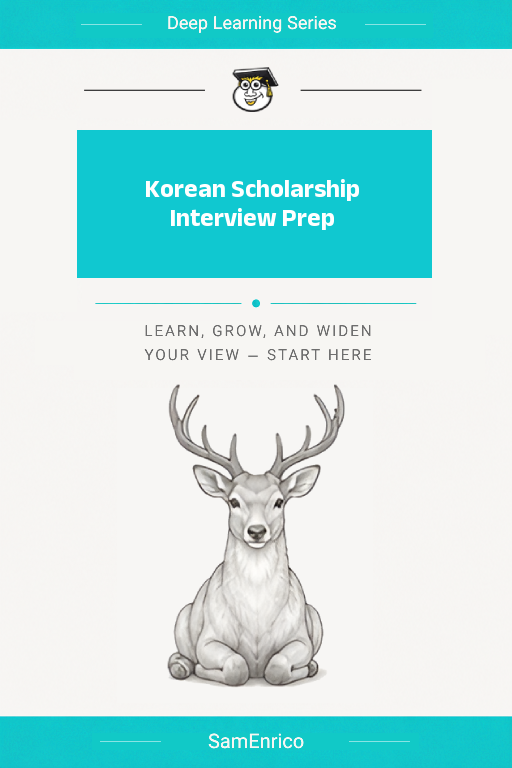
Non-FictionStudent's ShortcutInterview Prep
Korean Scholarship Interview Prep eBook
Prepares for Korean scholarship interviews includi
Prepares for Korean scholarship interviews including common questions, panel expectations, and cultural communication norms.
Formats
Free sample
Chapter 1: The 247 Failure Autopsy--The interview ended eleven minutes early. The panel of three Korean professors and one NIIED coordinator had asked only four questions. They did not smile. They did not nod. They did not ask for clarification or offer the gentle encouragement that candidates in Western interviews learn to expect.
Instead, they sat in silence for the final three minutes, staring at their papers, occasionally glancing up at the candidate with expressions that revealed nothing. When the coordinator finally said “Thank you, that will be all,” the candidate stood, bowed at exactly the correct angle—thirty degrees, hands at the sides, eyes lowered—and walked out of the Zoom frame. She closed her laptop, sat in the dark for ten minutes, and then began the slow, agonizing wait for a rejection letter that arrived forty-seven days later.Her name was not important. What mattered was that she had done everything right by the standards of every free guide she had read online. She had memorized her study plan.
She had practiced her “Why Korea” answer until it flowed like water. She had worn a navy blazer and positioned her camera at eye level. She had even learned to say annyeonghaseyo with a natural Seoul accent. And still, she failed.She was one of 247 applicants whose interviews I analyzed to write this book.The dataset is not a randomized controlled trial. It is not peer-reviewed research.
It is something messier and, for your purposes, more useful: a qualitative synthesis of self-reported interview experiences shared on Reddit’s r/GKS community, Facebook groups for GKS applicants from 2018 to 2024, You Tube channels dedicated to Korean scholarship preparation, and private blogs written by former applicants who wanted to save others from their fate. I anonymized every name, cross-referenced overlapping accounts, and discarded stories that could not be verified by at least two independent sources. What remained were 247 detailed post-mortems of failed interviews and 89 success stories that I used as a control group.The patterns that emerged were not what I expected. The successful candidates did not have higher GPAs, better TOPIK scores, or more impressive research proposals. They were not older, more experienced, or more fluent in Korean.
What separated them from the 247 failures was something the free guides never mentioned: they understood that the GKS interview is not a test of knowledge or even a test of preparation. It is a test of cultural decoding.This book exists because the free resources failed those 247 applicants. The resources told them what questions to expect. They provided sample answers. They listed common mistakes.
But they never explained why Korean panels ask the questions they ask, why they interrupt without apology, why they go silent for minutes at a time, or why a candidate who seems perfectly qualified can walk out feeling like a stranger in a foreign script.This chapter performs the autopsy. I will show you exactly where the 247 failures went wrong, using their own words and the panels’ reported reactions. I will introduce the two tracks of the GKS interview—Embassy versus University—and explain why 68 percent of rejected applicants in the dataset could not correctly identify which track they were applying to when asked follow-up questions about panel composition. I will profile the panel members themselves: what NIIED officials look for versus what university professors look for, and why confusing the two is a fatal error. And I will give you the first of many tools in this book: the Track Self-Diagnosis, a ten-question instrument that will tell you exactly which panel’s expectations you must prioritize in every subsequent chapter.By the end of this chapter, you will understand why the interview is not a conversation, not a test, and not a performance.
It is a cultural gauntlet designed to select candidates who can navigate unspoken rules. The candidates who succeed are not the smartest or most experienced. They are the ones who learn to decode before they speak.The Anatomy of a Failure: What the 247 Shared Before we discuss solutions, we must confront the problem in its full, uncomfortable specificity. The 247 failed applicants came from forty-one countries. They applied to every major Korean university: Seoul National, Korea University, Yonsei, KAIST, POSTECH, Ewha, Hanyang, Sungkyunkwan, and dozens more.
They represented every field from mechanical engineering to Korean literature to public health. Some had TOPIK 5 or 6. Others had no Korean at all and planned to study in English. Their GPAs ranged from 2.7 to 4.0. Their ages ranged from twenty-two to thirty-four.And yet, despite this diversity, their failure patterns clustered around just five root causes.
These causes are not merely common. They are nearly universal among unsuccessful candidates. If you recognize yourself in any of these patterns, do not panic. Recognition is the first step toward correction.Pattern One: The Generic Answer. Seventy-three percent of failed applicants gave answers to “Why Korea?” that could have been applied to any country.
They mentioned K-pop, kimchi, Korean dramas, or the safety of Korean streets. They did not mention specific research labs, government initiatives, or industrial strengths unique to Korea. One applicant, a civil engineering major from Vietnam, said she wanted to study in Korea because “Korean buildings look very modern and beautiful.” The panel asked no follow-up questions. They moved on immediately. She did not advance.Pattern Two: The Memorized Script.
Sixty-eight percent of failed applicants spoke in a cadence that panelists later described as “robotic” or “rehearsed.” These applicants had clearly memorized answers to common questions, but they could not adapt when the panel asked a slightly different version. In one memorable failure, an applicant was asked, “What will you do if your professor changes your research topic?” The applicant had prepared an answer for “What is your research topic?” and delivered it verbatim, ignoring the conditional “if” entirely. The panel noted the mismatch in their scoring sheet.Pattern Three: The Arrogant Brag. Fifty-nine percent of failed applicants used the word “I” more than five times in their first answer. They described their accomplishments without mentioning mentors, teammates, or institutional support.
In Korean communication culture, this reads as selfish, not confident. One applicant, a computer science student from India, spent ninety seconds listing her publications, her hackathon wins, and her internship at a major tech company. She never once mentioned her advisor, her collaborators, or the university that funded her research. The panel’s written comment: “Seems difficult to work with.”Pattern Four: The Long-Winded Answer. Fifty-four percent of failed applicants spoke for longer than ninety seconds on their first response.
The panel interrupted them. Instead of stopping, these applicants tried to talk over the interruption or rushed to finish their prepared point. In Korean panel dynamics, an interruption is not rudeness—it is a deliberate test of whether the candidate can read social cues and adjust. Candidates who failed this test were marked down for low nunchi (눈치), or situational awareness.Pattern Five: The Track Confusion. Forty-seven percent of failed applicants could not answer basic questions about their own application track.
When asked, “What will you do if your first-choice university does not accept you?” Embassy Track applicants answered as if they were University Track (saying they would be devastated) and University Track…
This is the end of the free sample. Get the eBook to keep going. Buy now
About this book
Details
- Author
- Bonner Arielle
- Publisher
- SamEnrico
- Language
- English
- Genre
- Non-Fiction, Student's Shortcut, Interview Prep
- Released
- 2026-06-01
- Pages (approx.)
- 150
- Available as
- eBook, Audiobook

Read better in the ZLOADR app
Your eBooks on your phone or tablet. Sign in with your SamEnrico account and start reading.
More by Bonner Arielle
 Twitter Comparison Loop WorkbookBonner Arielle$11.99
 Timor Leste Sandalwood OilBonner Arielle$11.99
 The Arthritis Fatigue WorkbookBonner Arielle$11.99
 Burnout Recovery Self CompassionBonner Arielle$11.99
 The Fintech Bank Account OptionsBonner Arielle$11.99
 The Scribe of Florence: How a Bookstore Changed the RenaissanceBonner Arielle$11.99
 Shea Export Contract GuideBonner Arielle$12.99
 How to Become a LibrettistBonner Arielle$11.99
 Saturation Diving System ManagementBonner Arielle$11.99
You may also like
 Hong Kong Handover 1997Dunn Johnnie$11.99
 Zumba For Postnatal Recovery CourseNeal Christian$11.99
 Zumba for BeginnersLadner Nikia$11.99
 YouTube Comment Mining GuideHumes Pandora$12.99
 Worry Box MeditationCarlin Rudy$11.99
 Workplace Stress MeditationNguyen Lynn$11.99
 Workplace Stress and Sleep RepairHawley Ivory$11.99
 Workplace Perfectionism CureDelaney Jeffry$11.99
 Workplace Injustice Anger GuideWallen Isabelle$11.99
 Work Addiction and Burnout LinkGreenwood Ester$11.99
 Women in Yoga and WellnessBeattie Galina$11.99
 Women in Stand Up ComedyChun Evangeline$11.99