
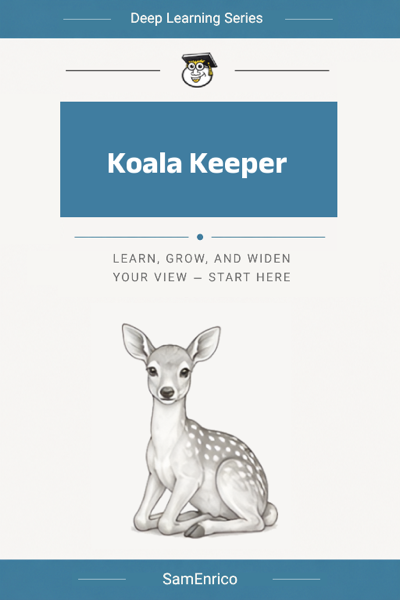
Koala Keeper eBook
A Coursebook on Koala Keeper
A Coursebook on Koala Keeper
Formats
Free sample
Chapter 1: The Jellybean Gambit...–- The radio crackled to life at 11:47 PM on a Tuesday. “Kate, we’ve got a joey on the shoulder of the M1. Southbound. Caller says the mother is hit. The joey is alive but moving toward the third lane.”Dr.
Kate Holloway was already reaching for her boots. She had been a senior wildlife veterinarian for eleven years, and she had learned one immutable truth: koalas do not die quietly. They die in the dark, on highways, in the jaws of family dogs, in the slow creeping blindness of chlamydia. And sometimes, if you are very lucky and very fast, they die on your operating table instead of on the asphalt, which feels like a victory even when it isn’t.The M1 at midnight was a river of semi-trailers and tired commuters. Kate pulled her rescue vehicle onto the shoulder, hazard lights strobing against the blackened trees.
The koala—what was left of the mother—was forty meters back, a dark heap that the trucks had already turned into a lesson about fragmentation. But the joey was alive. She heard it before she saw it: a thin, reedy cry, like a creaking door. It was the sound of a creature that did not know it should be dead.She found it curled against the steel base of a reflector post, no larger than her palm. Its eyes were still sealed shut with a milky film.
Its fur was the color of wet cement. It weighed, she would later learn, 0.4 grams. Less than a teaspoon of sugar. Less than a jellybean.This is the opening image of Koala Keeper, and it is not a metaphor. It is the lived reality of every wildlife rescuer on the eastern seaboard of Australia.
The jellybean joey—gestationally about 34 days old, roughly one-third of the way through its six-month pouch residency—had been thrown from its mother’s pouch on impact. It had survived because koala joeys are born with two gifts: a grip like a vice and a nervous system that does not understand fear. The mother’s milk was still warm on its lips.Kate scooped it into a fleece-lined pouch she kept in her jacket pocket. She did not offer water—a mistake she had made once, fifteen years ago, when she watched a dehydrated joey drown on the aspiration of a well-intentioned bottle. Instead, she placed a single drop of warm electrolyte solution on her fingertip and touched it to the joey’s lips.
The tongue flickered. The joey swallowed. She exhaled.By the time she reached the hospital, the joey had a name. She called him Jellybean. She would not know for another six months whether he would survive, whether his gut would colonize properly without his mother’s pap, whether his lungs would clear the micro-aspiration of roadside dust.
She knew only that she had won the first thirty minutes. In koala rescue, the first thirty minutes are the only ones you can control.This chapter is about those first thirty minutes. But more than that, it is about the paradox that defines the koala keeper’s existence: we are asked to save an animal that is biologically designed to fail in a world we have built to destroy it.The Paradox of the Picky Eater To understand the jellybean, you must first understand the leaf. This is the first and most important lesson of koala husbandry, and it is one that most beginners get exactly backwards. They assume that because koalas are specialized, they are simple.
In fact, the opposite is true. Koalas are not simple. They are exquisitely, maddeningly, almost self-destructively complex.Eucalyptus leaves are toxic. This is not a mild warning. It is a statement of biochemical warfare.
The tree produces phenols, terpenes, and formylated phloroglucinol compounds—a chemical arsenal designed to deter every herbivore that has ever evolved. For most mammals, a mouthful of eucalyptus would cause nausea, metabolic distress, and in sufficient quantity, death. For the koala, it is breakfast, lunch, and dinner.How? The answer lies in the koala’s gut, a fermentation chamber that defies mammalian convention. Unlike cows, which ferment in the foregut (the rumen), koalas are hindgut fermenters.
Their caecum—a blind pouch between the small and large intestines—can stretch up to two meters in length, nearly double the koala’s own body. Inside this caecum lives a microbial ecosystem so specialized that it exists nowhere else on Earth. These bacteria break down the toxic compounds that would kill any other animal.But here is the paradox: that same microbiome is fragile. Antibiotics can wipe it out. Stress can alter its composition.
A sudden change in eucalyptus species can starve it. And a joey is born with none of it.This is why the mother koala produces pap. Pap is not feces in the ordinary sense. It is a specialized, microbiome-rich slurry that the mother produces during the weaning period, typically when the joey is six to eight months old. The joey consumes it directly from the cloaca.
Without pap, the joey’s gut remains sterile—or worse, colonized by the wrong bacteria. Without pap, a joey cannot digest eucalyptus. Without pap, a joey will starve with a full stomach.Jellybean had no mother. He had no pap. He had Kate Holloway, a syringe, and a prayer.The Water Fallacy Before we go further, we must address one of the most persistent and dangerous myths in koala rehabilitation: the idea that koalas do not need to drink.For most of the twentieth century, it was accepted wisdom that koalas obtained all the water they needed from eucalyptus leaves.
Textbooks repeated this claim. Documentaries narrated it with authority. It became part of the koala’s cultural identity: the sleepy, drought-resistant marsupial that never came down from the trees.It was also wrong.The error was one of observation bias. Koalas descend from trees infrequently and mostly at night. Their drinking behavior is easily missed.
When researchers finally deployed motion-activated cameras at water stations in the wild, they captured something remarkable: koalas drinking regularly, often for several minutes at a time, especially during heatwaves and droughts.The climate has changed since the textbooks were written. Leaves are not what they used to be. Under drought stress, eucalyptus trees produce higher concentrations of toxic compounds and lower water content. A leaf that once provided both nutrition and hydration now provides neither. The koala, trapped in its evolutionary specialization, has no backup plan.This creates a clinical nightmare.
Dehydrated koalas present with sunken eyes, dry mucous membranes, and a characteristic posture: hunched, lethargic, unreactive. But offering water is not straightforward. The koala’s swallow reflex is easily overwhelmed. Water in the lungs—aspiration pneumonia—is a leading cause of post-rescue mortality, often more dangerous than the original injury.The protocol, refined over decades of trial and catastrophic error, is simple but absolute: oral water only if the koala is conscious, has a swallowing reflex, is normothermic, and has been stable for more than thirty minutes post-capture. Otherwise, you go subcutaneous.
A butterfly catheter into the loose skin between the shoulder blades. Warm fluids, not cold. Never more than 10% of…
This is the end of the free sample. Get the eBook to keep going. Buy now
About this book
Details
- Author
- Cordes Deandre
- Publisher
- SamEnrico
- Language
- English
- Genre
- Non-Fiction, Informative, Educational
- Released
- 2026-05-23
- Pages (approx.)
- 132
- Available as
- eBook, Audiobook

Read better in the ZLOADR app
Your eBooks on your phone or tablet. Sign in with your SamEnrico account and start reading.
More by Cordes Deandre
 Amazon Halo Sleep GuideCordes Deandre$11.99
 Endometriosis and PCOSCordes Deandre$11.99
 Bonsai Tree TendingCordes Deandre$11.99
 Work Addiction for LawyersCordes Deandre$11.99
 The Philosophers of Meroë: Wisdom and Sovereignty in the Kingdom of KushCordes Deandre$11.99
 Poland Remote Talent GuideCordes Deandre$12.99
 Queensland Graduate StreamCordes Deandre$12.99
 Ultimate Handbook Guide to Auckland : (New Zealand) Travel GuideCordes Deandre$11.99
 Understanding Respiratory AcidosisCordes Deandre$17.99