
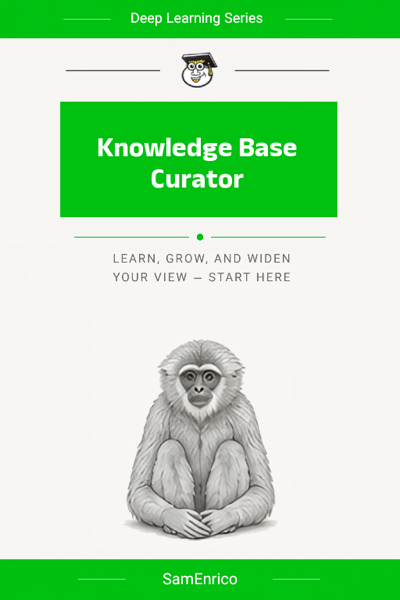
Non-FictionInformativeEducational
Knowledge Base Curator eBook
A Coursebook on Knowledge Base Curator
A Coursebook on Knowledge Base Curator
Formats
Free sample
Chapter 1: The Five Alarms--–- The email arrived at 4:47 PM on a Friday, which is how bad news always arrives. Maria Chen, a senior engineering manager at Apex Turbines, had just finished her final review of the quarter when her inbox pinged with a calendar cancellation. Tom Westerly, the company’s lead propulsion engineer for the past nineteen years, was retiring. Effective immediately. His farewell note was brief, gracious, and utterly devastating: “I’ve enjoyed my time here.
Happy to help with a transition if needed.” Maria knew what “if needed” meant in corporate language. It meant Tom had already checked out. It meant the knowledge inside his head—the start-up sequences he’d memorized, the supplier workarounds he’d developed, the eighteen design iterations that had failed before the successful nineteenth, the phone numbers of machinists who actually answered on weekends—was walking out the door in seventy-two hours.She did what any reasonable manager would do. She panicked. Then she called IT and asked for a backup of Tom’s laptop, his network drives, and his email archive.
IT delivered a 47-gigabyte folder of 14,000 files: PDFs from 2008 that wouldn’t open, spreadsheet formulas that referenced deleted tabs, email threads about “the valve issue” with no explanation of which valve or what issue, and a folder labeled “Old Stuff” containing subfolders labeled “Older Stuff” and “Really Old Stuff.” Maria had the data. She had the documents. She had, by every corporate metric, preserved Tom’s knowledge. And she had absolutely nothing she could use.This book exists because of Maria. And because of the thousands of Marias in thousands of organizations who discover, every single day, that preserving documents is not the same as preserving knowledge.
The difference between those two activities—storage and curation—is the difference between a library where books are piled on the floor and a library where they are cataloged, cross-referenced, and placed exactly where readers can find them. One is hoarding. The other is value creation. And the person who bridges that gap is the Knowledge Base Curator.The problem Maria faced is not new, but it has become catastrophically worse. For three decades, organizations have excelled at creating information.
Email, instant messaging, document collaboration, cloud storage, and now artificial intelligence have made it possible to generate more content in a week than an entire twentieth-century corporation produced in a year. But the capacity to create has vastly outpaced the capacity to organize. The result is what this book calls the Great Forgetting: the accelerating loss of knowledge that organizations already possess but cannot find, trust, or apply.Consider the scale of the problem. A 2023 study of Fortune 500 companies found that employees spend an average of 2.5 hours per day searching for information—not analyzing, not creating, not deciding, but simply looking for something they know exists somewhere. That is 30 percent of the average knowledge worker’s week.
Extrapolated across the entire US economy, the cost of lost and unfindable knowledge exceeds $1 trillion annually in lost productivity alone. And that figure does not include the harder-to-measure costs: decisions made with incomplete information, problems solved by relearning what was already known, innovations delayed because someone didn’t know the work had already been done, and the quiet catastrophe of retiring experts who take their knowledge with them.The traditional response to these problems has been knowledge management, or KM. For the past thirty years, KM has produced an industry of consultants, software platforms, and best-selling books promising to solve the knowledge crisis. And for the past thirty years, most KM initiatives have failed. Not partially failed, not underperformed, but failed in ways that are both predictable and almost identical across organizations.
The pattern is so consistent that it has a name: the KM Graveyard. An organization invests in a knowledge management system—a Share Point site, a Confluence wiki, a custom-built repository. Someone is appointed to manage it. Content is uploaded. Metadata is assigned.
Access is granted. And then, slowly at first and then all at once, the system dies. People stop contributing because they see no benefit. People stop searching because they can never find what they need. The repository becomes a digital mausoleum: files are preserved but no one visits.Why does this happen?
The answer, which this chapter will explore in depth, is that traditional KM prioritized the wrong things. It prioritized storage over sense-making, assuming that if knowledge was saved it would eventually be used. It prioritized control over flow, restricting access based on organizational hierarchy rather than enabling circulation based on need. And it prioritized technology over human behavior, buying platforms without addressing the underlying question: why would anyone use this system when email and Slack are faster?The alternative is curation. Not the passive archiving of documents, but the active, ongoing work of ensuring that knowledge remains usable, findable, trustworthy, and valuable.
A curator does not simply save files. A curator makes decisions: which knowledge matters and which can be archived or deleted; how knowledge should be structured so that others can find it; what context must be preserved so that knowledge remains interpretable; when knowledge has become obsolete and should be retired; and who has permission to create, modify, and retire knowledge assets.This book introduces a framework for understanding these curation decisions, organized around what this chapter calls the Five Alarms. Each alarm represents a type of risk to organizational knowledge. A skilled curator learns to recognize when each alarm is ringing and responds with the appropriate curation activity.The First Alarm: The Preservation Alarm This alarm rings when knowledge is at risk of becoming inaccessible due to technological obsolescence, format degradation, or the departure of the people who understand it. The Preservation Alarm is what should have gone off in Maria Chen’s head years before Tom Westerly retired.
It is the recognition that a PDF from 2010 stored on a server is not actually preserved if no one can open it, search it, trust it, or understand it without the context that existed in 2010.The Preservation Alarm sounds when files are in proprietary formats that may become unreadable; when knowledge exists only in the minds of specific individuals; when documentation lacks critical context about assumptions, constraints, or decision rationales; when there is no clear owner responsible for keeping an asset current; or when the organization is about to undergo a technology migration that could break existing files.Responding to the Preservation Alarm requires methods that go far beyond simple backup. It requires format selection and migration strategies to avoid technological obsolescence. It requires canonicalization—the process of converting knowledge into standard representations that can survive across systems. It requires capturing tacit knowledge from experts before they leave. And it requires architectural decisions about how knowledge will be stored, versioned, and made accessible over time horizons measured in decades, not fiscal quarters.
Chapter 2 provides the complete Preservation Alarm response toolkit.The Second Alarm: The Strategy Alarm This alarm rings when curation activities are misaligned with organizational goals. The Strategy Alarm is the recognition that not all knowledge is equally valuable and that curation resources must be invested where the return is highest. It is what distinguishes a…
This is the end of the free sample. Get the eBook to keep going. Buy now
About this book
Details
- Author
- Wentworth Bettye
- Publisher
- SamEnrico
- Language
- English
- Genre
- Non-Fiction, Informative, Educational
- Released
- 2026-06-02
- Pages (approx.)
- 157
- Available as
- eBook, Audiobook

Read better in the ZLOADR app
Your eBooks on your phone or tablet. Sign in with your SamEnrico account and start reading.
More by Wentworth Bettye
 Fear Of Failure And Perfectionist ParentsWentworth Bettye$11.99
 Endometriosis and AdenomyosisWentworth Bettye$11.99
 Dreem Headband GuideWentworth Bettye$11.99
 German Renewable Energy IncentivesWentworth Bettye$11.99
 The Workaholism Anxiety LinkWentworth Bettye$11.99
 Brushstrokes of the Sahara: The Lost Impressionists of Ancient EgyptWentworth Bettye$11.99
 Understanding Resistance to Thyroid Stimulating HormoneWentworth Bettye$17.99
 Victoria State Nomination GuideWentworth Bettye$12.99
 Philippines Remote Talent GuideWentworth Bettye$12.99
 How to Become a Duplicating-machine Operator IiWentworth Bettye$11.99
You may also like
 Hong Kong Handover 1997Dunn Johnnie$11.99
 Zumba For Postnatal Recovery CourseNeal Christian$11.99
 Zumba for BeginnersLadner Nikia$11.99
 YouTube Comment Mining GuideHumes Pandora$12.99
 Worry Box MeditationCarlin Rudy$11.99
 Workplace Stress MeditationNguyen Lynn$11.99
 Workplace Stress and Sleep RepairHawley Ivory$11.99
 Workplace Perfectionism CureDelaney Jeffry$11.99
 Workplace Injustice Anger GuideWallen Isabelle$11.99
 Work Addiction and Burnout LinkGreenwood Ester$11.99
 Women in Yoga and WellnessBeattie Galina$11.99
 Women in Stand Up ComedyChun Evangeline$11.99