
Non-FictionSelf-HelpShared Spaces
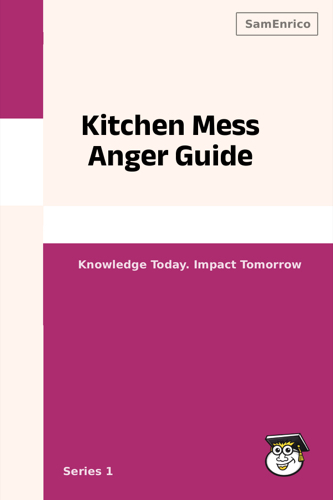
Kitchen Mess Anger Guide eBook
Address shared space neglect without rage, using s
by Layton Jetta
Address shared space neglect without rage, using signs and gentle reminders not blame.
Formats
Free sample
Chapter 1: The Sponge Conspiracy--–- You are not angry about a dirty sponge. You are angry because your brain has been lying to you, and no one ever told you the truth.Let me say that again, because it is the single most important sentence in this entire book: The crusty pan in the sink is not the problem. The overflowing trash is not the problem. The mystery leftovers breeding their own ecosystem in the back of the fridge are not the problem. They are symptoms.
They are the smoke, not the fire. And if you keep spraying water at the smoke while the fire rages somewhere else, you will spend the rest of your life exhausted, resentful, and convinced that everyone you live with is either lazy, malicious, or both.I have sat across from couples on the verge of divorce who could not stop screaming about a single unwashed coffee mug. I have mediated roommate meetings where two perfectly reasonable adults reduced each other to tears over whose turn it was to take out the recycling. I have watched a forty-five-year-old executive—a person who calmly manages million-dollar deals—lose his entire composure because his teenage daughter left a butter knife on the counter. In every single case, the mess was not the real argument.
The mess was the location where a much older, much deeper argument decided to show up.This book is not actually about kitchen mess. This book is about what kitchen mess does to your nervous system, your relationships, and your sense of self. And Chapter One is where we dismantle everything you think you know about why you get so angry.The Moment It All Went Wrong Let me describe a scene, and I want you to tell me if it feels familiar.You walk into the kitchen after a long day. You are tired. You are hungry.
You are already running the mental checklist of what you need to do before you can finally sit down: feed the pet, make dinner, pack lunch for tomorrow, wash the pan you used last night because you were too exhausted to deal with it then. You open the refrigerator. The leftovers you were planning to eat are still there, thank God. But the container is unsealed. The sauce has dripped onto the shelf below.
There is a smell.Your shoulders tighten. You close the fridge and turn toward the sink to wash your hands before cooking. And there it is.The sponge.It is sitting in a quarter inch of gray water. There are bits of food floating around it. The dish rack is full of clean dishes that no one put away.
The counter has coffee grounds ground into the granite. And next to the stove, your roommate’s / partner’s / child’s / parent’s breakfast plate is still sitting exactly where they left it twelve hours ago, with a dried egg yolk fused to the ceramic like a fossil.Something happens inside your body. You feel it in your chest first—a tightening, a heat. Then your jaw clenches. Then a voice in your head—loud, clear, absolutely certain—says: They did this on purpose.
They know this bothers me. They do not respect me. They do not care.By the time the other person walks into the kitchen twenty minutes later, you are not a human being anymore. You are a pressure cooker with the vent sealed shut. And when they say, “Hey, what’s for dinner?” you explode.The fight that follows is not about the sponge.
It is about the sponge the way the American Revolution was about tea. The tea was just the thing you could point to. The real issue was taxation without representation, autonomy, dignity, power. And that is exactly what is happening in your kitchen. The mess is the tea.
The real issue is that you feel unseen, unheard, and disrespected in the one place where you are supposed to feel safe.Why Your Brain Treats a Dirty Counter Like a Personal Attack Here is what is happening inside your skull, and I need you to pay close attention because this is the key that unlocks everything.The human brain is an ancient piece of machinery. Deep in your temporal lobe, there is a small, almond-shaped cluster of neurons called the amygdala. Its job is to scan the environment for threats. It does not think. It does not reason.
It reacts. And it reacts fast—about forty milliseconds faster than your conscious brain can catch up.When your amygdala detects a potential threat, it triggers what is called a threat response. You have heard of fight or flight. But there is a third option that matters here: fright. Sometimes the amygdala does not know whether to fight or run, so it freezes and floods your system with cortisol and adrenaline while your conscious brain frantically tries to figure out what is happening.Now.
Here is where it gets interesting.Your amygdala cannot tell the difference between a physical threat (a bear in the kitchen) and a social threat (disrespect, exclusion, unfairness). To your ancient lizard brain, being left out of the tribe was a death sentence. Humans survived because we lived in groups. If the group rejected you, you died. So your brain evolved to treat social rejection with the same urgency as a predator attack.When you see a mess that you interpret as someone else’s disregard, your amygdala does not think, “Oh, they were just tired.” It thinks, “DANGER.
DISRESPECT. REJECTION. THEY DO NOT VALUE YOU. YOU ARE NOT SAFE.”And then it dumps stress hormones into your bloodstream.Your heart rate increases. Your blood pressure rises.
Your digestion slows down (because who needs to digest food when you are about to be eaten by a bear or cast out of the tribe?). Your peripheral vision narrows. Your hearing sharpens. Your body is literally preparing for combat.Over a sponge.This is not a character flaw. This is not weakness.
This is not “being too sensitive.” This is biology. Your brain has been running the same threat-detection software for two hundred thousand years, and that software was not designed for shared refrigerators and passive-aggressive sticky notes. It was designed for saber-toothed tigers and rival clans. And right now, it is misfiring like crazy.The Mess-Rage Loop: How You Get Trapped Now that you understand the biology, let me show you the pattern. I call this the Mess-Rage Loop, and once you see it, you will start noticing it everywhere—in your own behavior, in your partner’s reactions, in every single kitchen fight you have ever had or ever will have.Here is how the loop works.Step One: You encounter a mess.
This is the trigger. It could be anything—a dirty dish, a sticky counter, a full trash can, a wet sponge. The mess itself is neutral. It has no moral weight. It is just matter out of place.Step Two: Your brain interprets the mess as a signal of disrespect.
This is where the amygdala hijacks the show. You do not consciously choose this interpretation. It happens automatically, in milliseconds…
This is the end of the free sample. Get the eBook to keep going. Buy now
About this book
Details
- Author
- Layton Jetta
- Publisher
- SamEnrico
- Language
- English
- Genre
- Non-Fiction, Self-Help, Shared Spaces
- Released
- 2026-06-08
- Pages (approx.)
- 139
- Available as
- eBook, Audiobook

Read better in the ZLOADR app
Your eBooks on your phone or tablet. Sign in with your SamEnrico account and start reading.
More by Layton Jetta
 Affirmation Art Therapy CourseLayton Jetta$11.99
 German Business NegotiationLayton Jetta$11.99
 Meth Cravings TriggersLayton Jetta$11.99
 The Fear of Dolls GuideLayton Jetta$11.99
 Ragnarök’s Last Knight: The Viking Who Challenged the GodsLayton Jetta$11.99
 English Cocker Spaniel BreedingLayton Jetta$11.99
 10 Ways to Use Dassant (Recipe Book)Layton Jetta$11.99
 Pre Seed Valuation LondonLayton Jetta$12.99
 US Market Sustainability LabelsLayton Jetta$12.99
 Understanding Umbilical Cord Ulceration Intestinal AtresiaLayton Jetta$17.99
You may also like
 Hong Kong Handover 1997Dunn Johnnie$11.99
 Zumba For Postnatal Recovery CourseNeal Christian$11.99
 Zumba for BeginnersLadner Nikia$11.99
 YouTube Comment Mining GuideHumes Pandora$12.99
 Worry Box MeditationCarlin Rudy$11.99
 Workplace Stress MeditationNguyen Lynn$11.99
 Workplace Stress and Sleep RepairHawley Ivory$11.99
 Workplace Perfectionism CureDelaney Jeffry$11.99
 Workplace Injustice Anger GuideWallen Isabelle$11.99
 Work Addiction and Burnout LinkGreenwood Ester$11.99
 Women in Yoga and WellnessBeattie Galina$11.99
 Women in Stand Up ComedyChun Evangeline$11.99