
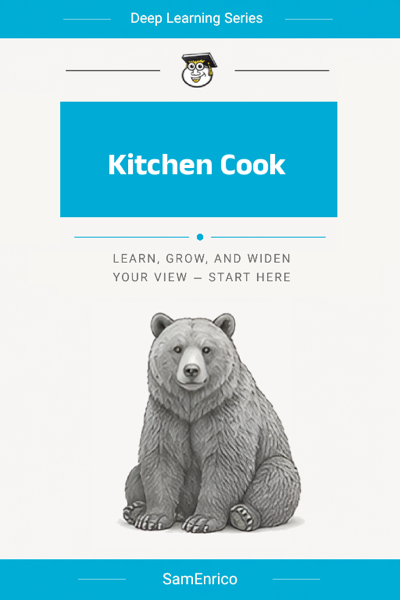
Non-FictionInformativeEducational
Kitchen Cook eBook
A Coursebook on Kitchen Cook
A Coursebook on Kitchen Cook
Formats
Free sample
Chapter 1: The Hidden Knife...--– There is a moment, just before you begin cooking, that determines everything. Your hand hovers over the knife. The onion sits on the cutting board, its papery skin catching the light. The recipe is open on your phone or sprawled across a stained index card. And in that single breath of hesitation, you face a choice that has nothing to do with ingredients and everything to do with who you believe yourself to be in the kitchen.Most people believe they are not cooks.
They believe cooking is something other people do—people with natural talent, people who grew up in kitchens that smelled of garlic and simmering stock, people who somehow inherited a gene for knowing when the chicken is done without a thermometer. If you are reading this book, there is a strong chance you have told yourself some version of this story. I cannot cook. I follow recipes and they still turn out wrong. I ruin everything I touch.
My kitchen is a place of stress, not joy.That story is a lie. Not a small, harmless lie, but the kind of lie that has cost you thousands of dollars in takeout, hundreds of hours of anxiety, and the quiet, daily pleasure of feeding yourself and the people you love. The truth is that cooking is not a talent. It is a sequence of decisions. And decisions can be learned.This chapter is not about recipes.
It is not about knife skills or food safety or which pan to buy. Those things will come, in their proper order, across the twelve chapters of this book. This chapter is about something more fundamental than any technique. It is about the mindset that separates people who cook from people who believe they cannot cook. It is about why organization is not a personality trait but a system.
It is about the single French phrase that, once understood, will change your relationship to the stove forever. And it is about the ethical responsibility we all share the moment we step into a kitchen—to ourselves, to the people we feed, and to the simple, profound act of transforming raw ingredients into nourishment.Before you learn to cook, you must learn to think like a cook. And thinking like a cook begins with a knife that has not yet been picked up.The Myth of Natural Talent There is a persistent and destructive belief that circulates through every home kitchen in America: the belief that some people are born cooks and the rest of us are doomed to frozen pizza. This belief is reinforced by cooking competitions on television, where chefs shout and flames leap and someone cries after their soufflé collapses. It is reinforced by cookbooks that assume you already know what "julienne" means and why you would bother.
It is reinforced by well-meaning family members who say things like, "Don't worry, cooking just isn't your thing."Here is what the television shows do not show you: the hundreds of hours of practice behind every effortless flip of a pan. What the cookbooks do not say is that every term was once unfamiliar to every chef who ever lived. What your family does not know is that "cooking isn't your thing" is a statement about your practice, not your potential.Let me tell you about the first time I made a proper omelet. It was not a good omelet. It was a gray, rubbery tragedy that stuck to the pan and emerged in three distinct pieces.
I had followed the recipe exactly—or so I thought. I had used the correct number of eggs. I had whisked them with a fork, just as the instructions said. I had added butter to the pan. And then I had stood there, paralyzed, as the eggs turned from liquid to solid faster than I could react.
The recipe said "cook for one to two minutes," but it did not tell me what to look for, what to listen for, what to smell for. It did not tell me that the pan was too hot, or that I should have used a nonstick surface, or that the difference between a good omelet and a disaster is about eight seconds of patience before folding.I made that same omelet twenty-seven times over the next two weeks. Not every day, but whenever I had fifteen minutes and three eggs to sacrifice to the cause. By the twelfth attempt, the omelet was no longer gray. By the nineteenth, it came out of the pan in one piece.
By the twenty-seventh, I could fold it without tearing. I was not born knowing how to make an omelet. I learned. And what I learned was not a recipe but a system of decisions: pan temperature, fat amount, egg agitation, folding timing, and the critical realization that the eggs continue cooking after they leave the heat.This is the pattern of every cooking skill you will learn in this book. You will try.
You will fail, probably multiple times. You will understand why you failed. You will try again. And one day, without fanfare, you will succeed. The person who succeeds is not a different person from the one who failed.
They are the same person, with more information and more practice.So let go of the myth of natural talent. It is a story you have been told to keep you afraid and buying prepared foods. The only thing that separates a cook from someone who does not cook is the decision to start, the willingness to fail, and the patience to learn from the failure. You have already made the first decision by opening this book. The second and third are up to you.Mise en Place: The Single Most Important Phrase in the Kitchen The French have a phrase that encapsulates everything a cook needs to know before the first flame is lit: mise en place (pronounced meez ahn plahss).
It translates literally to "putting in place." But like most translations, this one misses the depth of the original. Mise en place is not a task. It is a mindset. It is the difference between cooking in a state of panic and cooking in a state of calm control.Imagine two cooks preparing the same stir-fry. Cook One reads the recipe, then races to the refrigerator to pull out ingredients one at a time.
They chop the chicken while the pan is heating. They realize they forgot to buy bell peppers and substitute carrots, which cook at a different rate. They search through three drawers for the soy sauce. By the time they find it, the chicken is burning. The vegetables go in at different times because they were chopped at different sizes.
The final dish is unevenly cooked, some pieces raw and some charred. Cook One finishes exhausted, with a sink full of dirty bowls and a conviction that they cannot cook.Cook Two approaches the same recipe differently. Before turning on the stove, they read the recipe from beginning to end, noting every ingredient and every tool required. They gather the chicken, bell peppers, onion, garlic, ginger, and soy sauce on…
This is the end of the free sample. Get the eBook to keep going. Buy now
About this book
Details
- Author
- Ransom Sallie
- Publisher
- SamEnrico
- Language
- English
- Genre
- Non-Fiction, Informative, Educational
- Released
- 2026-05-09
- Pages (approx.)
- 149
- Available as
- eBook, Audiobook

Read better in the ZLOADR app
Your eBooks on your phone or tablet. Sign in with your SamEnrico account and start reading.
More by Ransom Sallie
 Cannabis Sleep MemoryRansom Sallie$11.99
 Navigating Passive AggressionRansom Sallie$11.99
 Retirement Downsizing Financial GuideRansom Sallie$11.99Retirement Downsizing Financial GuideRansom Sallie$11.99
 Etsy Digital Planner Shop Audit CourseRansom Sallie$11.99
 Cholera Vaccine Watery DeathRansom Sallie$11.99
 Whispers of the Lost Library: The Secret Scrolls of AlexandriaRansom Sallie$11.99
 The Silent Architect: How One Chief of Staff Shaped the Cold WarRansom Sallie$11.99
 How to Become a ButlerRansom Sallie$11.99
 Global Team Communication AuditRansom Sallie$12.99
 Quarterly Board Meeting GuideRansom Sallie$12.99
 Understanding Chlamydia PneumoniaeRansom Sallie$17.99
You may also like
 Hong Kong Handover 1997Dunn Johnnie$11.99
 Zumba For Postnatal Recovery CourseNeal Christian$11.99
 Zumba for BeginnersLadner Nikia$11.99
 YouTube Comment Mining GuideHumes Pandora$12.99
 Worry Box MeditationCarlin Rudy$11.99
 Workplace Stress MeditationNguyen Lynn$11.99
 Workplace Stress and Sleep RepairHawley Ivory$11.99
 Workplace Perfectionism CureDelaney Jeffry$11.99
 Workplace Injustice Anger GuideWallen Isabelle$11.99
 Work Addiction and Burnout LinkGreenwood Ester$11.99
 Women in Yoga and WellnessBeattie Galina$11.99
 Women in Stand Up ComedyChun Evangeline$11.99