
Non-FictionBiographyRevolutionary
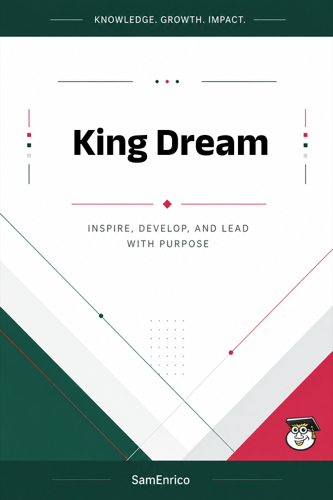
King Dream eBook
Chronicles the civil rights leader's I Have a Drea
Chronicles the civil rights leader's I Have a Dream speech.
Formats
Free sample
Chapter 1: The Bad Check...--–- The photograph arrived in Jet magazine on September 15, 1955, and within days, fourteen-year-old Emmett Till’s bloated, disfigured face had been seen by more Americans than had ever heard Martin Luther King Jr. speak. The image was a horror: the teenager’s skull crushed on one side, an eye gouged out, a bullet hole just above the ear, his body weighted to the bottom of the Tallahatchie River with a seventy-pound cotton-gin fan tied around his neck with barbed wire. His mother, Mamie Till Bradley, had made the radical decision to hold an open-casket funeral. “Let the people see what they did to my boy,” she said.
And they saw. Fifty thousand people filed past the casket in Chicago. Millions more saw the photograph in print. The murder of Emmett Till—accused of whistling at a white woman—did not start the civil rights movement. But it ended something.
It ended the polite fiction that America’s racial problem was a Southern problem, a slow-moving issue of manners and gradualism. It ended the delusion that the Emancipation Proclamation, issued ninety-two years earlier, had actually freed anyone in any meaningful sense.This chapter establishes the hundred-year gap between American promise and American reality that made King’s “I Have a Dream” speech necessary. It does so not with abstract arguments but with bodies, with debt, and with a metaphor that King would wield like a blade on the steps of the Lincoln Memorial: the bad check. To understand why 250,000 people traveled to Washington in August 1963, and why King’s sixteen minutes became the most famous speech in American history, you must first understand why the preceding century of “progress” was largely a lie.The Emancipation That Wasn’t On January 1, 1863, Abraham Lincoln signed the Emancipation Proclamation. It was a military order, not a moral awakening.
It freed enslaved people only in states actively in rebellion against the Union, leaving slavery untouched in border states like Kentucky, Missouri, Maryland, and Delaware. But in the public imagination—and in the granite of the Lincoln Memorial—it became the founding document of Black freedom. Four million people, held in bondage for two hundred fifty years, were legally declared free.The reality that followed was a betrayal so comprehensive that it required the invention of new legal, economic, and terroristic systems to maintain the old order. Reconstruction—the twelve-year period from 1865 to 1877 when federal troops occupied the former Confederacy and enforced new constitutional amendments—was the closest America came to delivering on its promises. The Thirteenth Amendment abolished slavery (with a loophole for “punishment for crime” that would later fuel mass incarceration).
The Fourteenth Amendment guaranteed birthright citizenship and equal protection under the law. The Fifteenth Amendment declared that the right to vote could not be denied “on account of race, color, or previous condition of servitude.” For a brief, breathtaking moment, Black men voted in large numbers. Black legislators were elected to statehouses and to Congress. Public schools for Black children were founded. Land was redistributed—briefly—through the Freedmen’s Bureau.Then the bargain was struck.
In 1877, as part of a disputed presidential election, the federal government withdrew its troops from the South. The experiment in interracial democracy ended. And what followed was not a return to the old order but something new, something uniquely American: Jim Crow.The Machinery of Jim Crow Jim Crow was not merely a set of laws. It was a comprehensive system of social, economic, and physical control. Between 1877 and 1950, Southern states passed hundreds of laws designed to separate Black and white Americans in every conceivable sphere: schools, hospitals, theaters, restaurants, water fountains, bathrooms, waiting rooms, cemeteries, and even windows—in some municipalities, Black people could not look out of a window facing a white neighborhood.
The Supreme Court blessed this system in Plessy v. Ferguson (1896), declaring that “separate but equal” facilities did not violate the Fourteenth Amendment. Of course, nothing was equal. In 1930, South Carolina spent $14.55 per white student and $4.43 per Black student. Mississippi spent $31.25 per white student and $5.73 per Black student.
Black schools used discarded white textbooks. Black hospitals were former storage closets. Black cemeteries were unmarked fields.But the laws were only part of the machinery. The rest was terror. From 1877 to 1950, more than four thousand documented lynchings occurred in the United States, the vast majority in the South, the vast majority of victims Black, the vast majority killed by white mobs with no legal consequence.
Lynchings were not spontaneous eruptions of mob violence. They were ritualized public spectacles, often announced in newspapers in advance, drawing crowds of thousands who posed for photographs with the mutilated bodies. Victims were burned, castrated, hanged, dragged behind trucks. The stated justification was almost always an alleged crime against white womanhood—a myth that covered the real purpose: enforcing racial hierarchy through the threat of annihilation.King was eleven years old when Emmett Till was murdered. He had already experienced segregation: the “white only” water fountains in Atlanta, the back of the bus, the whispered warnings from his parents about how to move through white spaces without provoking violence.
But Till’s murder, and the subsequent acquittal of his killers by an all-white jury in Mississippi, marked something. King later wrote that Till’s death was “one of the most brutal and inhuman crimes of the twentieth century.” He also noted the lesson: white juries would not convict white men for killing Black boys. The law was not neutral. The law was a weapon.The Lonely Island of Poverty When King stood on the steps of the Lincoln Memorial on August 28, 1963, he spoke of a “lonely island of poverty” surrounded by a “vast ocean of material prosperity.” This was not metaphor. It was accounting.
By 1963, the economic gap between Black and white Americans had barely budged since 1865. The typical Black family earned fifty-six cents for every dollar earned by a white family. Black unemployment was twice the white rate. Black homeownership was less than forty percent. The GI Bill, which created the white middle class after World War II by providing low-interest home loans and free college tuition, was systematically denied to Black veterans through discriminatory lending practices and segregated universities.
Between 1945 and 1960, more than ten million homes were built in new suburbs—almost all of them restricted to white buyers through legally enforceable racial covenants. Black families were confined to aging urban housing stock, paying higher rents for worse conditions.King called this the “manacles of segregation and the chains of discrimination.” The language was deliberate. Manacles and chains were not abstract economic terms; they were the physical restraints of slavery, repurposed as metaphor to remind his audience that the system had changed shape but not substance. Sharecropping, the dominant economic arrangement in the rural South, was slavery in all but name. Black families worked white-owned land in exchange for a share of the crop—but the accounting was rigged.
At the end of each season, the sharecropper was told he owed more than he had earned, trapping him in perpetual debt. To leave was to risk arrest. To complain was to risk the rope.The Bad Check Now we arrive at the metaphor…
This is the end of the free sample. Get the eBook to keep going. Buy now
About this book
Details
- Author
- Tucker Lawrence
- Publisher
- SamEnrico
- Language
- English
- Genre
- Non-Fiction, Biography, Revolutionary
- Released
- 2026-06-09
- Pages (approx.)
- 135
- Available as
- eBook, Audiobook

Read better in the ZLOADR app
Your eBooks on your phone or tablet. Sign in with your SamEnrico account and start reading.
More by Tucker Lawrence
 Startup Founder Stress HandbookTucker Lawrence$11.99
 Social Media Imposter ComparisonTucker Lawrence$11.99
 The Council of Trent SessionsTucker Lawrence$11.99
 Breath Visualization GuideTucker Lawrence$11.99
 Corn Mother Spiritual TeachingsTucker Lawrence$11.99
 Nigeria Fashion Grant GuideTucker Lawrence$11.99
 IBS Constipation GuideTucker Lawrence$11.99
 Therapeutic Listening SkillsTucker Lawrence$11.99
 The Pythagorean Theorem: The Harmony of NumbersTucker Lawrence$11.99
 The Puppet Masters of Wall Street: How the Fed’s Shadow Rulers Shaped the 2008 CrisisTucker Lawrence$11.99
 Frostborn and Firebound: The Djinn’s Oath to OdinTucker Lawrence$11.99
 Options Strategies for Income and HedgingTucker Lawrence$11.99
You may also like
 Hong Kong Handover 1997Dunn Johnnie$11.99
 Zumba For Postnatal Recovery CourseNeal Christian$11.99
 Zumba for BeginnersLadner Nikia$11.99
 YouTube Comment Mining GuideHumes Pandora$12.99
 Worry Box MeditationCarlin Rudy$11.99
 Workplace Stress MeditationNguyen Lynn$11.99
 Workplace Stress and Sleep RepairHawley Ivory$11.99
 Workplace Perfectionism CureDelaney Jeffry$11.99
 Workplace Injustice Anger GuideWallen Isabelle$11.99
 Work Addiction and Burnout LinkGreenwood Ester$11.99
 Women in Yoga and WellnessBeattie Galina$11.99
 Women in Stand Up ComedyChun Evangeline$11.99