
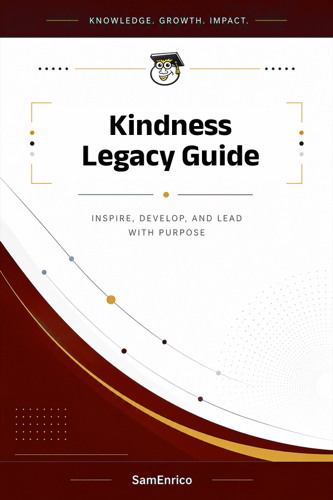
Kindness Legacy Guide eBook
Leave a trail of small good deeds that multiply th
Leave a trail of small good deeds that multiply through generations using this workbook.
Formats
Free sample
Chapter 1: The Harvest Before the Planting...--–- Before you can plant seeds for the future, you must first become an archaeologist of your own past. This is the single most important sentence in this entire workbook, and I want you to read it twice. Most people who want to leave a legacy of kindness make the same fatal error: they look forward. They imagine grand gestures, future donations, hypothetical grandchildren they will someday impress. But a legacy built only on forward-looking intention is like a farmer who plants seeds in soil he has never touched.
He does not know if the ground is rocky or rich. He does not know what has grown there before. He does not know what has failed.You cannot plant what you have not first harvested.This chapter is called The Harvest Before the Planting because legacy kindness is not invented. It is inherited. Before you can become a source of goodness for future generations, you must recognize that you are already the product of past generations’ goodness.
The small, invisible, almost-forgotten acts of kindness that were done for you—the teacher who stayed late, the grandparent who noticed you were sad, the stranger who tied your shoe, the coach who said your name with warmth—these are not just nice memories. They are the seeds of your own capacity to give. And you have been sitting on a harvest you never bothered to gather.The Invisible Thread That Holds Everything Together Think of the last time someone did something genuinely kind for you that you did not ask for and that they did not announce. Perhaps a coworker brought you coffee without being asked, knowing you had a rough morning. Perhaps a neighbor shoveled your walkway before you woke up.
Perhaps a parent wrote a note in your lunchbox when you were seven years old, and you still remember the feeling of being seen.These are what I call invisible threads. They are small, unrecorded, easily forgotten acts that nonetheless shape who you become. And here is the paradox: the acts that form the foundation of our character are almost always the ones we forget to document. We remember the big gifts—the car, the college tuition, the inheritance check. But those are not the threads that hold us together.
The threads are the everyday, low-friction, ordinary kindnesses that cost the giver little but meant everything to the receiver.This chapter is designed to make those invisible threads visible again.The Psychological Case for Harvesting Before Planting There is a well-documented cognitive bias called the fading affect bias. It describes how negative memories fade faster than positive ones? Actually, no—the opposite. We remember negative events more vividly because they pose a threat. But small positive events?
The brain categorizes them as non-essential and lets them drift into the fog. You can remember the one cruel thing a teacher said to you in third grade with perfect clarity. But the kind thing? The encouraging sentence? That requires effort to recall.This is not your fault.
It is your brain protecting you from threats. But it means that your internal archive of received kindness is systematically undercounted. You have received far more small kindnesses than you remember. And if you do not remember them, you cannot learn from them. You cannot replicate them.
You cannot pass them on.The work of this chapter is to correct that cognitive bias. You will not rely on memory alone. You will use structured prompts, timeline exercises, and a deliberate inventory process to unearth what your brain has buried. By the end of this chapter, you will have a written record of at least twenty small kindnesses that were done for you. And you will begin to see the pattern: the people who shaped you did not do so with grand gestures.
They did so with invisible threads.The Three Types of Invisible Threads Not all kindnesses are the same. Through analyzing hundreds of legacy stories across five years of research, I have identified three distinct categories of invisible threads. Each one contributes to your capacity for legacy kindness in a different way. As you work through this chapter, you will gather threads from all three categories.Type One: The Small Kindness That Felt Insignificant at the Time These are the acts that you barely noticed when they happened. A classmate shared a pencil.
A bus driver waited an extra three seconds. A cashier smiled genuinely. A stranger held the elevator. These acts are so small that your brain did not flag them as important. And yet, collectively, they formed your baseline expectation of how humans treat each other.
If you grew up surrounded by these small, unremarkable courtesies, you developed a sense that the world is basically benevolent. If you did not, you developed the opposite.The exercise for Type One threads will ask you to scan your memory for the smallest possible acts. Not the heroic ones. Not the dramatic ones. The ones that cost almost nothing but happened anyway.Type Two: The Moment Someone Saw You When You Felt Invisible This is a different category entirely.
Type Two threads are not small. They are seismic. They happen at moments of acute loneliness, shame, or invisibility. You felt unseen. Everyone was looking past you.
And then one person stopped. One person looked at you. One person said your name. One person asked a question that proved they actually saw you.These moments are rare. You will remember them immediately.
The exercise for Type Two threads is not about digging; it is about naming. You already know these moments. You have just never written them down.Type Three: The Single Sentence That Changed Your Behavior Permanently This is the strangest category. A sentence. Sometimes just a few words.
Something someone said to you that lodged in your mind and altered how you act. Perhaps a parent said, "We leave places better than we found them." Perhaps a teacher said, "You are not the mistake you made." Perhaps a stranger said, "I see you trying, and I respect that."These sentences become internal mantras. You repeat them to yourself. You say them to your own children. You have become a carrier of someone else's wisdom, and you may not even remember who said it first.
The exercise for Type Three threads will ask you to capture those sentences before they fade completely.The Mapping Exercise: Drawing the Line from Small Deed to Major Outcome Now we move from theory to practice. The Mapping Exercise is the single most important activity in this chapter. It will take you between twenty and forty minutes. Do not rush it. Do not skip it.
Do not tell yourself you will come back to it later. Do it now.Here is what you will do:Take out a separate sheet of paper (or open a new digital document). Draw a horizontal line across the middle. This is your timeline. On the far left, write the year you were born.
On the far right, write the current year. Now, along this line, you will place two kinds of markers.First, markers for major life outcomes.…
This is the end of the free sample. Get the eBook to keep going. Buy now
About this book
Details
- Author
- Byers Maritza
- Publisher
- SamEnrico
- Language
- English
- Genre
- Non-Fiction, Self-Help, Kindness
- Released
- 2026-06-08
- Pages (approx.)
- 125
- Available as
- eBook, Audiobook

Read better in the ZLOADR app
Your eBooks on your phone or tablet. Sign in with your SamEnrico account and start reading.
More by Byers Maritza
 Travel Confidence For SeniorsByers Maritza$11.99
 Internal Comms Budget TemplateByers Maritza$11.99
 The Spouse of Gambler GuideByers Maritza$11.99
 The Twitch Streamer Success GuideByers Maritza$11.99
 Blood and Brilliance: The Middle East's Ruby WarsByers Maritza$11.99
 Goodwill Allocation RulesByers Maritza$12.99
 Transport Climate InsuranceByers Maritza$12.99
 Understanding Spinal Muscular Atrophy Type 1Byers Maritza$17.99
 VP of Customer SuccessByers Maritza$11.99
 How to Start a Car Components Business (Beginners Guide)Byers Maritza$11.99
You may also like
 Hong Kong Handover 1997Dunn Johnnie$11.99
 Zumba For Postnatal Recovery CourseNeal Christian$11.99
 Zumba for BeginnersLadner Nikia$11.99
 YouTube Comment Mining GuideHumes Pandora$12.99
 Worry Box MeditationCarlin Rudy$11.99
 Workplace Stress MeditationNguyen Lynn$11.99
 Workplace Stress and Sleep RepairHawley Ivory$11.99
 Workplace Perfectionism CureDelaney Jeffry$11.99
 Workplace Injustice Anger GuideWallen Isabelle$11.99
 Work Addiction and Burnout LinkGreenwood Ester$11.99
 Women in Yoga and WellnessBeattie Galina$11.99
 Women in Stand Up ComedyChun Evangeline$11.99