
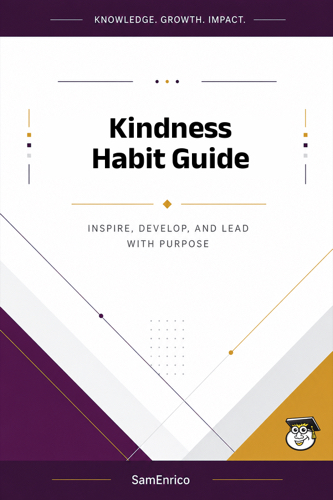
Kindness Habit Guide
Perform small daily acts that compound into a comp
Perform small daily acts that compound into a compassionate life.
Formats
About this book
Free sample
Chapter 1: The Hidden Chemistry–- Emma had never thought of herself as unkind. She paid her taxes, held doors for strangers, and donated old coats each winter. But one Tuesday evening, collapsed on her couch after a fourteen-hour workday, she scrolled past a video of a teenager helping an elderly man cross a busy intersection. Something strange happened: her eyes welled up, her chest felt warm, and she suddenly wanted to be better. Not richer, not thinner, not more successful.
Better in the quiet way that no one could see on a résumé. That unexpected emotional surge, the author explains, was not weakness or sentimentality. It was Emma’s brain doing exactly what evolution designed it to do—rewarding her for witnessing goodness.This chapter will forever change how you understand your own impulses toward compassion. Before you perform a single kind act, before you track a single habit, you need to know what is already happening inside your skull every time you give, receive, or even watch kindness. The biology of benevolence is not a soft metaphor.
It is a hard science of neurotransmitters, neural networks, and physiological changes that affect your longevity, your mental health, and your daily energy levels. By the end of this chapter, you will see kindness not as a moral obligation but as a biological imperative—something your body craves the same way it craves sleep, water, and connection.The Neurochemistry of Giving Let us begin in the laboratory. In the early 2000s, neuroscientists at the University of California, Los Angeles, began scanning the brains of people who had just donated money to charity. The results were astonishing. The same regions that light up when someone eats chocolate, wins money, or takes certain recreational drugs—the ventral striatum and the nucleus accumbens—lit up just as brightly when participants wrote a check to help orphans or gave a small gift to a stranger.
The brain, it turns out, cannot distinguish between a reward that benefits the self and a reward that benefits another. Both register as pleasure.This discovery upends centuries of philosophical cynicism…
This is the end of the free sample. Get the eBook to keep going. Buy now
Contents
- Chapter 1
- Chapter 2
- Chapter 3
- Chapter 4
- Chapter 5
- Chapter 6
- Chapter 7
- Chapter 8
- Chapter 9
- Chapter 10
- Chapter 11
- Chapter 12
Details
- Author
- Cathey Christopher
- Publisher
- SamEnrico
- Language
- English
- Genre
- Non-Fiction, Self-Help, Kindness
- Released
- 2026-06-10
- Pages (approx.)
- 137
- Available as
- eBook, Audiobook

Read better in the ZLOADR app
Your eBooks on your phone or tablet. Sign in with your SamEnrico account and start reading.
More by Cathey Christopher
 Neurodivergent Conversation CourseCathey Christopher$11.99
 Mindful Household Chores CourseCathey Christopher$11.99
 Walking Meditation for Long COVIDCathey Christopher$11.99
 Price Benefit Positioning MapCathey Christopher$11.99
 Tangaroa's Silent War: The Spies of the DeepCathey Christopher$11.99
 Quantum Outback: The Race to Build a Desert SupercomputerCathey Christopher$11.99
 Software Quality Assurance ManagerCathey Christopher$11.99
 Delaware LLC Non Resident WorkbookCathey Christopher$12.99
 BPO Data Security GuideCathey Christopher$12.99
 Understanding Greenberg DysplasiaCathey Christopher$17.99
 How to Start a Cellulose Wadding Business (Beginners Guide)Cathey Christopher$11.99
You may also like
 Hong Kong Handover 1997Dunn Johnnie$11.99
 Zumba For Postnatal Recovery CourseNeal Christian$11.99
 Zumba for BeginnersLadner Nikia$11.99
 YouTube Comment Mining GuideHumes Pandora$12.99
 Worry Box MeditationCarlin Rudy$11.99
 Workplace Stress MeditationNguyen Lynn$11.99
 Workplace Stress and Sleep RepairHawley Ivory$11.99
 Workplace Perfectionism CureDelaney Jeffry$11.99
 Workplace Injustice Anger GuideWallen Isabelle$11.99
 Work Addiction and Burnout LinkGreenwood Ester$11.99
 Women in Yoga and WellnessBeattie Galina$11.99
 Women in Stand Up ComedyChun Evangeline$11.99