
Non-FictionSelf-HelpKeynote Skills
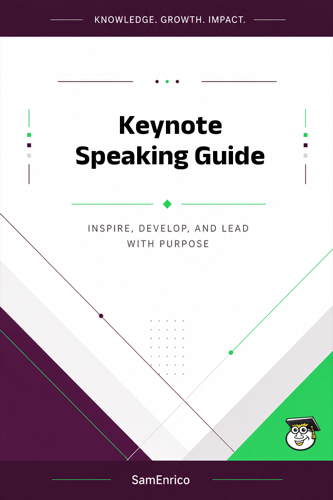
Keynote Speaking Guide eBook
Deliver memorable main stage talks that inspire au
Deliver memorable main stage talks that inspire audiences.
Formats
Free sample
Chapter 1: The Funeral Rule...--In the spring of 2014, a mid-level marketing director named Alex stood at the back of a hotel ballroom, watching a keynote speaker pace across a crimson stage. The speaker had seventy-two slides, a Bluetooth clicker, and the charisma of a refrigerator manual. He opened with “Thank you for having me,” then spent eleven minutes explaining his company’s quarterly earnings. By minute fifteen, sixty percent of the audience was checking email. By minute thirty, three people were openly sleeping.
When he finished, the applause was polite, brief, and mercilessly forgettable.Alex drove home that night and said to his wife, “I have to give that same speech next quarter. I’m going to bomb.”She looked up from her book. “What was his speech about?”Alex opened his mouth. Closed it. Opened it again.He could not remember a single sentence.Not the data.
Not the story. Not the call to action. Nothing.That is the Funeral Rule, and this chapter is where you learn to never let it happen to you.The Day You Realize You Are a Data Ghost Most corporate speakers treat the stage like a classroom. They believe their job is to transfer information from their brain to the audience’s brain, as if human beings are external hard drives waiting to be filled. They cram slides with bullet points.
They recite statistics like scripture. They confuse volume of data with quality of impact.Here is the hard truth that the top ten books on keynote speaking all agree upon, whether they cite neuroscience or decades of stage experience: Data is forgotten within forty-eight hours. Feeling is remembered for decades.Carmine Gallo, in his analysis of the most-viewed TED Talks, found that the most shared presentations were not the ones with the most facts. They were the ones that triggered a neurological response—oxytocin for trust, dopamine for surprise, or serotonin for status. Jane Atkinson, in her work with professional speakers, observed that audiences do not hire speakers to teach them something they could read on Wikipedia.
They hire speakers to feel something they cannot generate alone.The Funeral Rule is simple: If you died tomorrow and your audience attended your funeral, would anyone quote your keynote in their eulogy?Not your salary. Not your title. Not the number of slides you had.The one sentence you left inside them.If you cannot answer that question right now, you are not a keynote speaker. You are a data ghost—present in the room, invisible in the memory.The Three Pillars of an Epic Talk (And Why Two Are Not Enough)After synthesizing the research from Talk Like TED, Made to Stick, and The Epic Keynote, we can reduce all memorable communication to three neurological pillars. Every great keynote rests on all three.
Remove one, and the speech collapses from epic to adequate.Pillar One: Emotional (Oxytocin or Dopamine)The human brain is not a logic engine. It is a survival organ that processes emotion three hundred times faster than rational thought. When you trigger a strong emotion, the brain releases neurochemicals that act as “memory glue.”Oxytocin (Trust, Empathy, Connection): Released when you tell a vulnerable story, show warmth, or demonstrate that you understand the audience’s pain. Oxytocin is why the Moth storytellers succeed and why robotic presenters fail. Without oxytocin, your audience listens with their guard up.Dopamine (Surprise, Anticipation, Reward): Released when you break a pattern, reveal a shocking statistic, or deliver a “jaw drop” moment.
Dopamine is why audiences lean forward in their chairs. Without dopamine, your speech becomes a straight line—predictable, flat, forgettable.Most speakers hit neither. The good ones hit one. The great ones hit both within the first five minutes.Pillar Two: Novel (Pattern Disruption)The brain has a built-in filter called “habituation.” When something is familiar, the brain ignores it to save energy. When something is novel—when it breaks a pattern or challenges a deeply held assumption—the brain wakes up.Novelty is not about being weird.
It is about being unexpected. If every corporate speaker opens with “Thank you for having me,” the audience’s brain has already checked out before you say your name. If you open with silence, a prop, or a bold claim, the brain jolts awake.Chip and Dan Heath, in their analysis of sticky ideas, call this the “violation of expectations.” You must say something that makes the audience think, “I have never heard anyone say that before.”Pillar Three: Memorable (The Car Ride Home Test)This is the hardest pillar. You can be emotional and novel and still be forgettable. Memorability requires simplicity so extreme it hurts.The audience will not remember your three-act structure.
They will not remember your clever transitions. They will remember one sentence—the one they repeat to their spouse, their colleague, or their dog on the car ride home.That sentence is your entire reason for being on stage.If you have not engineered that sentence, you have not engineered a keynote. You have engineered a lecture, and lectures are what people sleep through.The “So What?” Filter: Your First Brutal Editing Pass Before you write a single word of your keynote, you must run your concept through a filter that most speakers never encounter until it is too late. It is called the “So What?” Filter, and it will hurt your feelings.Ask yourself: If the audience’s behavior does not change after hearing me, did I waste their time?If the answer is yes or even maybe, you are not ready to speak. You are ready to research, to rethink, or to retire the topic entirely.This filter comes directly from the principle of transformation over information.
A keynote that informs but does not transform is a podcast episode, not a main stage talk. The audience can get information from a blog post, a You Tube video, or a Chat GPT summary. They cannot get accountability, inspiration, or emotional permission from any of those sources. That is what you provide.The “So What?” Filter asks four specific questions about your concept:What specific belief does my audience currently hold that is wrong? (If none, why are you speaking?)What specific behavior will they change by the end of my talk?
(If you cannot name the behavior, you cannot design the speech.)What will it cost them emotionally, socially, or financially if they do not change? (If the cost is zero, the urgency is zero.)What is the one sentence they will repeat? (If you do not know, you have not found your core idea.)Run every potential keynote topic through these four questions. If any question returns a blank, go back to the drawing board. The stage is not a place to figure out what you think.
It is a place to deliver what you know will change people.The Mission Statement: Your Speaker’s Manifesto Professional speakers do not wander onto the stage hoping for the best. They arrive with a mission statement so clear they could tattoo it on their forearm.A Speaker’s Manifesto has a specific structure: “I am here to turn [current negative state] into [future positive…
This is the end of the free sample. Get the eBook to keep going. Buy now
About this book
Details
- Author
- Costello Rosario
- Publisher
- SamEnrico
- Language
- English
- Genre
- Non-Fiction, Self-Help, Keynote Skills
- Released
- 2026-06-07
- Pages (approx.)
- 126
- Available as
- eBook, Audiobook

Read better in the ZLOADR app
Your eBooks on your phone or tablet. Sign in with your SamEnrico account and start reading.
More by Costello Rosario
 South Park Voice StoriesCostello Rosario$11.99
 Vitamin A For Vision And SkinCostello Rosario$11.99
 Debt Toggle Features ModelingCostello Rosario$11.99
 Gen Z Wellness SpendingCostello Rosario$11.99
 Creative Habits for EngineersCostello Rosario$11.99
 Liver Disease ED GuideCostello Rosario$11.99
 Vaginismus Treatment GuideCostello Rosario$11.99
 Tipu Sultan's Last Stand: The Siege of SeringapatamCostello Rosario$11.99
 The Silent Sabotage of Prague: The War of Austrian Succession’s Shadow WarCostello Rosario$11.99
 How to Produce a Coulter (Agriculture)Costello Rosario$11.99
 How to Become a Parts-order-and-stock ClerkCostello Rosario$11.99
 Post-Hire Assessment Traps ManualCostello Rosario$12.99
You may also like
 Hong Kong Handover 1997Dunn Johnnie$11.99
 Zumba For Postnatal Recovery CourseNeal Christian$11.99
 Zumba for BeginnersLadner Nikia$11.99
 YouTube Comment Mining GuideHumes Pandora$12.99
 Worry Box MeditationCarlin Rudy$11.99
 Workplace Stress MeditationNguyen Lynn$11.99
 Workplace Stress and Sleep RepairHawley Ivory$11.99
 Workplace Perfectionism CureDelaney Jeffry$11.99
 Workplace Injustice Anger GuideWallen Isabelle$11.99
 Work Addiction and Burnout LinkGreenwood Ester$11.99
 Women in Yoga and WellnessBeattie Galina$11.99
 Women in Stand Up ComedyChun Evangeline$11.99