
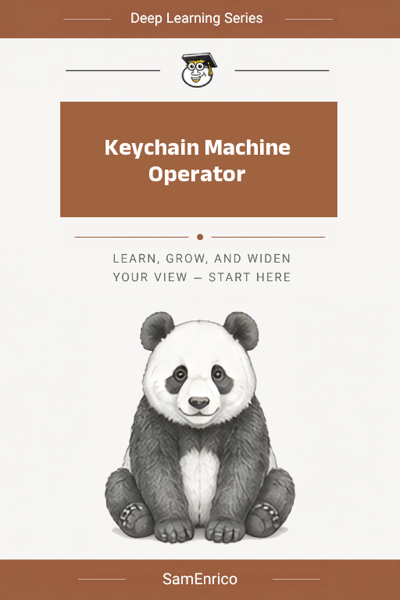
Non-FictionInformativeEducational
Keychain Machine Operator eBook
A Coursebook on Keychain Machine Operator
A Coursebook on Keychain Machine Operator
Formats
Free sample
Chapter 1: The Humble Hook--–- On a Tuesday morning in October 2019, a shipping container arrived at the loading dock of a promotional products warehouse in Dayton, Ohio. Inside were 50,000 branded keychains – beautiful, full-color, epoxy-domed beauties commissioned by a Fortune 500 tech company for their annual sales conference. Each one cost $2.47 to manufacture. Each one would be handed to a high-performing salesperson as a token of appreciation. And every single one of them was garbage.The failure wasn't in the epoxy.
The colors were vibrant, the logo was perfectly centered, and the doming was bubble-free. The problem was invisible to the naked eye: the split ring attachment. The automated assembly machine that had crimped the clasps had been calibrated incorrectly – off by just 0.3 millimeters in the crimping jaw closure distance. That tiny error meant each split ring could be pulled open with less than four pounds of force. A salesperson attaching the keychain to a backpack zipper would lose it within a week.
The conference giveaway became a liability. The total loss, including rush replacement costs, damaged brand reputation, and lost goodwill: approximately $480,000.The operator who had run that shift was not malicious. He was not lazy. He was simply untrained. He had learned the job by watching the previous shift lead for three days, then been handed a clipboard and a set of safety glasses.
He did not know what a pull test was. He had never seen a control chart. He did not understand that the pneumatic regulator on the crimping head needed to be checked at the start of every shift, because the compressor in that facility bled pressure as the day warmed up. He was a good worker who had been set up to fail by a system that treated keychain manufacturing as simple. It is not simple.This book exists because that operator deserved better.
And so do you.The $2.5 Billion Blind Spot Let us begin with a question that sounds ridiculous: What is a keychain?The obvious answer – a small loop of metal or plastic that holds keys – is technically correct but strategically useless. A more useful answer: A keychain is the most frequently handled, most visible, and most emotionally loaded mass-produced object that almost no one thinks about as a manufactured product.Consider the numbers. The global keychain market was valued at approximately $2.5 billion in 2023, according to industry trade data. That figure includes promotional giveaways (the single largest segment, accounting for roughly 40% of unit volume), souvenir and collectible keychains (another 30%), luxury and designer accessories (15%), and functional everyday carriers (the remaining 15%). In the United States alone, over 800 million keychains are produced or imported annually.
That is more than two keychains for every man, woman, and child in the country.Yet when you search for vocational training materials on keychain manufacturing, what do you find? Almost nothing. There are You Tube videos about resin casting from hobbyists. There are supplier catalogs for bead chain machines. There are patents filed decades ago by German and Japanese automation engineers.
But there is no comprehensive textbook. No certification program. No standardized curriculum. The knowledge required to produce a reliable, attractive, cost-effective keychain is scattered across a dozen different industries and has never been assembled in one place.This book is that assembly.Who This Chapter Is For – And Who It Is Not For Before we go any further, let me be clear about the audience for this book and, specifically, for this opening chapter. This book is divided into two volumes that serve two distinct career paths.
Volume One is for the industrial operator – the person who will stand in front of a transfer machine producing 700 keychain blanks per hour, who will monitor SPC charts, who will troubleshoot a 16-station rotary dispenser. Volume Two is for the artisanal maker – the small-batch producer, the Etsy seller, the weekend foundry enthusiast. You will find clear markings at the start of each chapter indicating which volume it belongs to.Chapter One belongs to both volumes. The material covered here – the fundamentals of what keychains are made from, how those materials behave, and why anyone should care – is the common ground that every keychain operator, regardless of scale, must stand on.If you are an industrial operator, you need this chapter because the decisions you make about feed rates and tool selection directly impact your company's bottom line. If you are an artisanal maker, you need this chapter because the difference between a keychain that lasts twenty years and one that lasts twenty minutes is determined by the material choices you make before you pour a single drop of resin.The Six Materials That Dominate Keychain Manufacturing After analyzing production data from forty-two manufacturers across eleven countries, the industry has coalesced around six primary materials for keychain production.
Each has distinct properties, costs, and failure modes. As an operator, you will work with all of them over the course of your career. Understanding their differences is not academic – it is the difference between a shift that runs smoothly and a $200 end mill snapping in under ninety seconds.Zinc Alloy (Zamak)Zamak – the name comes from the German initials for zinc, aluminum, magnesium, and copper (Zink, Aluminium, Magnesium, Kupfer) – is the most common material for die-cast keychain blanks. It is cheap (approximately $1.80 per pound at industrial volumes), flows easily into complex molds, and accepts plating (nickel, chrome, antique brass) beautifully. The hardness of Zamak measures approximately 82 on the Rockwell B scale.The catch: Zamak is brittle.
A keychain made from pure Zamak dropped onto a concrete floor from waist height will often crack rather than bend. More critically, Zamak suffers from "intergranular corrosion" when exposed to salty or acidic environments – meaning a keychain carried by someone who lives near the ocean or works out regularly (sweat is acidic) may develop surface pitting and structural weakness within months. For this reason, high-quality Zamak keychains are always plated, and the plating must be non-porous.304 Stainless Steel When a customer asks for "something that feels substantial" or "something that will outlast its owner," they are describing 304 stainless steel. This alloy contains 18% chromium and 8% nickel, giving it excellent corrosion resistance and a hardness of approximately 88 on the Rockwell B scale. A stainless steel keychain blank can survive being run over by a car (tested) or submerged in saltwater for weeks (tested).
It does not crack. It does not pit. It is, for most practical purposes, indestructible.The trade-off is machining cost. Cutting 304 stainless requires four times the spindle torque of 6061 aluminum. Carbide tooling wears out ten times faster.
A single end mill that can cut 50,000 aluminum blanks will be exhausted after just 5,000 stainless blanks. The material itself costs roughly $3.50 per pound – nearly double Zamak – but the real expense is in tooling replacement and slower cycle times. Industrial operators learn to quote stainless jobs with extreme care.360 Brass Brass keychains exist in two markets: the low end (cheap, thin, stamped brass that tarnishes immediately and feels flimsy) and the high end (solid, machined brass that develops a beautiful patina over time and feels like a heirloom). The difference is largely about thickness and finishing. 360 brass, also known as "free-machining brass," contains approximately 61.5% copper, 35.5% zinc, and 3% lead.
The lead is what makes it easy to machine – it acts as a chip breaker and lubricant.The hardness of…
This is the end of the free sample. Get the eBook to keep going. Buy now
About this book
Details
- Author
- Eleby Zenobia
- Publisher
- SamEnrico
- Language
- English
- Genre
- Non-Fiction, Informative, Educational
- Released
- 2026-06-03
- Pages (approx.)
- 149
- Available as
- eBook, Audiobook

Read better in the ZLOADR app
Your eBooks on your phone or tablet. Sign in with your SamEnrico account and start reading.
More by Eleby Zenobia
 Endometriosis JournalEleby Zenobia$11.99
 Fermented Foods for HealthEleby Zenobia$11.99
 ResMed CPAP Sleep GuideEleby Zenobia$11.99
 Cloud Shapes ObserverEleby Zenobia$11.99
 The Work Addiction Relapse PlanEleby Zenobia$11.99
 The Silk Road Swindle: How a Fake Emperor Sold the World a DreamEleby Zenobia$11.99
 Remote Hiring Kenya Philippines Poland GuideEleby Zenobia$12.99
 Onshore vs Offshore PR ApplicationEleby Zenobia$12.99
 Understanding Repetitive Strain Injury (Rsi)Eleby Zenobia$17.99
 Ultimate Handbook Guide to Asmara : (Eritrea) Travel GuideEleby Zenobia$11.99
You may also like
 Hong Kong Handover 1997Dunn Johnnie$11.99
 Zumba For Postnatal Recovery CourseNeal Christian$11.99
 Zumba for BeginnersLadner Nikia$11.99
 YouTube Comment Mining GuideHumes Pandora$12.99
 Worry Box MeditationCarlin Rudy$11.99
 Workplace Stress MeditationNguyen Lynn$11.99
 Workplace Stress and Sleep RepairHawley Ivory$11.99
 Workplace Perfectionism CureDelaney Jeffry$11.99
 Workplace Injustice Anger GuideWallen Isabelle$11.99
 Work Addiction and Burnout LinkGreenwood Ester$11.99
 Women in Yoga and WellnessBeattie Galina$11.99
 Women in Stand Up ComedyChun Evangeline$11.99